
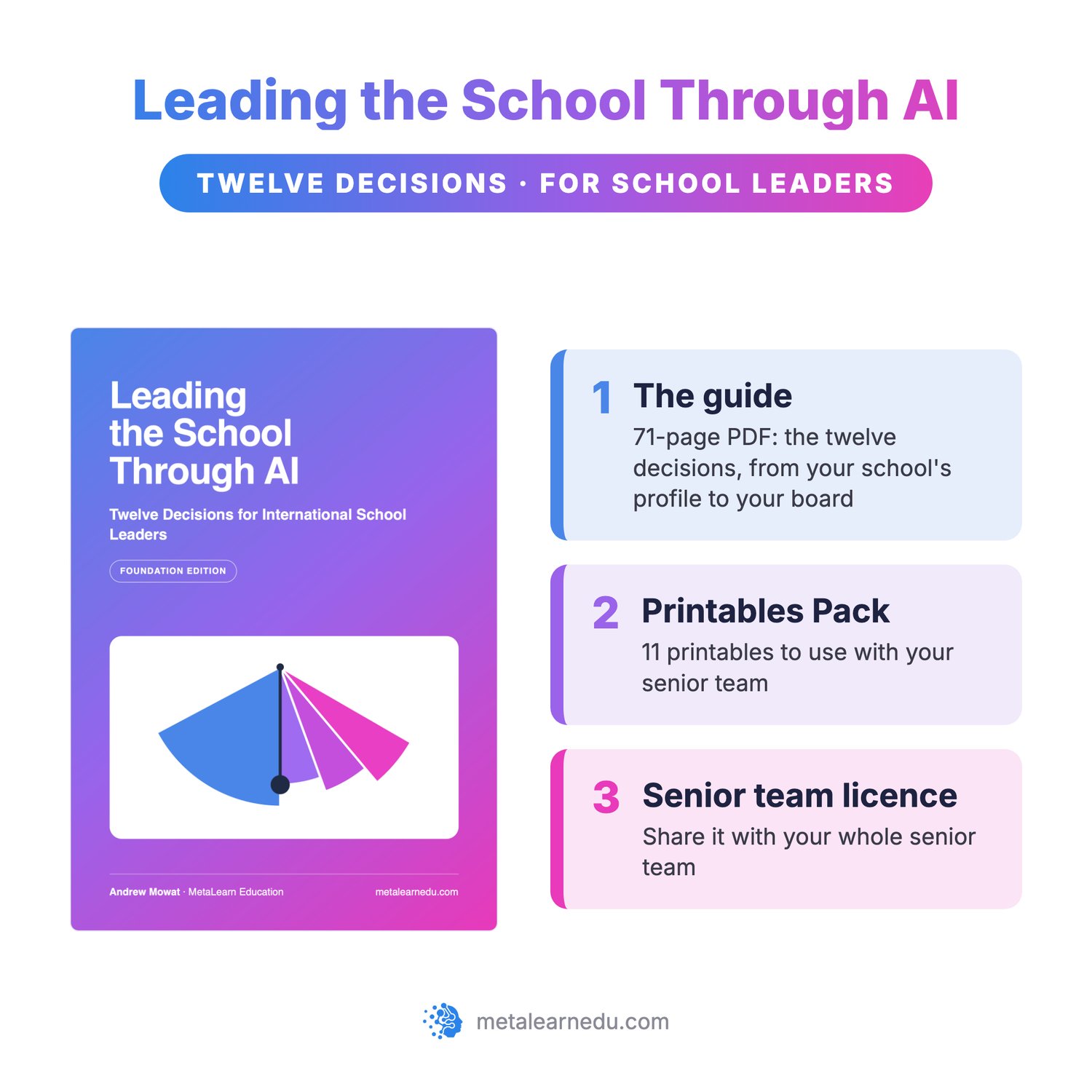
Leading the School Through AI: Twelve Decisions for International School Leaders
When AI arrived in schools, the first leadership conversation was about policy: what's allowed, what's banned, who signs off. That work was needed. A policy can only settle what's allowed, though. It can't tell a teacher, a student or a Head what good use of AI looks like, and most of us in schools don't yet know.
This guide is for the Head and senior team of an international school who have accepted that AI is already in their classrooms, staffrooms and admissions office, and who now have to decide what the school does about it.
What's in the download
1. The guide (71-page PDF). It starts with you: where you stand with AI, and how you use it. It then sets out the Thinking Pendulum, the model at the centre of the guide, and the radial rubric, which shows what good looks like in each kind of thinking. From there it works through the six pressures on an international school, your school's profile, and the twelve decisions a senior team has to make, with what to take to your board and the order to do it in.
2. Printables Pack (11 pages). Your school's profile and complexity score, a decision trace for each decision, the twelve decisions map, the radial rubric for leaders, a self-diagnostic for each member of your team, a vendor checklist, a five-minute thinking trace, a leadership team conversation and more.
The twelve decisions
1. Your position on AI, and how you say it
2. Who owns AI, and the rulebook you follow
3. Safeguarding in an AI world
4. Data, tools and buying
5. A shared language for AI in learning
6. Your assessment architecture
7. Staff capability that survives turnover
8. Where AI literacy lives in your curriculum
9. Equity: language and access
10. Where saved time goes
11. Parents, the board and university pathways
12. Operations and admissions
You don't have to take them in order. The decisions map helps your team find the ones your school needs first.
What is the Thinking Pendulum?
The Thinking Pendulum is a model, developed by Andrew Mowat, of how people think when they use AI. In Mode 1, the vending machine, you press the button and take the result. In Mode 2, the thinking partner, AI pushes your own thinking through three zones: sense checking, outcome determining and problem shaping. The guide uses it for students, for teachers and for leaders themselves.
Who wrote it
Andrew Mowat has spent 42 years in education, in roles from the classroom to school leadership, and has been training teachers on AI since April 2023. He works with international schools across Asia on how students learn and think, and he shows in the guide how he made it with AI.
Five years of updates
Your copy is yours to keep, and you'll get every update for five years at no extra cost.
Licence
This licence covers one school's senior leadership team: share the guide and print the printables for your own team. For support with your plan, book a short call through the Schools button at metalearnedu.com.