



Tweezer Tops & Bottoms Explained — How equal (PDF Guide)
You were told a tweezer is two candles with matching highs or matching lows. So you looked for matching highs, found almost none, loosened your eye a little, and suddenly found them everywhere. Nothing was wrong with your marking. The definition has a number in it that nobody prints.
The number is a tolerance — how far apart two highs can be and still count as equal. At exactly equal there are 1,318 tweezers in 35,944 bars. At within one per cent there are 45,080. That is 34 times the count from a parameter you have never seen stated. This is a 39-page PDF that teaches Tweezer Tops & Bottoms from the first thing you see on the screen through to a written strategy with an entry, a stop and an explicit rule for when the trade is wrong.
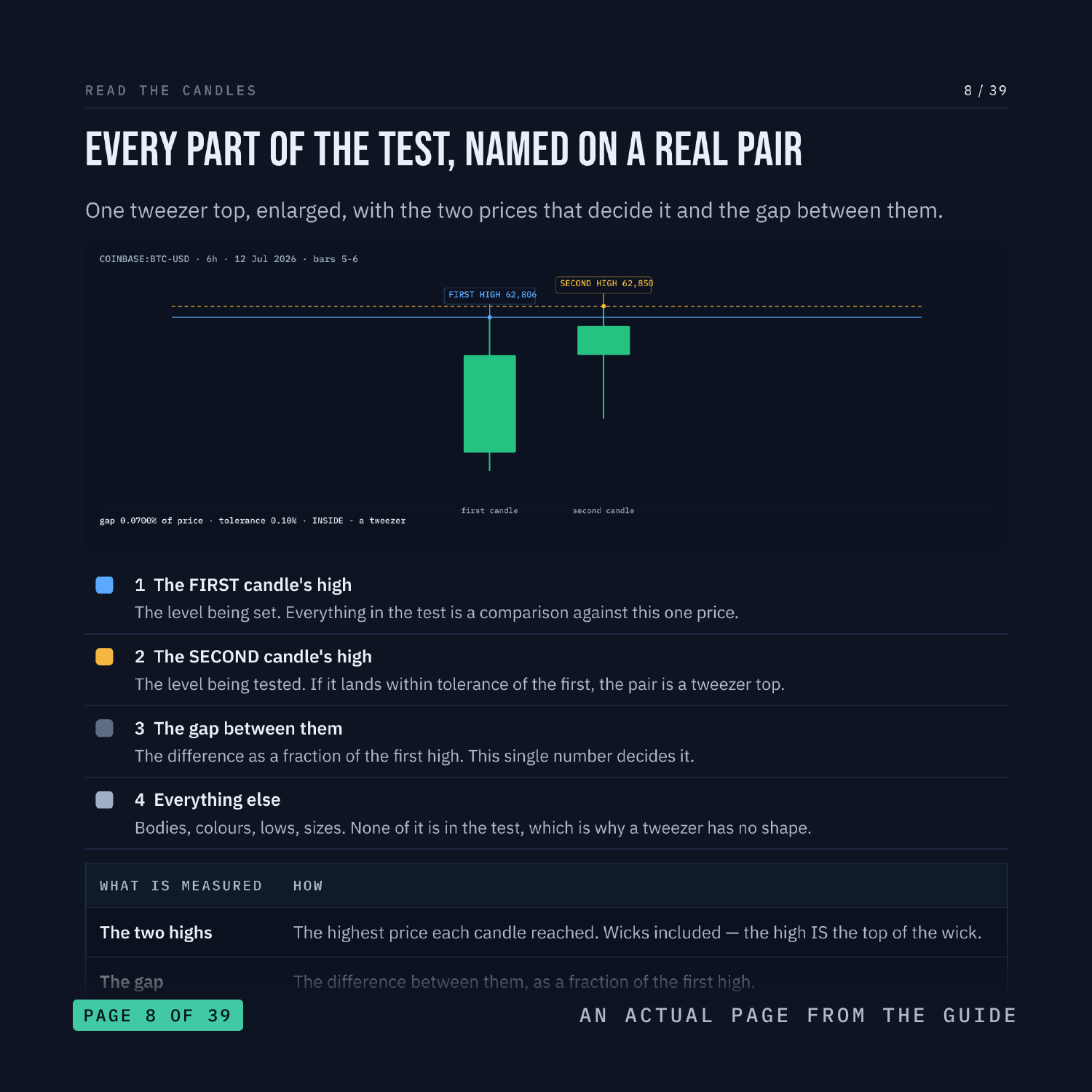
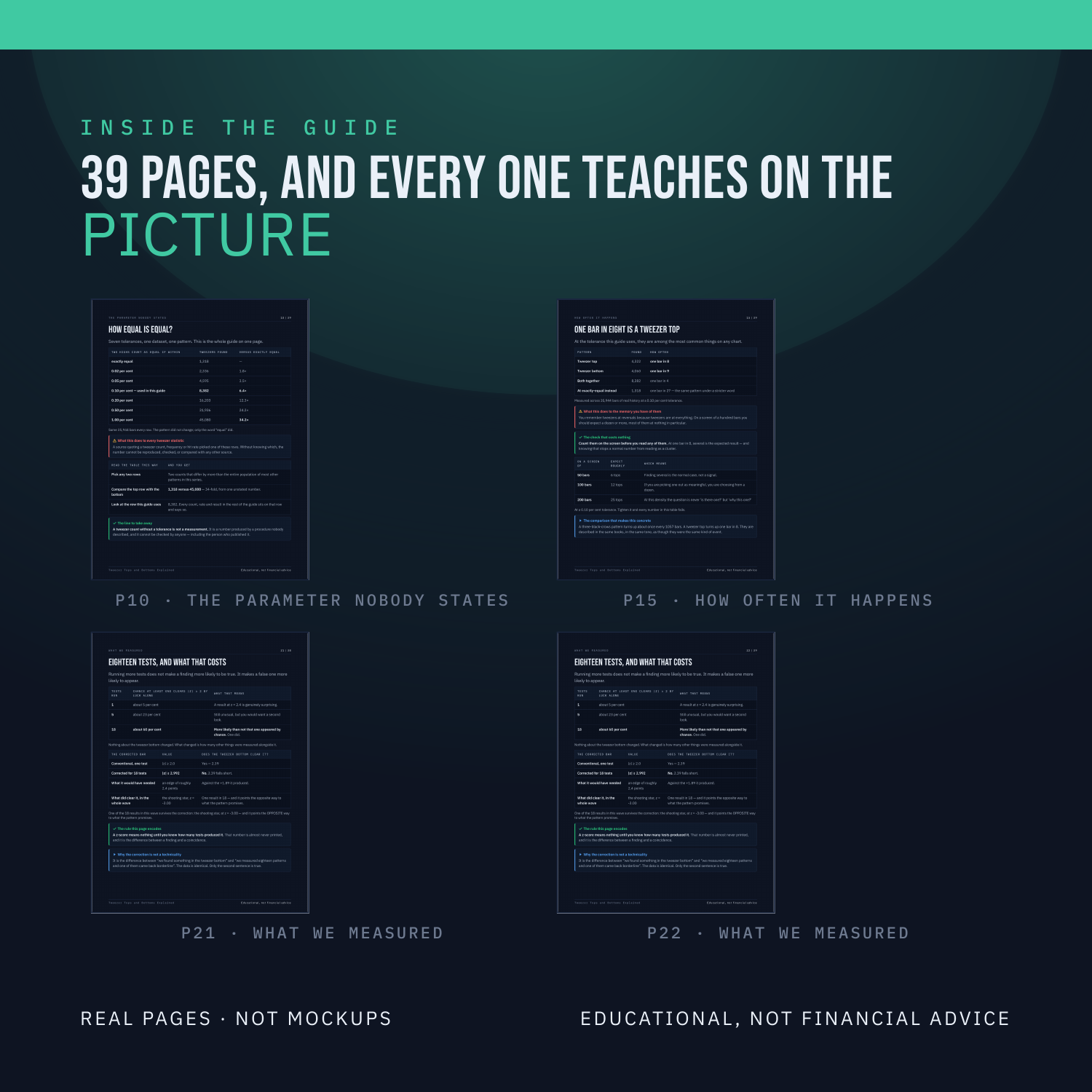
Nothing is taught underneath a chart. Every label sits on the candle, the line or the level it is describing, on real BTC, ETH, SOL and LINK charts, with the actual gap between the two highs printed on the candles. There are three quizzes on real charts, each followed by the same chart re-shown annotated with the reasoning, plus faded practice pages where the first steps are filled in and you finish the rest.
WHAT'S INSIDE
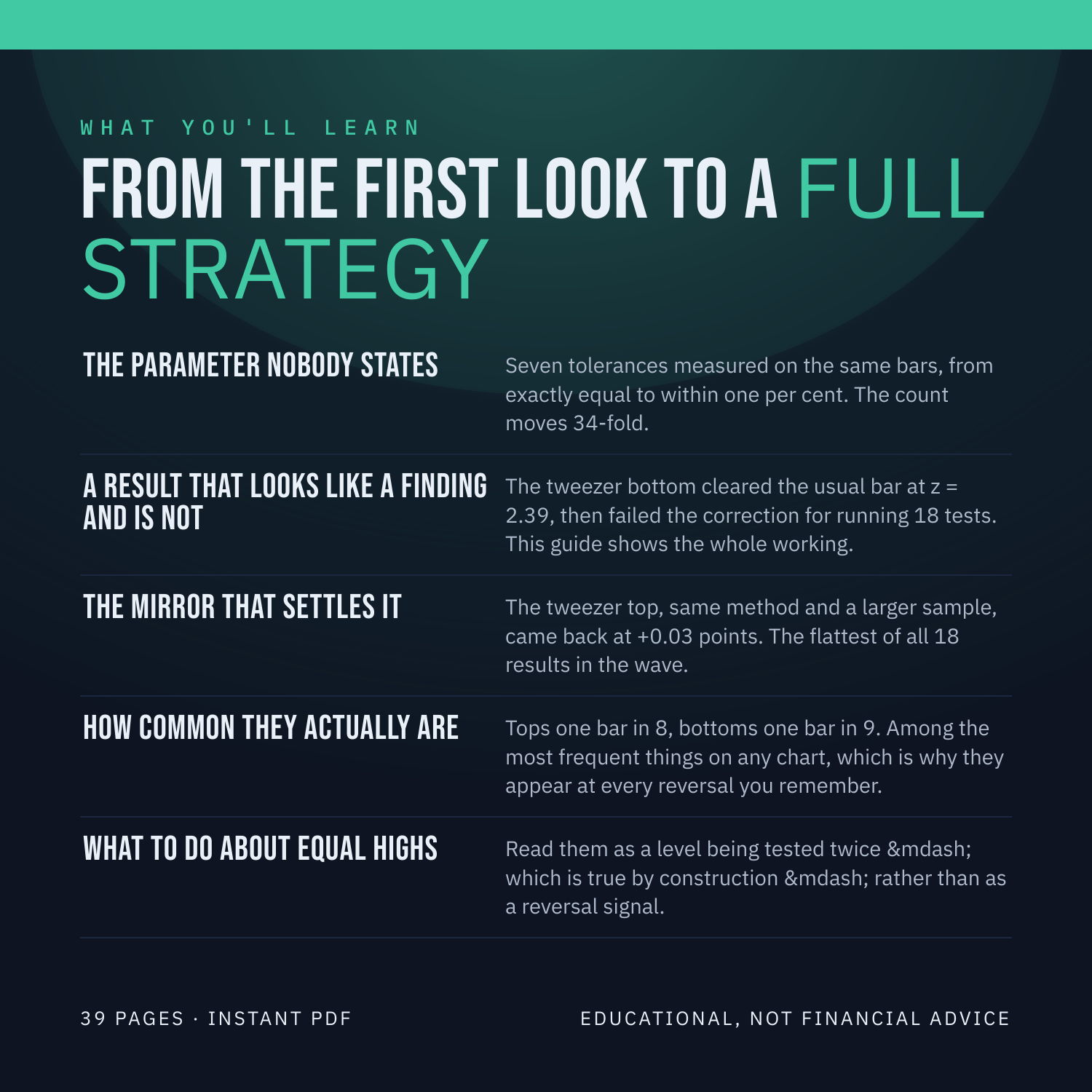
- The parameter nobody states — Seven tolerances measured on the same bars, from exactly equal to within one per cent. The count moves 34-fold.
- - A result that looks like a finding and is not — The tweezer bottom cleared the usual bar at z = 2.39, then failed the correction for running 18 tests. This guide shows the whole working.
- - The mirror that settles it — The tweezer top, same method and a larger sample, came back at +0.03 points. The flattest of all 18 results in the wave.
- - How common they actually are — Tops one bar in 8, bottoms one bar in 9. Among the most frequent things on any chart, which is why they appear at every reversal you remember.
- - What to do about equal highs — Read them as a level being tested twice — which is true by construction — rather than as a reversal signal.
WHAT YOU'LL BE ABLE TO DO
- State the tolerance you used before you call anything a tweezer.
- - Read a z-score against the number of tests that were run.
- - Explain why a result at z = 2.4 is not automatically a finding.
- - Use the mirror pattern as a check on any directional claim.
- - Treat a twice-tested level as information without treating it as a signal.
AN HONEST NOTE
Tweezer Tops & Bottoms is a clue, not a crystal ball. It describes what price has already done. This guide contains no win-rates, no backtest results and no promises about what you will make, because nobody can verify those and you should not trust anyone who prints them. What it hands you instead is a set of rules you can test yourself on TradingView in an afternoon. Educational, not financial advice.
Instant download. 39 pages, PDF.