
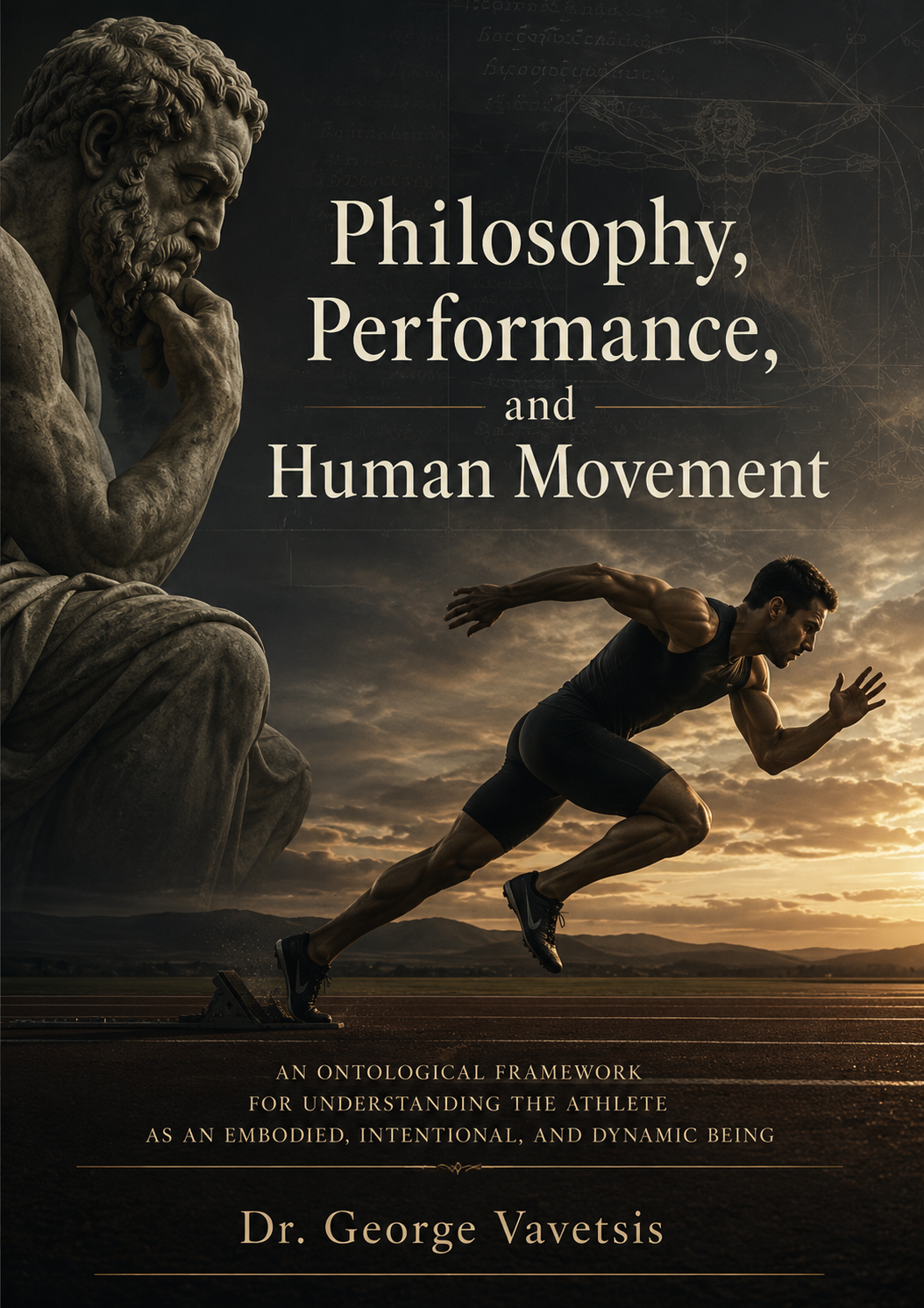
Philosophy, Performance, and Human Movement
Pages: 873
Human movement has always occupied a paradoxical position within philosophical inquiry. It is at once the most immediate and familiar dimension of existence, yet also among the least understood in its deepest ontological significance. The athlete runs, jumps, rotates, collides, accelerates, decelerates, stabilizes, perceives, anticipates, and adapts—not merely as a biomechanical organism obeying physiological laws, but as a living embodiment of intentionality, consciousness, becoming, and existential expression. The athletic body is therefore not reducible to muscle fibers, neural impulses, metabolic pathways, or mechanical outputs alone. It is simultaneously biological matter, lived experience, symbolic structure, and ontological manifestation. This book emerges from the conviction that human performance can only be fully understood when science and philosophy are no longer separated, but integrated into a unified interpretation of embodied existence.
Modern sport science has generated extraordinary advances in biomechanics, exercise physiology, motor learning, neurodynamics, and performance analytics. Yet despite these achievements, much of contemporary discourse continues to approach the athlete through reductionistic paradigms that fragment the body into isolated variables and mechanistic systems. While such approaches are invaluable for measurement and intervention, they often neglect the deeper reality that movement is always movement-of-being. Athletic action is not merely force production against an external resistance; it is the exteriorization of intention into the world. The athlete does not simply perform movement—the athlete inhabits movement as a mode of existence.
The purpose of this work is therefore not simply to discuss sport philosophically, nor merely to reinterpret philosophy through athletics, but to establish a comprehensive ontological framework for understanding the athlete as an embodied, dynamic, intentional, and continuously evolving system. The athletic body is approached here as a lived entity—a pre-reflective structure through which the world becomes intelligible and through which existence itself is disclosed. Athletic performance becomes far more than competition or entertainment; it becomes a phenomenological event in which human existence manifests its possibilities, limitations, vulnerabilities, and transcendence.
At the center of this book lies the proposition that elite athletic performance represents one of the most profound revelations of human becoming. In moments of authentic competition, the athlete enters a state where cognition, perception, emotion, instinct, timing, and corporeality converge into unified intentional action. The distance between consciousness and movement diminishes. Decision and execution collapse into immediacy. Tempo becomes meaning. The body no longer appears as an object possessed by the self but as the very condition through which the self encounters reality. Such moments reveal not merely technical mastery, but ontological participation in existence itself.
The chapters that follow investigate this reality through multiple philosophical and scientific lenses. Aristotelian hylomorphism illuminates the inseparability of form and matter in the athletic organism. Phenomenology reveals the athlete as embodied consciousness situated within a meaningful world. Dynamical systems theory interprets performance as emergent adaptation within unstable environments. Existential philosophy uncovers the athlete’s confrontation with uncertainty, finitude, struggle, and transcendence. Neuroscience and cognitive science further demonstrate that perception, intention, and movement are inseparable processes distributed throughout the living body rather than confined to isolated cerebral mechanisms.
Particular attention is devoted to the concept of the athlete as an autopoietic system of continuous becoming. Athletic development is not treated merely as physiological adaptation, but as ontological transformation. Training alters more than tissue structure or metabolic efficiency; it reconstructs perception, agency, identity, and existential capacity. The elite athlete is therefore not simply “conditioned,” but continually recreated through recursive interactions between body, environment, cognition, competition, and history. Every repetition, collision, failure, tactical decision, and adaptation contributes to the ongoing production of embodied selfhood.
This work also explores the relationship between instability and excellence. High-level sport unfolds within environments characterized by uncertainty, temporal pressure, open-skill variability, and competitive indeterminacy. It is precisely within these unstable conditions that human agency becomes visible. The athlete’s greatness is not found in the elimination of chaos, but in the capacity to perceive order within it and to act meaningfully despite incomplete information. Elite movement therefore represents not rigid control, but adaptive harmonization between organism and environment. The athlete becomes a dynamic system capable of continuously reorganizing itself under fluctuating demands.
Equally important is the recognition that athletic existence contains an irreducibly aesthetic and existential dimension. Athletic beauty is not superficial ornamentation added to movement after efficiency is achieved. Rather, beauty emerges from the harmonious integration of force, rhythm, perception, timing, intention, and embodied coherence. The elegance of elite movement reflects an ontological unity in which mechanics and meaning become inseparable. The athlete reveals not merely what the human body can do, but what human existence can become when directed toward disciplined intentionality.
The philosophical investigation of sport is therefore not peripheral to understanding humanity; it is central to it. In the athlete, one encounters the biological organism striving toward transcendence, the finite body reaching beyond itself, and the existential subject discovering meaning through action. The sporting arena becomes a condensed theater of human existence where freedom, suffering, vulnerability, risk, courage, discipline, identity, and transformation unfold with exceptional clarity.
This book is written for those who refuse to separate science from meaning, physiology from philosophy, or movement from existence. It is intended for sport scientists, philosophers, strength and conditioning coaches, biomechanists, neuroscientists, rehabilitation specialists, performance analysts, and all those seeking a deeper understanding of embodied human performance. Its ambition is not merely to explain athletic movement, but to illuminate the athlete as a living expression of ontological possibility.
Ultimately, the athlete is more than a performer of tasks. The athlete is a becoming-being whose movement discloses the hidden architecture of existence itself. In every acceleration, stabilization, collision, adaptation, and act of competitive courage, human life reveals its ceaseless striving toward meaning, mastery, and transcendence.