
The Petrodollar Decoded — Why Everything You Think You Know About Money Is Incomplete
You hear the word "petrodollar" constantly. In videos. In analysis. In arguments about the dollar, about oil, about wars in the Middle East. Everyone references it. Almost nobody can explain how it actually works.
This guide fixes that. Permanently.
The Petrodollar Decoded is a 40-page structural education document that takes you from 1944 — when the dollar became the world's reserve currency at Bretton Woods — through the Nixon Shock that broke the gold standard, through the secret 1974 Kissinger-Saudi deal that replaced gold with oil, through every crisis that has threatened the system since, and into the current moment — where the Iran war, the Strait of Hormuz closure, and the rise of BRICS alternatives are testing the system's foundations at every level simultaneously.
This is not a summary. This is not a news recap. This is the complete structural education on the mechanism that funds American military power, keeps interest rates low, allows $39 trillion in debt to function, makes the dollar the world's reserve currency, and determines the price of everything you buy.
When this mechanism breaks — and every structural indicator says it is breaking — the consequences will reshape who holds wealth, who loses it, and what money itself means for the next generation. This guide ensures you understand the system before the system changes.
What you will learn:
→ Why the Bretton Woods system collapsed — the Triffin Dilemma, the gold drain, and how France sent warships to New York to collect physical gold from the Federal Reserve vault
→ The Nixon Shock — how America broke its promise to the world on a Sunday evening in August 1971 and what the chaos years that followed looked like: currencies swinging, gold soaring 24x, stocks collapsing 42%, inflation hitting double digits
→ What Kissinger actually negotiated with Saudi Arabia in 1974 — not just oil pricing, but military protection, weapons dependency, financial recycling, development contracts, and an implicit political understanding that lasted 50 years
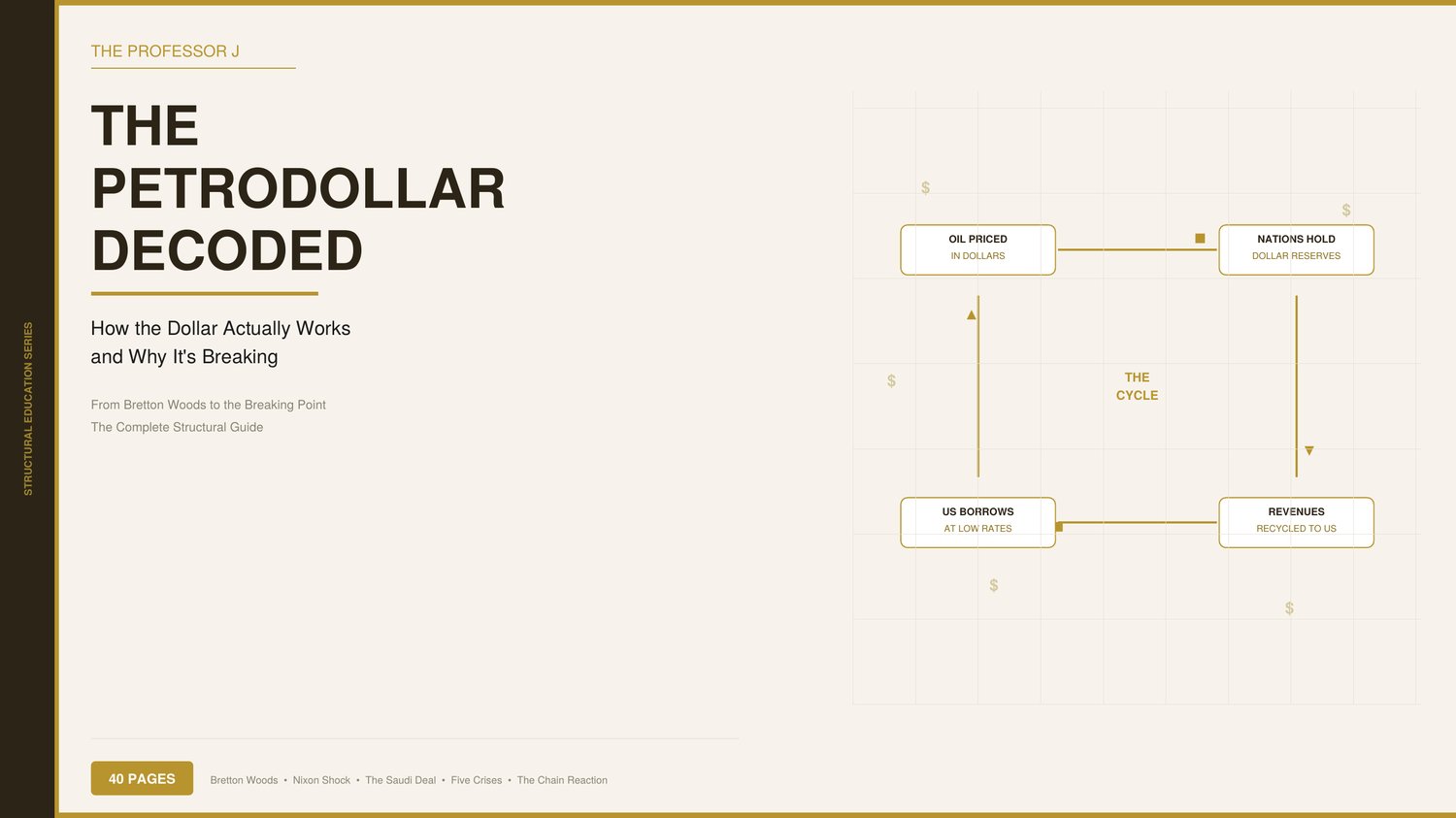
→ The complete four-step petrodollar mechanism — oil priced in dollars, nations accumulating dollar reserves, Gulf states recycling revenues into American assets, and America borrowing at artificially low rates — explained so clearly you could teach it to someone else
→ How different nations experience the system — why Japan pays a structural tax, why Gulf states are privileged but dependent, why China is building exits, why Russia proved they work, and why most Americans have no idea the system exists
→ The recycling machine — where Gulf petrodollars actually go: Treasury bonds, Silicon Valley, Manhattan real estate, defense contracts, and the military hardware loop that makes the entire arrangement self-reinforcing
→ What the petrodollar gives America — five structural advantages that no other nation on Earth possesses, and what they cost everyone else
→ Every time the system was threatened — five historical crises analyzed in structural detail: the Iranian Revolution (1979), Saddam Hussein's euro switch and what happened next (2000-2003), Gaddafi's gold dinar proposal and what happened next (2009-2011), Russia's ruble-yuan pivot after sanctions (2022), and Saudi Arabia accepting yuan (2023)
→ The enforcement pattern — the structural fact that every leader who attempted to abandon dollar oil pricing was subjected to military intervention, and what happens when the enforcer's military credibility is visibly strained
→ Why 2026 is different from every previous crisis — the Iran war is the first to threaten supply, pricing, recycling, military credibility, and allied commitment simultaneously. No previous crisis attacked all five dimensions at once
→ The Gulf state recalculation — why the petrodollar's central players are quietly reassessing their commitment, what their $50,000 drone vulnerability means, and why the answer to "who protects us?" is changing
→ The BRICS alternative architecture — New Development Bank, CIPS payment system, bilateral trade agreements — none ready to replace the dollar yet, but all growing. The exits exist. They are marked. And traffic through them is increasing
→ The digital currency dimension — how China's digital yuan provides a technologically modern pathway for oil trade entirely outside American-controlled infrastructure
→ The five-step chain reaction if the petrodollar breaks — Gulf states fall under Iranian influence, petrodollar collapses, Japan and South Korea remilitarize, Europe makes peace with Russia, dollar loses reserve status — each stage triggering the next
→ What it would feel like domestically — $780 billion in additional annual interest payments, higher mortgage rates, more expensive imports, contracting consumer spending, and a standard-of-living correction with no post-war precedent
→ What sterling's decline actually looked like in practice — British pensions losing 90% of real value, the 1976 IMF bailout humiliation, and what happened to ordinary households as the empire's currency eroded over 30 years
→ Three structural scenarios for the dollar's future — managed decline (most likely), accelerated collapse (possible), and system renewal (least likely) — with detailed consequences and positioning analysis for each
→ Six structural positioning principles for navigating a currency transition — drawn from how the wealthiest families in history preserved wealth through every previous reserve currency change
→ Three "What If" scenario models — the Saudi Switch, the Hormuz Trigger, and the Slow Erosion — each with triggering event, immediate consequences, medium-term trajectory, long-term shift, and specific positioning implications
→ Complete petrodollar timeline from 1944 to March 2026
→ Full glossary of structural terms
→ Eight essential books for deeper study
→ Six frequently asked questions answered with structural honesty
40 pages. 10 chapters. 5 appendices. 82 years of history. One mechanism. Zero filler.
Who this is for:
This guide is for anyone who has ever heard the word "petrodollar" and wanted to truly understand it — not the 90-second version, but the complete structural picture. It is for people who watch the Iran war and sense that something deeper than military strategy is at stake. It is for people who hold dollars and want to understand the structural forces acting on their purchasing power. It is for people who believe that understanding the system is the first step toward navigating it.
Who this is NOT for:
This is not financial advice. It is not a trading guide. It contains no stock picks, no crypto recommendations, and no specific investment instructions. It is structural education — the deepest, most honest explanation of the dollar system available outside classified briefings and academic journals. What you do with the knowledge is your decision.
From the guide:
"The most powerful systems are the ones nobody knows exist."
"Reserve currencies do not die in battle. They die of debt, doubt, and alternatives."
"The petrodollar did not need alternatives to survive. It needed the absence of alternatives. That absence is over."
"The best time to understand the system was before the crisis began. The second best time is now."
— The Professor J