
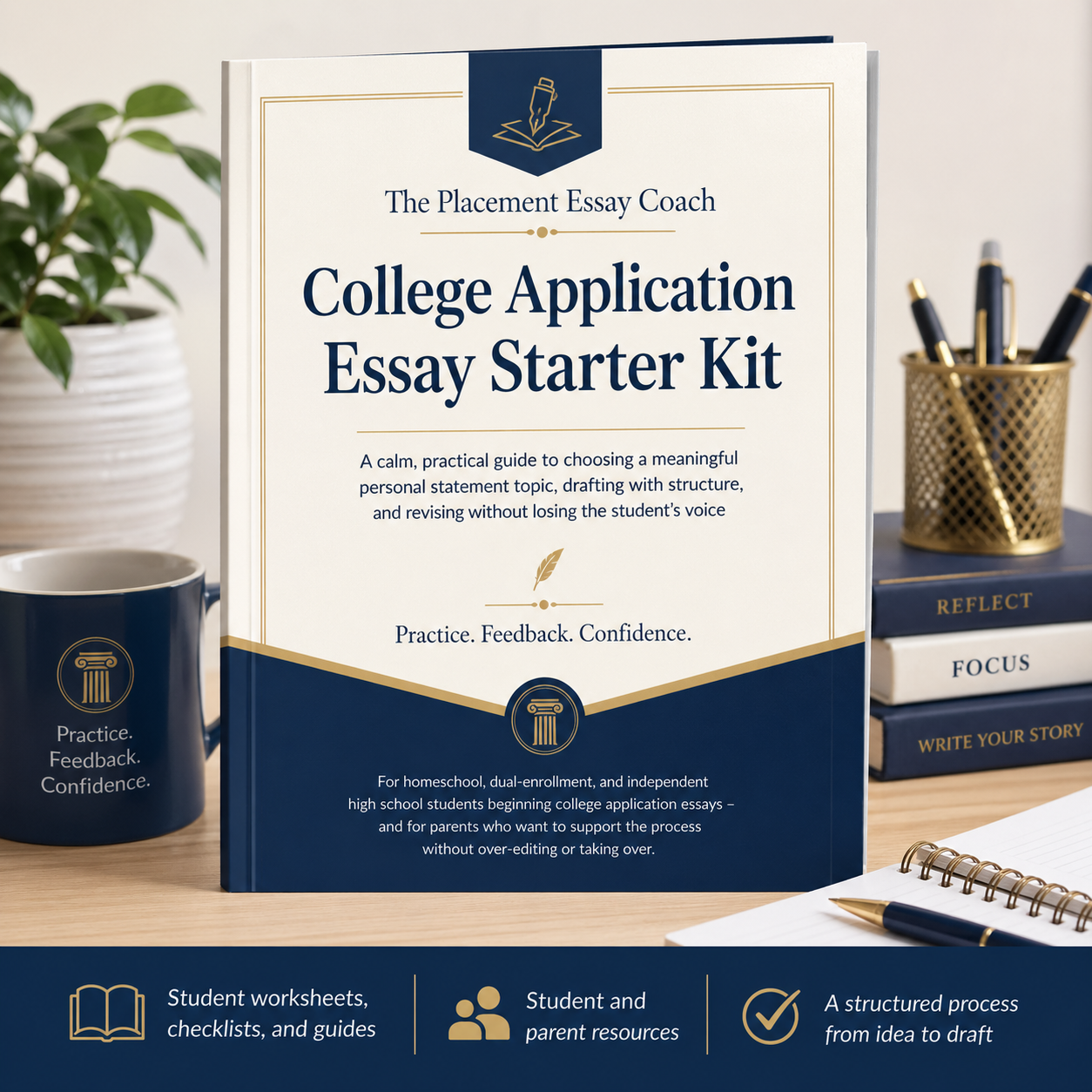
College Application Essay Starter Kit
A calm, practical guide to choosing a meaningful personal statement topic, drafting with structure, and revising without losing the student’s voice.
The College Application Essay Starter Kit is a self-guided PDF resource for homeschool, dual-enrollment, and independent high school students who are beginning the college application personal statement process.
It is also designed for parents who want to support their student’s writing without over-editing, taking over, or accidentally turning the essay into an adult-written version of the student.
This guide helps students move from “I don’t know what to write about” to a clearer, more thoughtful essay direction — with worksheets, examples, checklists, and parent-friendly guidance along the way.
Who This Is For
This starter kit is a good fit for:
- Students beginning a college application personal statement
- Homeschool students who want structured essay support
- Dual-enrollment students preparing for future applications
- Independent learners who need a clear writing process
- Parents who want to help without taking over the essay
- Students who feel unsure whether their story is “interesting enough”
Students do not need a dramatic life story to write a meaningful essay. This guide helps them find specific, honest material from real responsibilities, questions, memories, routines, values, and moments of growth.
What This Kit Helps With
This resource walks students through the early and middle stages of the application essay process, including:
- Understanding what a personal statement is — and what it is not
- Choosing a meaningful topic
- Avoiding cliché or overly generic essay ideas
- Finding stronger angles inside common topics
- Brainstorming real memories, responsibilities, values, and patterns
- Turning a small moment into a larger reflection
- Creating a flexible first-draft structure
- Revising for clarity, reflection, voice, and authenticity
- Helping parents give useful feedback without rewriting the essay
- Preparing a final draft for submission
The tone is calm, structured, and practical — not fear-based, not flashy, and not built around admissions panic.
Table of Contents
The kit includes:
- Introduction for Students and Parents
- What the Personal Statement Is
- What the Personal Statement Is Not
- Placement Essay vs. Application Essay
- Choosing a Topic
- Avoiding Cliché Topics
- Topic Strength Test Worksheet
- Brainstorming Worksheet
- Values / Identity / Story Inventory
- Small Moment, Larger Meaning Worksheet
- First-Draft Structure Guide
- Flexible Outline Template
- Bad vs. Better Topic Examples
- Revision Checklist
- Voice and Authenticity Checklist
- Parent Feedback Guide
- Parent Comment Sentence Starters
- Student Revision Planning Page
- Final Pre-Submission Checklist
- Next Steps and Optional Feedback Service
What Makes This Different
Many students think a college essay has to be impressive, dramatic, or perfectly polished from the start.
This guide takes a different approach.
It helps students ask better questions:
What do I notice?
What have I carried?
What have I misunderstood and learned from?
What responsibility, routine, place, object, or small moment reveals something true about me?
How can I revise without losing my real voice?
Instead of pushing students toward a formula, this kit helps them develop a personal statement that is specific, reflective, and still genuinely theirs.
Inside the Kit
Topic-Finding Support
Students get guided questions and worksheets to help them move past obvious first ideas and find stronger essay material. The kit includes prompts about memories, responsibilities, repeated patterns, values, personal context, growth, and moments that may seem ordinary but reveal something meaningful.
Cliché Rescue Tools
Common essay topics are not automatically bad — but predictable handling can weaken them. This guide shows students how to rescue familiar topics like sports, volunteering, family influence, academic struggle, jobs, or personal growth by making them more specific and reflective.
Bad vs. Better Examples
Students can see the difference between broad, generic essay ideas and more focused, thoughtful versions. These examples help make the revision process concrete instead of vague.
Drafting Structure
The kit includes a flexible first-draft structure and outline template so students can begin writing without feeling trapped by a rigid formula.
Revision and Voice Checklists
Students learn how to revise in layers: first for meaning and structure, then for specificity, reflection, sentence control, and final proofreading. The voice checklist helps protect the student’s own language and perspective from becoming over-edited.
Parent Feedback Guidance
Parents receive clear guidance on how to read a draft, what kinds of comments help, and what kinds of comments can accidentally take over the essay. The goal is to help students say what they mean more clearly — not to replace their voice.
A Good Fit If Your Student Says…
- “I don’t know what to write about.”
- “Nothing interesting has happened to me.”
- “I know my topic, but it sounds generic.”
- “I’m afraid my essay doesn’t sound impressive enough.”
- “My parent wants to help, but I don’t want them to rewrite it.”
- “I have a draft, but I’m not sure what to fix.”
- “I need structure, but I don’t want my essay to sound like a school assignment.”
What This Is Not
This is an educational writing resource. It is not admissions consulting, ghostwriting, college-specific strategy, or a promise of admission, scholarship results, placement, or any particular outcome.
The student remains the author of the essay.
The goal is not to create a perfect adult-written essay. The goal is to help the student write a clear, specific, thoughtful essay that still sounds like the student.