
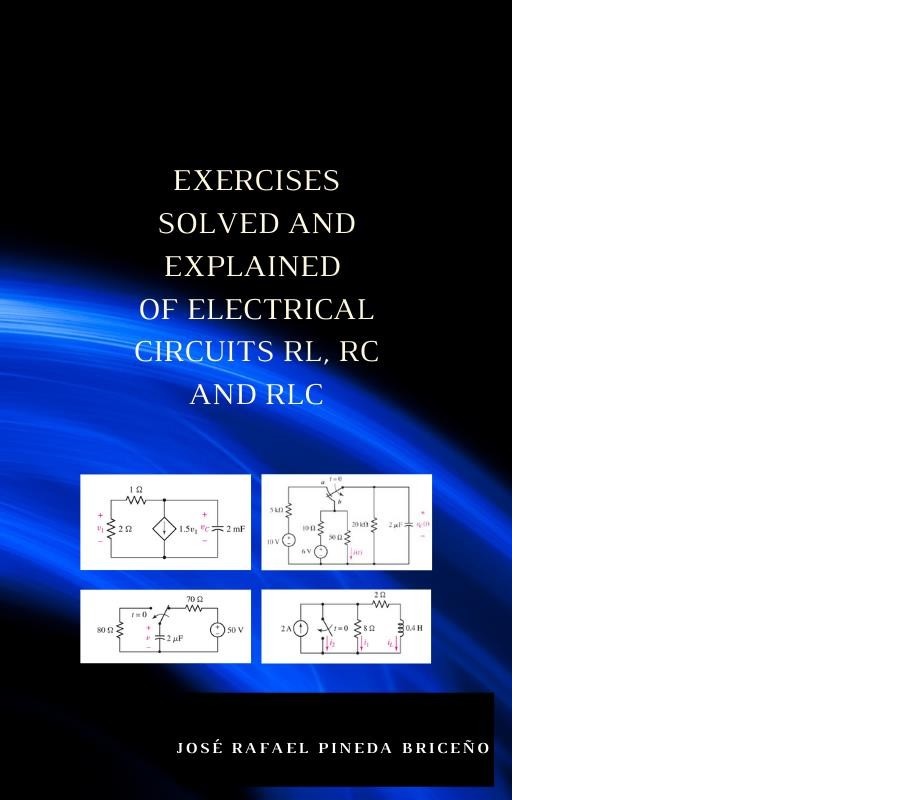
Exercises solved and explained of electrical circuits RL, RC and RLC
The aim of this book " EXERCISES SOLVED AND EXPLAINED OF ELECTRICAL
CIRCUITS RL, RC AND RLC ", is to present in a simple and explanatory way, what any engineering student would want.
Its title honors the fact that each of its 20 exercises is explained in detail, with notes and clarifications. This book is not a collection of exercises with their solutions, but rather, the explanation of how they should be carried out; therefore, beyond being a book of exercises, it is a book of explanation of electrical circuits in transient regime, with their first and second order equations, through exercises.
The exercises have been chosen, starting with simple exercises that encourage you to continue, until you reach the necessary level to understand without difficulty the RL, RC and RLC circuits in direct current. This learning process is carried out in a continuous and progressive manner, making it possible to enjoy the simplicity with which the resolution of each of the exercises is explained.
Therefore, I recommend this guide book to all engineering students, as a basis for clarifying the basic knowledge of Transient Regime of RL, RC and RLC Circuits in direct current.
From my teaching experience, I estimate that it is a low percentage of students who would try to solve the exercises before seeing the solutions, if so, congratulations, however, for those who learn by seeing the solutions, I invite them to try and follow step by step the explanations given, if they make a mistake, no problem, they also learn from it.
Finally, I am sure that the readers of this book would also like to have similar books on solved and explained exercises of single-phase alternating current circuits, solved and explained exercises of power analysis in single-phase circuits, and solved and explained exercises of three-phase alternating current. So I will undertake this work, given my experience of more than 40 years in teaching these subjects, in my extensive university career.
Congratulations to the English-speaking students who can count on this book.
José Rafael Pineda Briceño.