
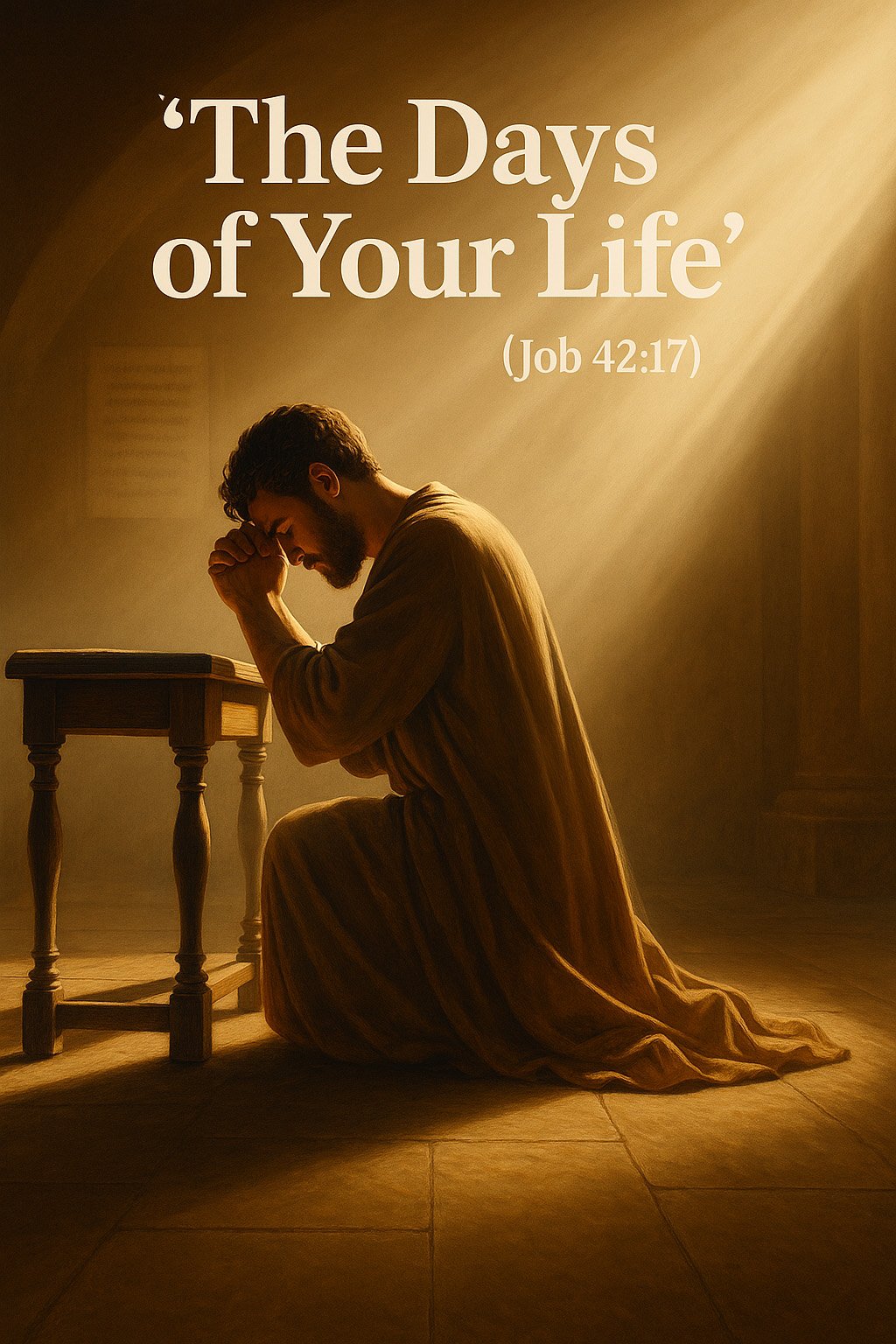
"The Days of Your Life" (Job 42:17)
“The Days of Your Life” (Job 42:17)
“So Job died being old and full of days.”
This is the Bible’s way of saying that Job’s life was complete. Throughout the Old Testament, no matter the section in which a person’s death was recorded, there is the mention of them being “old and full of days.”
While the casual reader may gloss over this oft-repeated phrase; the phrase is full of theological significance. For example, the word “full” (as in “full of days”) does not mean that the person was necessarily old. If that were the case, then the words “old” and “full” in Job 42:17 would be redundant. But they are not redundant.
The word “full” in this context is translated from a Hebrew word that means “enough.” This means that a person who had not lived very long could also be said to have been “full of days.”
There is the implication that God Himself saw or determined that the person had lived in this life long enough. Job had accomplished the purpose for which God let him live. Then there is the use of the word “days.” The word “day” in Scripture is used several ways. One way is a literal 24-hour period – such as in Genesis 7:11-12 where it rained for 40 days and forty nights.
Another usage for the word “day” is for a period of indeterminate length, such as in Genesis 2:4, where it reads in part “in the day that the Lord God made the earth and the heavens.” This is more like a season.
The final usage for the word “day” is in the sense of judgment, as in the “day of the Lord” (Zechariah 14:1; Isaiah 13:6; Joel 2:1; 1 Thessalonians 5:2). This is a period of judgment, such as when God told Adam in Genesis 2:17, which reads in part, “in the day that thou eatest thereof thou shalt surely die.” So, the recording of the death of Job, or your death, or mine, is full of godly significance. It says at least five things about us.
- God has determined the span of our lives.
- a. Job affirmed that God had set limits on his life (Job 14:5).
- b. Job’s life could not end until it was “full” (Psalm 139:16).
- Our days are full of events.
- a. Job was foreordained to meet calamity (Job 14:1).
- b. We will meet trials as part of our “days.”
- i. Don’t see trials as strange (1 Peter 4:12).
- ii. God determines the kind of trouble (1 Thessalonians 3:3).
- iii. All must know suffering (Job 5:7, 7:17–18, 30:25).
- iv. The righteous suffer too (Job 9:22–24, 21:7, 24:1–2).
- There have been days of sin, anger, bitterness and regret.
- a. God will judge our lives (Hebrews 9:27; 1 Cor. 3:11–15).
- b. We will see our seasons of sin.
- i. Satan used it to tempt Job (Job 1:9–11).
- ii. Job saw no good (Job 6:8–9).
- iii. He blamed friends and family (Job 6:15–17, 19:13–14).
- iv. Even his wife blamed God (Job 2:10, 6:4).
- c. God gives time to repent (2 Peter 3:9; Romans 2:4).
- God will give us a chance to repent and get our hearts right.
- a. Job pleaded his case with others (Job 13:3; 22–23; 31:35).
- b. Job realized his foolishness (Job 42:2–4).
- God judges the completed life.
- a. Job repented (Job 42:5–6).
- b. Job prayed for friends (Job 42:9).
- c. Only those with a clean heart meet God in peace (Psalm 24:3–4; Matthew 5:8; Hebrews 12:14).