
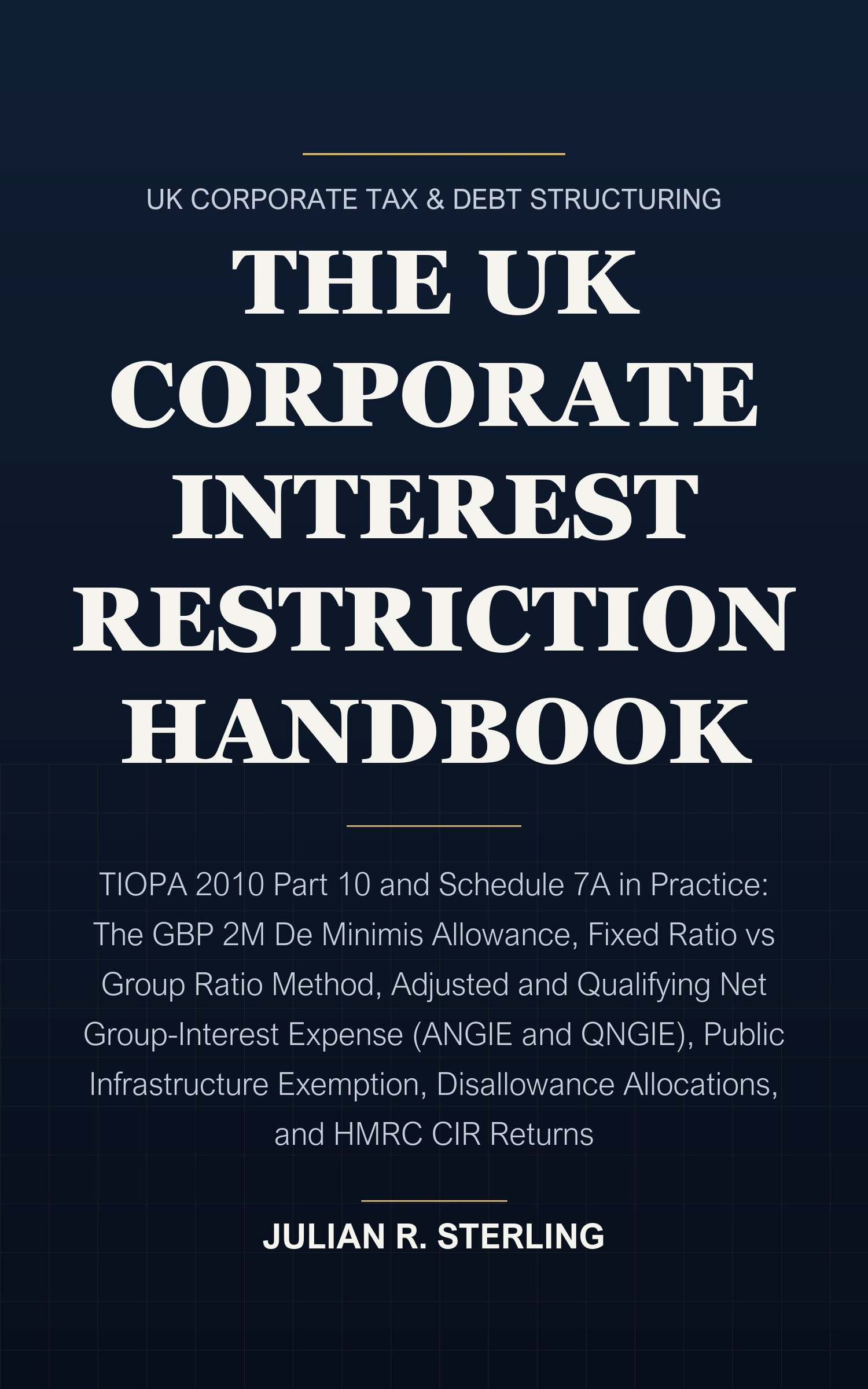
The UK Corporate Interest Restriction Handbook (PDF edition)
The UK Corporate Interest Restriction (CIR) under TIOPA 2010 Part 10 and Schedule 7A is one of the most mechanically demanding provisions in UK Corporation Tax. Groups with Aggregate Net Tax-Interest Expense (ANTIE) above the £2.00m de minimis threshold must coordinate UK Tax-EBITDA, consolidated IFRS Adjusted Net Group-Interest Expense (ANGIE) and Qualifying Net Group-Interest Expense (QNGIE), related-party debt exclusions under s. 414, 5-year unused interest allowance carry-forwards, indefinite company-level disallowed interest balances, and strict Schedule 7A return mechanics (including the Finance Act 2026 reporting company reforms).
One complete UK-headed multinational group carries every calculation from trial balance to HMRC Interest Restriction Return. Across FY2024 to FY2026, Thamesbridge Infrastructure & Industrial Group plc generates £3.00m of unused interest allowance in FY2024 (ANTIE £9.00m vs. £12.00m Fixed Ratio allowance), faces a £5.10m Fixed Ratio disallowance in FY2025 after acquisition leverage pushes ANTIE to £16.50m, cuts that disallowance to £3.50m by electing the Group Ratio Method at 35.71% (saving £1.60m of deductions and £0.40m in cash tax at 25% UK CT), allocates the disallowance across consenting and non-consenting subsidiaries while respecting the £0.70m statutory pro-rata cap on OpCo 2, evaluates a Public Infrastructure Exemption (PIE) election reducing FY2025 disallowance further to £2.85m, and reactivates the full £3.50m balance in FY2026 to recover £0.88m of UK Corporation Tax.
What is inside:
- 15 chapters in four parts covering TIOPA 2010 ss. 372-498, Schedule 7A, HMRC CFM95000-CFM99000, and Finance Act 2026 administrative and s. 407 technical amendments
- Complete ANTIE and Aggregate Tax-EBITDA reconciliations from UK CT600 computations, including negative Tax-EBITDA offsetting and the zero aggregate floor
- Side-by-side Fixed Ratio Method (30% cap + ANGIE Fixed Ratio Debt Cap) vs. Group Ratio Method (QNGIE / Group-EBITDA capped at 100% + QNGIE Debt Cap) with s. 414 related-party and results-dependent exclusions
- Public Infrastructure Exemption (PIE, ss. 432-449) eligibility, limited-recourse debt rules, 5-year irrevocability lock-in, and exact quantitative trade-off modeling
- Schedule 7A disallowance allocations (consenting vs. non-consenting paras 22-23 pro-rata caps), indefinite company-level carry-forwards, and FY2026 reactivation mechanics
- Special sectors (UK REITs, private equity funds, banking, insurance, oil and gas, securitisation), IAS 12 / FRS 102 deferred tax accounting, Pillar Two interaction, and a 30/60/90-day compliance calendar
This edition: PDF, A5, 113 pages, DRM-free.