
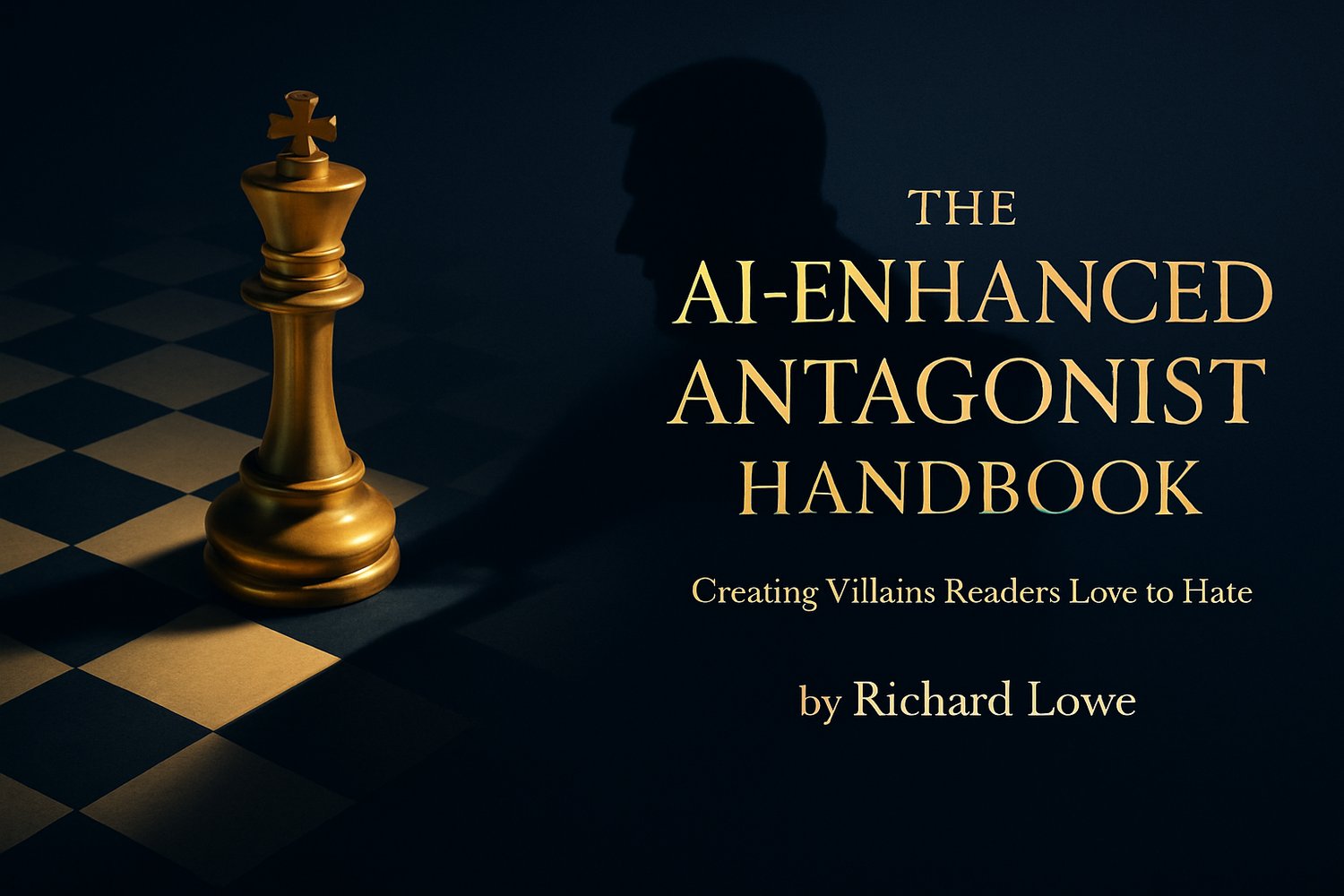
AI-Enhanced Antagonist Handbook
Your Villain Is More Important Than Your Hero
"Give your villain a tragic backstory." "Make them sympathetic." "Let them explain their motivation." You followed every piece of antagonist advice you could find. Your villain is still forgettable.
Craft books hand you checklists. Conferences recycle the same formulas. Writing teachers parrot advice they heard from other writing teachers. Nobody teaches the psychology underneath because nobody bothered to learn it themselves.
This checklist approach is how you get Malekith from Thor: The Dark World. Don't remember Malekith? Neither does anyone else. Dark elf. Wants to do something bad with red stuff. CGI nothing. Someone followed every item on the villain checklist and still produced garbage.
Meanwhile, Darth Vader. Hannibal Lecter. The shark from Jaws. Annie Wilkes. These characters define their stories more than any protagonist ever could.
Seven Antagonist Types
Not every antagonist is a villain. The handbook covers seven types and when to use each one. Villains provide morally wrong opposition like Hannibal Lecter. Rivals compete for the same goal like Draco Malfoy. Nemeses create personal enmity across time like Moriarty. Systems offer institutional opposition like the Capitol in Hunger Games. Forces bring nature, disaster, or disease like the shark in Jaws. Shadows serve as internal antagonists like Tyler Durden. False Allies betray from within like Littlefinger. You'll learn when to use each type, how to build it, how to combine types for complexity, and the specific pitfalls that make each type fail.
Psychology First, Checklists Never
Antagonists fail for predictable reasons. The Sauron Problem gives you an iconic but dramatically inert opponent. The Malekith Problem produces forgettable CGI nothing. The Motivation Problem creates evil for evil's sake. The Twist Villain Problem plants reveals that contradict everything readers have seen. Once you can diagnose the specific failure, you can fix it.
The handbook teaches you to build villains from the inside out. You'll understand what your antagonist believes they're accomplishing, what wound shaped them, what moral framework they operate within, and what line they won't cross. Not "give them a sad backstory." Actual psychological architecture you can replicate.
Genre-Specific Antagonists
Romance antagonists create obstacles to love that feel insurmountable without being contrived. Fantasy antagonists embody corrupted versions of the magic system's potential. Thriller antagonists balance intelligence and hubris so detectives earn their wins. Historical antagonists navigate period-accurate morality without alienating modern readers. Science fiction antagonists embody warnings about what humanity might become. YA antagonists challenge protagonists still forming their identities.
What's Inside
The handbook covers the psychology of opposition, explaining what antagonists do to stories and readers and why "evil" is lazy characterization. You'll learn the dark mirror structure and why the best antagonists reflect distorted versions of the protagonist. Complete coverage of all seven antagonist types with examples from Hans Gruber to the xenomorph. Building antagonist psychology through motivation, wounds, moral frameworks, and intelligence calibration. The antagonist-protagonist relationship including five dynamics and escalation without exhaustion. Scene craft for introductions, confrontations, and final showdowns that earn the climax. Guidance on redemption, death, and defeat that satisfies readers. A diagnostic guide for common failures with specific fixes.
Five deep-dive case studies analyze Anton Chigurh's use of fate as antagonist, Annie Wilkes as intimate horror, Iago's motiveless malignity, the xenomorph as inhuman threat, and failures like Steppenwolf and generic Bond villains.
40+ AI Prompts That Push Past Defaults
Ask AI for a villain and you get archetypes. Tortured past. Clear goal. Sympathetic motivation. Your antagonist sounds like every other AI-assisted villain because AI defaults to patterns, not psychology. The prompts in this handbook explore your specific antagonist's psychology, test their motivation logic, generate alternatives you haven't considered, and diagnose why scenes aren't working.
From an Author With 113 Published Books
My Peacekeeper series features Admiral Ridivask, a nemesis I've developed across fifteen planned books. My collection Grim explores what happens when the antagonist might be right. My novel Shield of Ashes depicts nuclear war with no single villain, only systemic antagonism that emerges from rational decisions. I've written antagonists that work and antagonists that failed. The failures taught me more.
116 pages. 7 chapters. 4 appendices. 40+ AI prompts. 5 case studies.
The villain your story deserves is waiting for you to build them.