
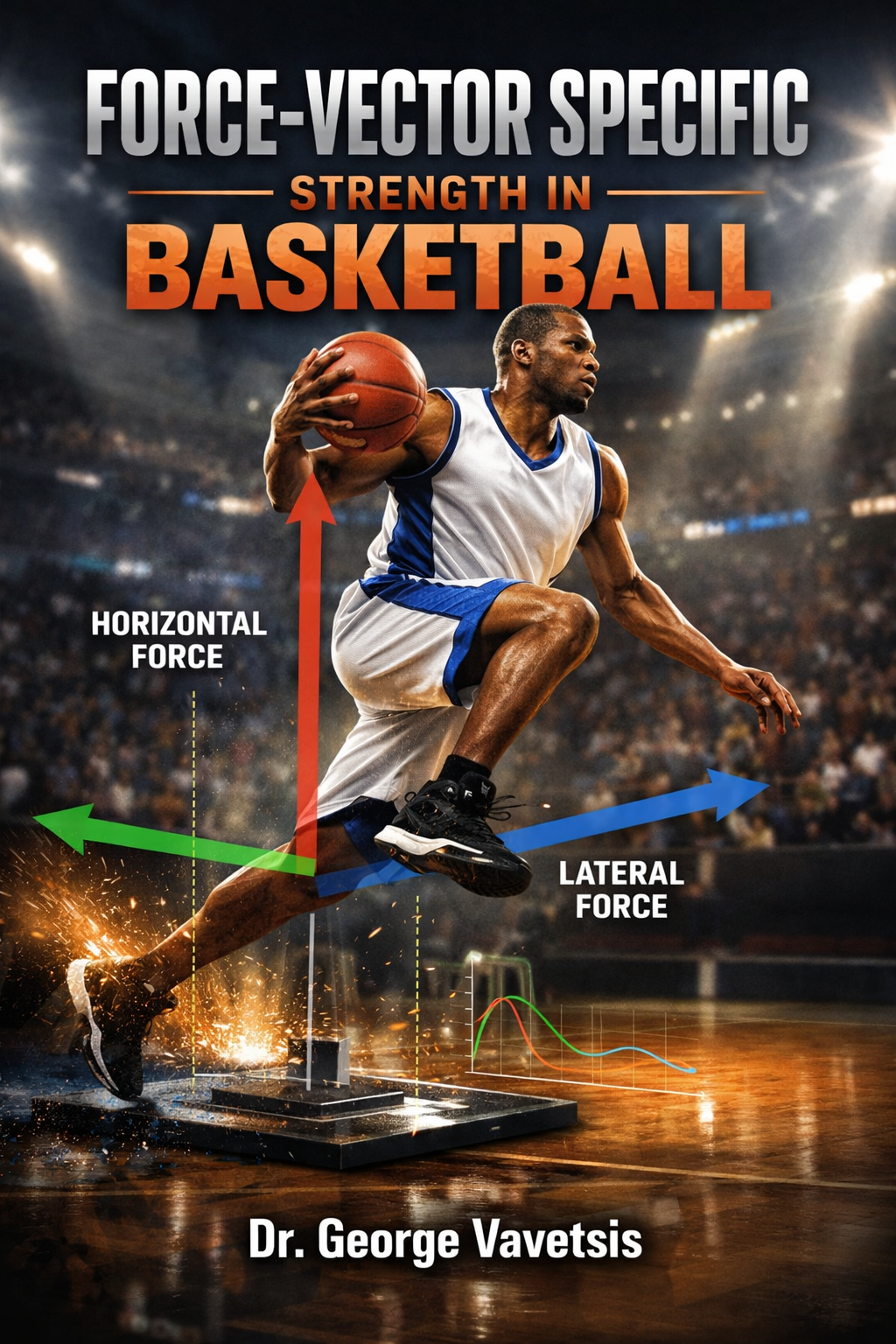
Force–Vector Specific Strength in Basketball
Pages: 536
Basketball is a game of force expressed in fractions of a second and in constantly shifting directions. Every rebound, first step, deceleration, cut, jump shot, or block is governed not simply by how strong an athlete is, but by how, where, and when force is applied to the ground. Traditional strength training paradigms have long emphasized load magnitude, muscle groups, or generic power outputs. While these approaches have undeniable value, they often fall short in explaining why equally strong athletes move differently on the court—or why gains in the weight room do not always translate into improvements in basketball performance.
This book is written from the premise that basketball performance is fundamentally a force–vector problem. The direction, orientation, and temporal characteristics of ground reaction forces determine whether strength transfers to sport. Vertical force without sufficient rate of force development fails to elevate the athlete in time. Horizontal force without appropriate vector alignment leaks into braking or unwanted displacement. Lateral force applied too late or at the wrong angle compromises defensive slides and change-of-direction efficiency. Strength, therefore, must be understood not only as capacity, but as vector-specific expression under sport-relevant constraints.
Force–Vector Specific Strength in Basketball was developed to bridge the gap between biomechanics, neuromuscular physiology, and applied strength and conditioning practice. Rather than offering a generic catalogue of exercises, this text provides a framework for analyzing basketball actions through ground reaction force decomposition and then systematically aligning training methods with those force demands. The goal is not to replace established strength principles, but to refine them—so that every exercise choice, loading zone, velocity target, and progression strategy is justified by its vector relevance to the game.
A central theme throughout the book is that force magnitude and force direction are independent yet interacting qualities. Vertical ground reaction force capacity, early-phase rate of force development, braking impulse, elastic recycling, and stiffness regulation all contribute differently depending on the task. A maximal squat may improve vertical force capacity, but without adequate early RFD it may not enhance first-step explosiveness or late-game finishing. Similarly, plyometric work may elevate reactive strength, yet without sufficient force reserves it may plateau quickly or increase injury risk. This text emphasizes identifying such mismatches and resolving them through targeted programming rather than indiscriminate volume increases.
Another guiding principle is decision-based programming. Basketball seasons are dense, unpredictable, and neurologically demanding. Strength training cannot exist in isolation from fatigue, match congestion, or tactical demands. For this reason, each chapter integrates practical decision rules derived from force–velocity profiling, jump diagnostics, velocity-based training, and rate-of-force-development monitoring. These tools allow the practitioner to decide what to emphasize, when to emphasize it, and when to pull back, preserving transfer while minimizing unnecessary fatigue.
Importantly, this book does not treat basketball players as a homogeneous population. Guards, wings, and bigs express force differently due to role-specific constraints, body mass, and movement demands. Guards rely heavily on early-phase RFD, elastic efficiency, and rapid vector redirection. Wings operate in a hybrid zone, requiring both force capacity and velocity preservation across multiple planes. Bigs depend more on braking control, vertical force magnitude, and stiffness regulation under high contact loads. Force–vector theory provides a unifying language to address these differences without fragmenting the training process.
From a methodological standpoint, the content is intentionally dense and technical. This is not an introductory text. It is written for strength and conditioning coaches, sport scientists, and performance practitioners who already understand basic biomechanics and training theory and are seeking a more precise, diagnostic-driven approach. Concepts such as impulse partitioning, vector misalignment, braking–propulsive ratios, distal-to-proximal sequencing, and velocity-loss thresholds are treated not as abstractions, but as actionable variables that can and should influence daily programming decisions.
At the same time, the book remains grounded in practice. Each chapter translates theory into exercise selection, weekly structure, loading strategies, and monitoring priorities. Velocity ranges, RFD targets, frequency recommendations, and progression models are provided not as rigid prescriptions, but as reference points within a broader adaptive system. The intention is to equip the reader with a framework that can be customized to different competitive levels, technological resources, and coaching environments.
Ultimately, this work argues for a shift in perspective: from asking “How much strength does this athlete have?” to asking “Is this athlete producing the right force, in the right direction, at the right time?” When that question guides programming, strength training becomes less about accumulation and more about precision. Transfer improves, fatigue becomes manageable, and performance gains become more robust under the chaotic realities of competition.
If this book succeeds, it will not be because it introduces new exercises, but because it sharpens the lens through which strength is viewed in basketball. Force–vector specificity is not a trend or a method—it is a way of thinking. The pages that follow invite the reader to adopt that mindset, challenge habitual practices, and design training systems that respect the true mechanical demands of the game.