
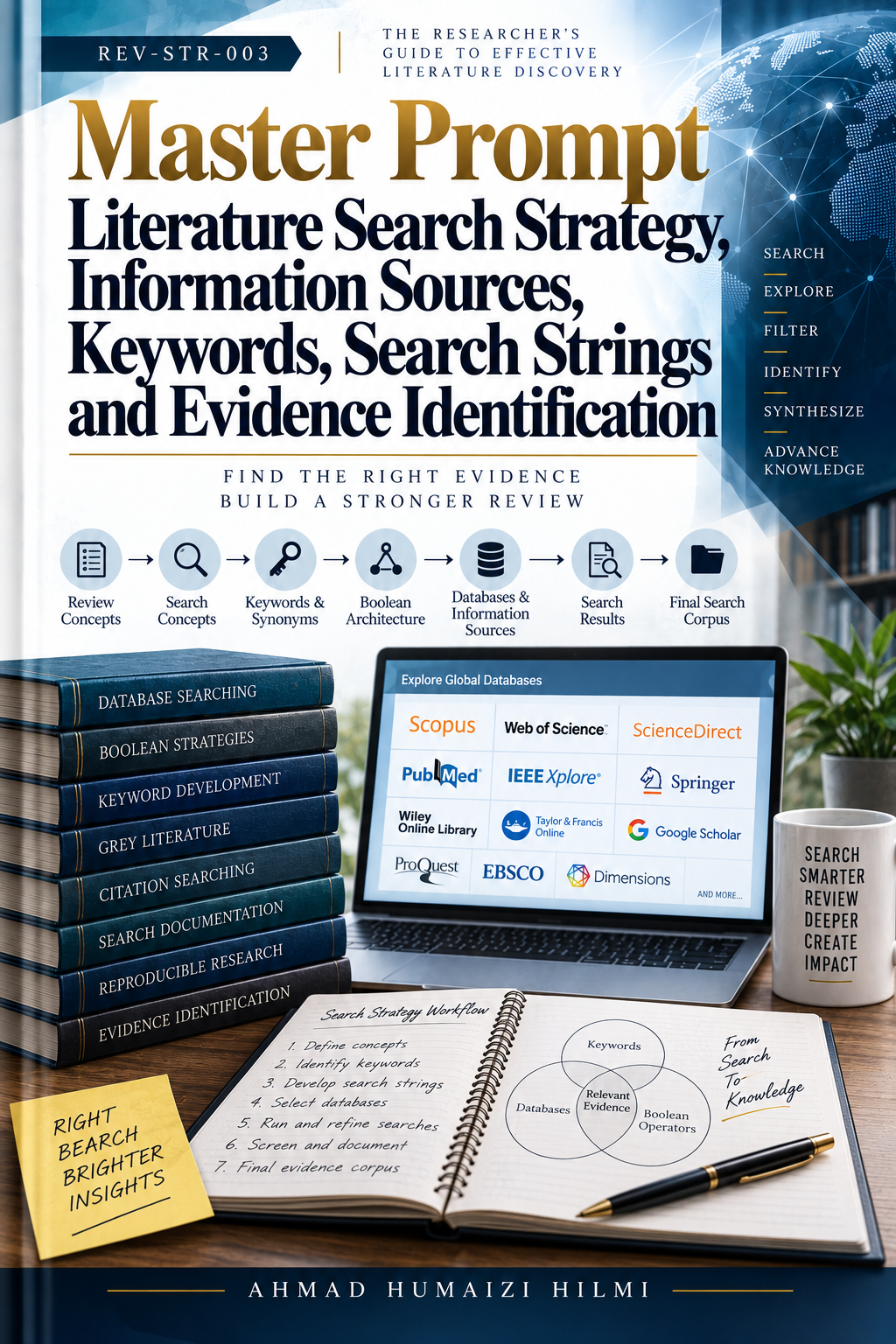
3. REV-STR-003 — Literature Search Strategy, Information Sources, Keywords, Search Strings and Evidence Identification
Description
This Master Prompt focuses on designing, testing, executing, documenting and critically justifying a transparent and sufficiently comprehensive evidence-identification strategy for a scholarly review paper. It guides researchers in converting the conceptual language of the review problem, objectives and review questions into operational search concepts; identifying keywords, synonyms, spelling variants, acronyms, broader and narrower terminology, related concepts and controlled vocabulary where available; constructing Boolean search architectures; applying phrase searching, truncation, wildcards, proximity operators and field restrictions where supported; selecting bibliographic databases and complementary information sources; translating the strategy across database interfaces; defining justified temporal, language, document-type and other search limits; recording search dates and results; and preserving complete search histories so that the identification process can be understood, audited and reproduced. The uploaded papers demonstrate that database selection and keyword development should be treated as iterative methodological decisions: one reviewed methodology explicitly moves from defining databases and keyword combinations to an initial search, with the possibility of revising either before the final search.
A major emphasis is placed on question–search alignment and coverage rather than database familiarity or convenience. Researchers should justify each database or source according to disciplinary relevance, indexing scope, geographical coverage, publication types and the likelihood that it contributes unique evidence. A multidisciplinary review may therefore require databases representing several fields rather than relying on one broad index. The uploaded childhood-loss protocol, for example, uses four multidisciplinary databases, includes both peer-reviewed and grey literature, and supplements database searching through citation screening and relevant special-issue searching. Other papers demonstrate complementary strategies: one review searched six databases and explicitly translated its search strings across them, with a later search update, while another combined bibliographic database searching with interviews and targeted organizational website searches. The collection therefore supports a layered evidence-identification architecture rather than assuming that one database or one search channel is automatically sufficient.