
Atomic Structure and Scale: AQA GCSE Physics (60-Minute Lesson + Answers)
Lesson 1 of 5: Atoms and Isotopes
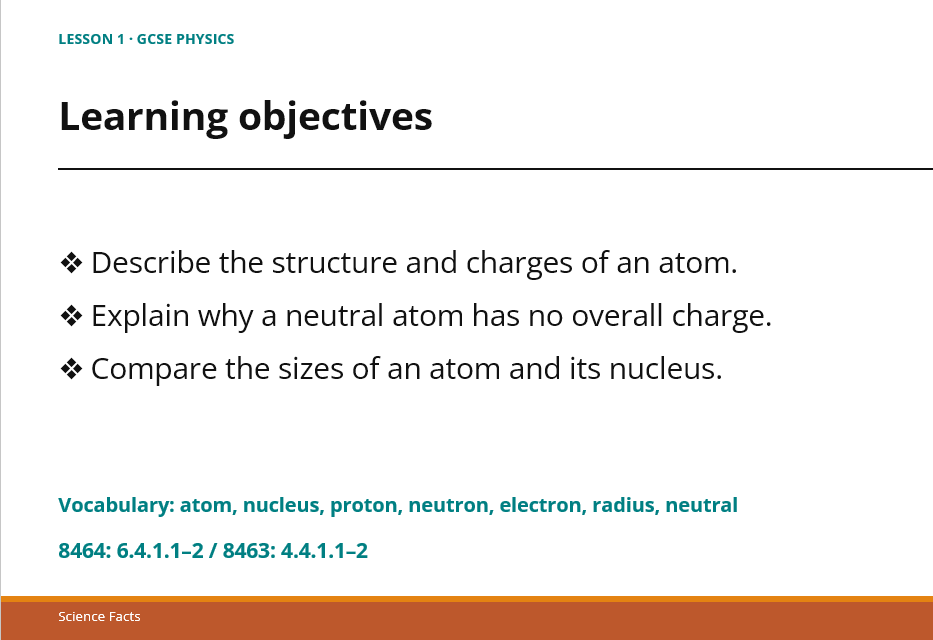
AQA Specification: Physics (8463): 4.4.1.1–4.4.1.2 | Combined Science (8464): 6.4.1.1–6.4.1.2
Level: Foundation and Higher Tier | Duration: 60 minutes
This ready-to-teach, 20-slide PowerPoint lesson covers the structure of atoms, the relative charges and masses of subatomic particles, electrical neutrality, and the relative sizes of atoms and their nuclei. Pupils learn to identify protons, neutrons and electrons, explain why neutral atoms have no overall charge, and compare atomic and nuclear radii using standard form and scale calculations. Suitable for GCSE classroom teaching, tutoring, home learning and independent revision.
What's Included?
- Do Now retrieval and prerequisite knowledge checks.
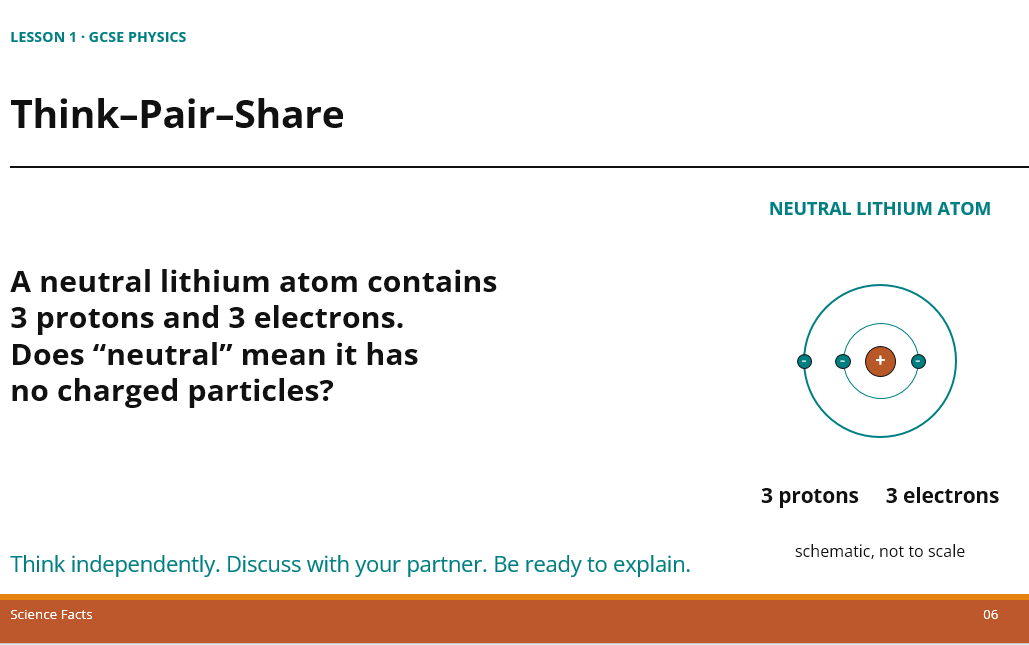
- Think–Pair–Share discussion exploring why neutral atoms still contain charged particles.
- Clear scientific explanations and labelled diagrams illustrating atomic structure and subatomic particles.
- Modelled worked examples determining electron numbers, explaining electrical neutrality and calculating nuclear size.
- Mini-whiteboard (MWB) assessments and independent GCSE-style practice questions.
- Atomic scale calculations involving standard form, atomic radii and nucleus-to-atom size comparisons.
- Stretch and challenge activities comparing electron and proton masses and explaining why electrons are excluded from mass number.
- Green-pen self-assessment with answers and marking guidance.
- Exit ticket to assess learning outcomes.
Lesson Structure: Retrieval (10 min) | Discussion (4 min) | Teaching (7 min) | Modelling (13 min) | MWB (4 min) | Practice (14 min) | Review (5 min) | Exit Ticket (3 min).
Science Facts – Curriculum-aligned GCSE Science resources designed for effective teaching, assessment and independent revision.