
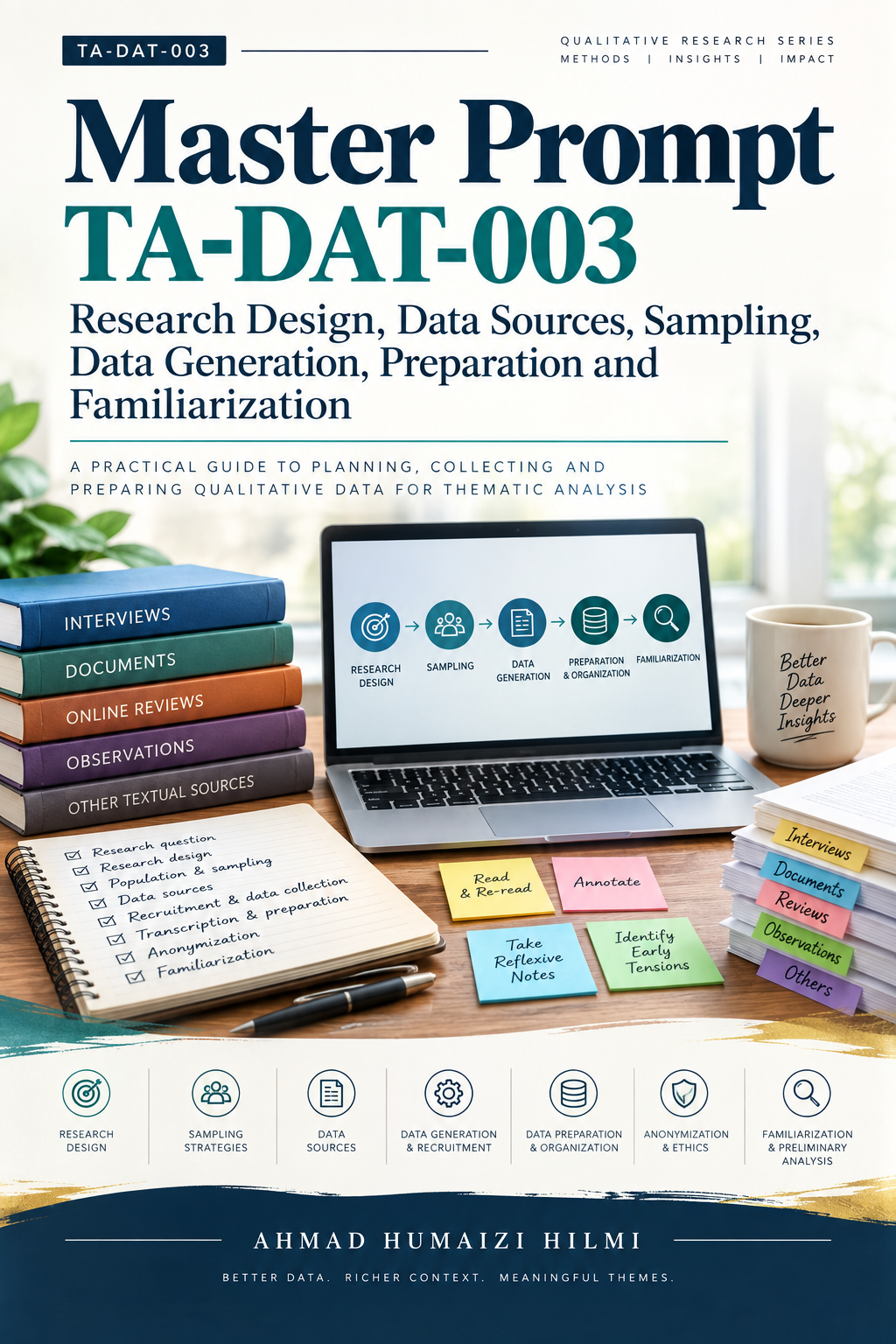
TA-DAT-003 — Research Design, Data Sources, Sampling, Data Generation, Preparation and Familiarization
Description
This Master Prompt focuses on preparing appropriate qualitative evidence for thematic analysis and developing deep familiarity with the dataset before formal coding begins. It guides researchers in aligning the research problem and research questions with an appropriate qualitative or mixed-method research design; defining the population, context and unit of analysis; selecting and justifying sampling strategies; establishing inclusion and exclusion criteria; determining data adequacy; choosing appropriate primary, secondary, documentary or digital data sources; documenting recruitment and data-generation procedures; preparing, cleaning, organizing and anonymizing data; and developing systematic familiarity with the complete dataset before formal coding and theme development.
A major emphasis is placed on recognizing that thematic analysis is not restricted to conventional interview transcripts. The uploaded studies demonstrate its application to semi-structured interviews, documents, review evidence, online comments, social-media datasets, institutional materials and mixed or sequential datasets. For example, one study combined latent class analysis with thematic analysis of user feedback, demonstrating integration of qualitative evidence within a broader analytical design. Another analyzed 111,953 preprocessed YouTube comments using computational methods alongside manual thematic analysis, illustrating the need for explicit data acquisition, preprocessing and sampling procedures when digital datasets are involved. The literature also demonstrates detailed purposive and maximum-variation sampling, information-power reasoning, iterative assessment of data adequacy, concurrent collection and analysis, verbatim transcription and reflexive documentation.