
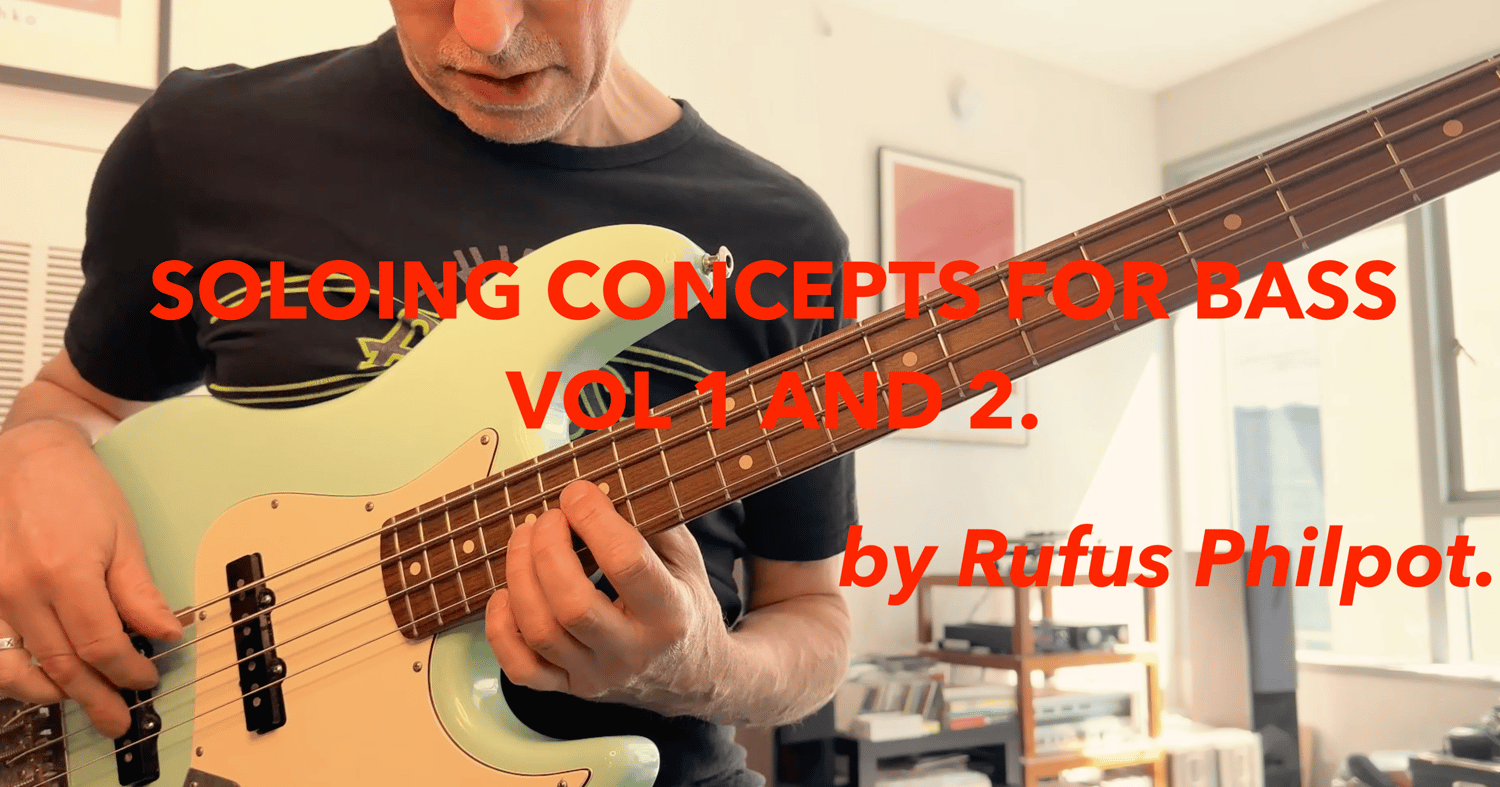


Soloing Concepts Vol 1 and 2 BUNDLE.
Soloing Concepts for Bass- by Rufus Philpot
Vol 1. And Vol. 2 Bundle.
Welcome to the new video course !
Around 100 minutes in total length of intensive tuition material, and NO Music Notation reading required.
Please note:
I have split the new course into Vol 1 and 2, and EACH of those
volumes has two videos to download.
This means the file sizes are more manageable to download.
Vol 1 : Part 1 & 2,
Vol 2 : Parts 3 and 4
PLUS you get the full 5 page worksheet ( also available as a separate
download ) -AND another pdf which details the topics contained in each volume -these are specific
to the videos.
So in this bundle you will get a grand TOTAL of 4 video files and
TWO .pdfs!
Lots to woodshed. Around 100 minutes of intensive video tutorial material!!
Vol 1
In volume 1 I discuss analyzing a chord progression-such as the
one found in Autumn Leaves, and then give you a breakdown of
the various scales or modes I recommend trying over the chords
presented here. The vocabulary I show you is exactly what great
players like Mike Stern, Cannonball Adderley and Jaco Pastorius
used on the many classic recordings they have made.
Jaco -on Donna Lee for instance -used a great deal of half
whole diminished ideas over the V7 chords there…yet far too few
bassists make use of this incredible sounding scale in their
solos…
I also take you through WHY the HW Diminished scale is a better
choice than say only using mixolydian…
You’ll find discussions on choice modes from Harmonic Minor,
Harmonic Major ( in particular the 2nd mode, the Dorian b5) and
of course (!) the Melodic Minor. I show you where I use the
Locrian #2 and Altered Scale in particular.
n Part 2 of Volume 1 you’ll find examples of running through
specific modes on the ii chord into modes on v chords using
ideas derived from melodic minor and diminished harmony,
depending on whether the ii v progression is major or minor in
quality…www.rufusphilpot.com
You will see there is often MORE than one option for playing over
each chord type.
Next is a more advanced exercise using the ii v i in G minor ( as
per the Autumn Leaves chord progression example)- which will
help develop your ability to connect from one mode/scale into
the nearest available note in the next chord and scale.
I demonstrate various fingering options for these too- BUT please
experiment and find as many workable fingerings as you can-this
is something I spent many hours doing as a student.
Also I share my own personal thoughts on TRANSCRIBING
solos. You will find some incredible solo recommendations in the
5 page PDF worksheet too.
I would say these videos are Intermediate in level, so practice
slowly and refer to my YouTube channel for more on basic
melodic minor mode explanations and fingerings etc.
Vol. 2 : Interval studies-4th sequences, pentatonic based
lines and more..
In volume 2 I hone in on some very specific building blocks.
To create some contrast from stepwise scalar lines a great
resource can be using larger intervals -and 4ths in particular have
a wonderful modern sound-especially when combined with full
range low to high or high to low practice concepts…www.rufusphilpot.com
In this Vol. 2 I take a specific interval- the 4th-and work this
through Dorian and Lydian modes.
Analysis of a line I use in the video-that G minor lick…
Next we look at applying interval sequences to a minor
pentatonic -using both 4ths and a major 3rd.
This gives you a perfect foundation for then playing the great little
lick I use over the G minor I chord (such as in Autumn Leaves)
I explain WHY this works and then show you the note I ADD from
a different mode ( the Dorian) to give this lick it’s VERY distinctive
sound!
I demonstrate the 4th sequence idea also from root to root of the
mode, but next up is a full range example- more challenging and
specifically geared towards strengthening your knowledge of
the fingerboard from the lowest to highest available note.
I also reveal my thought process on how and why I am shifting at
specific points on the neck, and the concept behind this.
I also go through this with the Lydian mode-using 4ths..
Check out Stanley Clarke’s brilliant use of 4ths ( and the Lydian
mode) during his solo on his composition “Song to John Part 2”
from his iconic ‘Journey to Love” record. Note: I actually break
down a couple of ideas in his solo on my Youtube channel-give it
a watch too!
I also look at Interval sequences (using 4ths) over Dorian, and
Lydian
Another variation -in the video- try moving from D minor into Eb
minor keeping those ascending or descending 4th sequences
moving continuously…www.rufusphilpot.com
Bonus D minor Dorian based lick. Another very cool line for
you to practice.
In part 4 I also look at full range exercises using a specific mode
and also a bonus slick- a D minor based sequential line using
sequences of 4ths and a major 3rd-borrowing from both
pentatonic and Dorian.
I play these at fast and slow tempos-so you can practice these
by playing along with me.
This is around 100 minutes of video tutorial.