
Lezgin.HO 23andme format
Lezgins are an Indigenous people of the eastern Caucasus, primarily inhabiting southern Dagestan in Russia and northern Azerbaijan. They speak Lezgin, a member of the Northeast Caucasian language family—one of the oldest and most linguistically diverse regions in the world. Within this family, Lezgins are most closely related to groups such as the Tabasarans, Rutuls, and Tsakhurs, with whom they share deep cultural and linguistic ties shaped by centuries of mountain life in the Caucasus.
Historically, Lezgins played a major role in regional resistance and state-building. One of the most famous Dagestani figures is Imam Shamil, a key leader of the Caucasian resistance against Russian expansion in the 19th century. Although often associated broadly with Dagestan and Chechnya, Shamil came from an Avar-speaking environment and became a symbol of Caucasian independence and Islamic resistance. Another prominent Lezgin figure is Suleiman Stalsky, a celebrated poet often called the “Homer of the 20th century,” whose works helped preserve Lezgin language and oral tradition during the early Soviet era.
Under the Russian Empire, Lezgin lands were drawn into imperial control during the Caucasian Wars of the 19th century, a period marked by conflict, displacement, and the suppression of local political autonomy. During the Soviet Union, Lezgins experienced rapid social transformation: literacy expanded, traditional clan structures weakened, and the Lezgin language was standardized and taught, but at the cost of political centralization and the division of Lezgin populations between Dagestan and Azerbaijan. In the Russian Federation, Lezgins remain one of Dagestan’s largest ethnic groups, maintaining a strong cultural identity while navigating challenges related to economic development, language preservation, and regional stability in the North Caucasus.
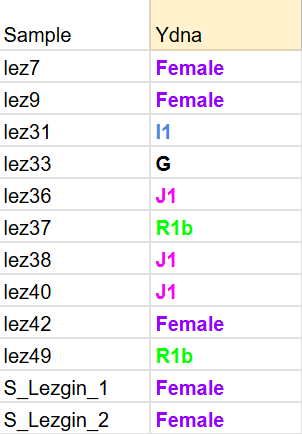
For this video, I’ve gathered 12 Lezgin genomes from Harvard’s aadr + HO dataset.