

Make More - Pay Less
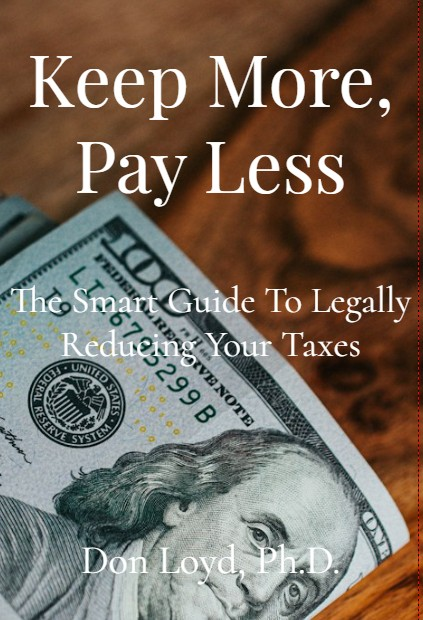
Very few authors can honestly say they've spent more than 50 years in real estate, closed hundreds of transactions in a year, built businesses, invested, developed property, taught at the graduate level, and written more than 70 books. That perspective comes through in pages of my new book, Keep More, Pay Less - The Smart Guide to Legally Reducing Your Taxes. Rather than sounding like a general financial writer, this version sounds like someone who's "been there" and learned these lessons firsthand.
If there's one lesson I've learned after more than fifty years in business, it's this: making money is only half the battle. Keeping it often determines whether someone merely earns a good living or builds lasting wealth.
I've watched talented entrepreneurs work seventy-hour weeks, close impressive sales, and celebrate record-breaking years only to discover that far too much of what they earned quietly disappeared. Not because their businesses failed. Not because they lacked ambition. They simply didn't understand how tax planning fit into wealth building. I've seen it happen over and over again.
Early in my real estate career, I believed success meant working harder than everyone else. I was willing to make one more phone call, show one more property, negotiate one more contract, and stay in the office long after others had gone home. Hard work certainly mattered, and it still does. Yet somewhere along the way I discovered another truth. Two people can work equally hard, earn similar incomes, and finish the year in completely different financial positions. One keeps building wealth while the other keeps wondering where all the money went. The difference often comes down to planning. That's why I wanted this book to exist.
Too many people believe taxes are simply something that happens after the money has been earned. They think planning begins when they gather receipts for their accountant in March or April. By then, many opportunities have already slipped away. Tax preparation records history. Tax planning helps shape the future. Those are two very different things.
Here's the thing. Congress didn't write tax laws merely to collect revenue. Those laws also encourage behavior that strengthens our economy. They reward entrepreneurship. They encourage investment. They support business expansion, retirement savings, charitable giving, real estate development, research, job creation, and countless other activities that contribute to economic growth. Those incentives aren't loopholes. They're invitations.
Imagine you're standing before two roads leading toward exactly the same destination. One road contains unnecessary toll booths every few miles. The other has fewer tolls because someone took time to study a better route. Both roads are completely legal. Both eventually arrive at the same place. Which road would you choose? That's exactly what intelligent tax planning accomplishes.
Throughout my career as a real estate broker, Managing Principal Broker, investor, builder, developer, lender, and business owner, I've watched clients make life-changing financial decisions. Some created tremendous wealth over time. Others earned excellent incomes yet struggled financially because they focused only on increasing revenue while ignoring what happened after taxes.
If you ask me, after-tax income tells a much more meaningful story than gross income ever will.
Business owners understand this better than most people. Revenue alone doesn't determine success. Profit matters. Cash flow matters. Smart planning matters. Every unnecessary dollar paid in taxes becomes one less dollar available for hiring employees, purchasing equipment, investing in additional real estate, expanding operations, or strengthening retirement.
Real estate investors have known this for generations.
Depreciation. Like-kind exchanges. Capital gains planning. Interest deductions. Cost segregation. Entity selection. Those aren't obscure accounting terms. They're powerful financial tools when used properly. Think of them as pieces of a well-built toolbox. A carpenter wouldn't build an entire house with only a hammer, and an investor shouldn't build long-term wealth using only one financial strategy.
During 2024 and 2025, business owners across America faced rising operating costs, stubborn inflation, higher borrowing expenses, and continued economic uncertainty. Those challenges reminded all of us that every dollar matters. Every unnecessary expense affects profitability. Every legal opportunity deserves careful consideration. Taxes represent one of the largest expenses many families and businesses will ever face. Why wouldn't you learn how to manage that expense wisely?
Now let me be perfectly clear. This book doesn't promote tax evasion, questionable shelters, offshore schemes, or secret loopholes somebody claims government doesn't want you to know about. Whenever someone promises you'll never pay taxes again, I'd recommend holding onto your wallet. Real wealth rarely comes from shortcuts. It usually grows through knowledge, discipline, patience, and consistent decision-making.
That's exactly what you'll find throughout these pages.
We'll discuss business structures, retirement planning, real estate investing, deductions, depreciation, charitable giving, estate planning, timing strategies, recordkeeping, and many other opportunities intentionally written into tax law. Some ideas may apply directly to your circumstances. Others may simply broaden your understanding and prepare you for future opportunities. Either outcome represents progress because informed people make better financial decisions.
Think of this book as sitting across a table from someone who's spent decades navigating business, investing, and real estate. I'll explain complicated ideas in everyday language, point out opportunities worth exploring, and encourage you to ask better questions when meeting with your CPA, attorney, or financial adviser. You don't have to become a tax expert. You simply need enough understanding to recognize opportunities before they pass by.
Long story short, wealth isn't measured only by what you earn. It's measured by what you keep, how wisely you invest it, and how effectively you put it to work for future generations.
I sincerely hope this book helps you see taxes from an entirely different perspective. Instead of viewing them as an unavoidable burden, begin seeing them as an area where knowledge creates opportunity. You worked hard for every dollar you've earned. Learning how to legally protect more of those dollars may become one of the wisest financial investments you'll ever make.
So grab a cup of coffee, settle into a comfortable chair, and let's begin building a smarter approach toward taxes, wealth, and long-term financial freedom together.