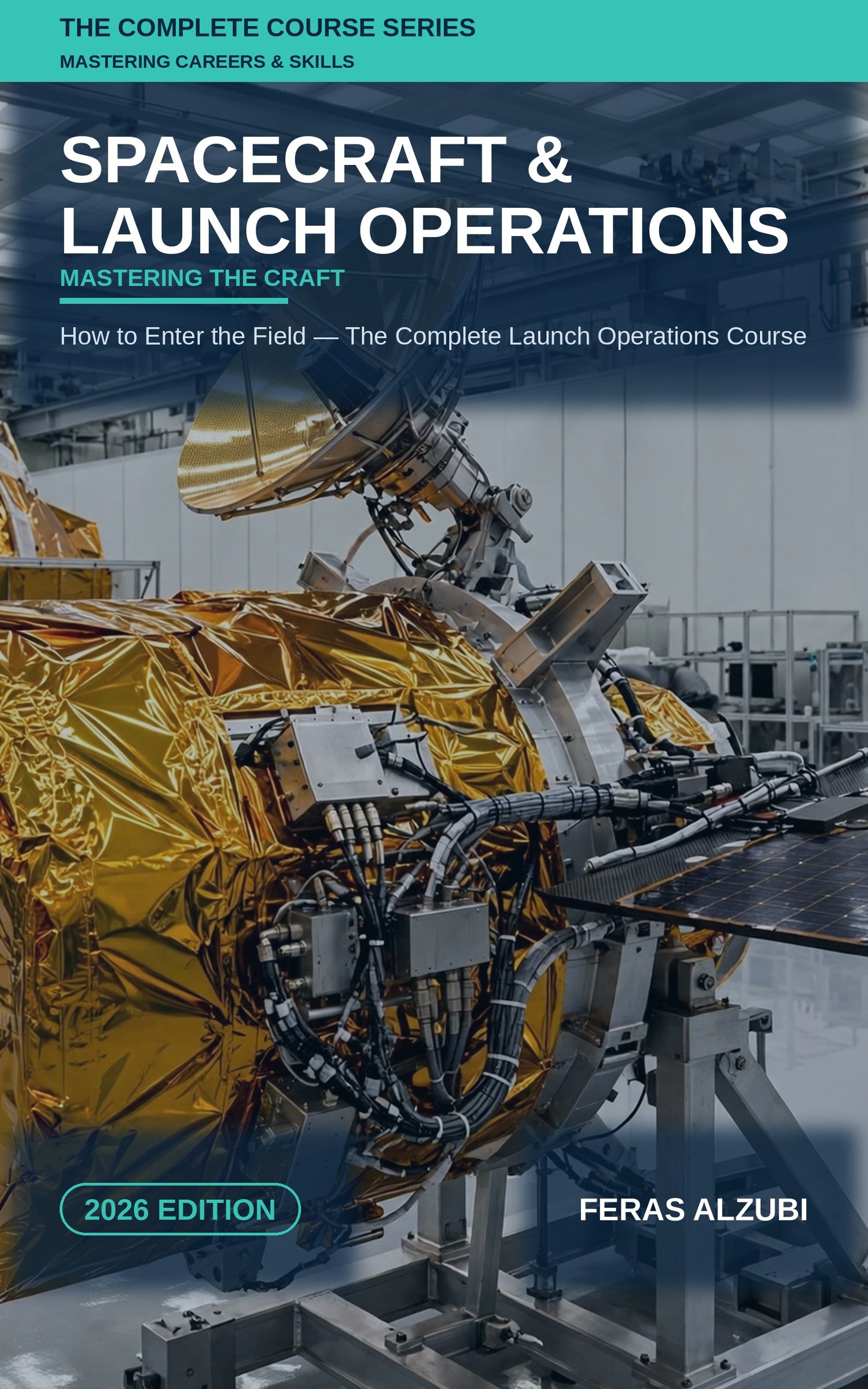
Spacecraft & Launch Operations: Mastering the Craft
Spacecraft & Launch Operations: Mastering the Craft — How to Enter the Field
What this book teaches. The complete course for the spacecraft and launch technician's craft — the whole field taught from zero to advanced practice in one book. Spacecraft and launch vehicles are built, integrated, tested, processed, and launched by technicians: the people who assemble the bus, install the harnesses, blanket the thermal hardware, prove the vehicle against its environments, encapsulate the payload, serve the pad, and stand the countdown polls. This book teaches that whole craft: orbits and the space environment, mathematics and measurement, electricity, materials and fasteners, drawings and specifications, and safety — all taught from the ground up, inside the book, with no aerospace experience assumed — and then the specialty itself: spacecraft systems, structures, power, avionics and harnesses, propulsion at technician level, thermal control, assembly and integration under cleanroom and torque discipline, spacecraft testing at method level, the launch vehicle and its ground interfaces, propellants and pressurants at recognition level, payload processing, ground support equipment, the launch site, countdown discipline, quality and documentation as the field's spine, mission operations, recovery and reuse, failure and the technician's evidence role, constellation production, facilities, tools and calibration, the standards landscape by scope, export controls and ethics, and the judgment the work demands. Hazardous operations — propellants, pressurants, pyrotechnics, stored energy — are taught at recognition, rules, and response level only: the book names the hazard, the controlling qualifications and documents by scope, and your stop-work authority and duty to escalate; it never teaches a procedure for performing the hazardous operation itself, and it never replaces your employer's program, the range's requirements, or the governing documents.
Who it is for. The reader entering spacecraft and launch operations who wants the whole field in one place; the working technician who wants the reasoning underneath the routine; and the student preparing to walk into employer training and interviews ready. No FAA certificate or government license exists for this work, and this book invents none: the U.S. Bureau of Labor Statistics publishes no "spacecraft technician" occupation, and the book never prints one — hiring runs through two occupations whose own federal definitions cover it (Aerospace Engineering and Operations Technologists and Technicians, and Aircraft Structure, Surfaces, Rigging, and Systems Assemblers), each printed in its own box with its source named on its face, the assembler occupation's projected decline printed wherever its pay is printed. The voluntary credentials in the landscape — SpaceTEC's Certified Aerospace Technician Core and ASTM International's NCATT Aircraft Electronics Technician examination — and Cornell University's Foundations of Space Technology certificate are stated exactly as their issuers state them, as landscape only: this book is never preparation for any of them. The book also states plainly, up front, that most flight-hardware technician work is performed under export-control law, and that this work is geographically concentrated, so a reader outside those clusters should expect that entering the field may mean moving. What the book promises is readiness: the knowledge, the vocabulary, the worked judgment, and the study system.
What's inside (every count verified against the actual book):
34 chapters in five parts, from the foundations of the field to facilities, standards, and the career
730 practice items with every option explained — a 50-item diagnostic scored by strand with a readiness tracker, 510 chapter exercises & skills checks (15 close every chapter), 50 guided spacecraft and launch case files in two batteries, and 120 repair-set items in eight strand sets
38 labeled figures — photorealistic plates of the real hardware and facilities (spacecraft buses, harnesses and connector panels, test chambers, processing facilities, ground support equipment), each verified part by part, plus diagrams of the processes themselves
A 372-entry glossary, compiled from the chapters' own key-term lists
3 cheat sheets — a life-cycle sheet, a numbers sheet carrying only unit definitions and the book's own worked givens, and a safety and judgment sheet
2 study plans — a 2-week intensive and a 4-week standard plan
Read the first chapter free — the sample on this page is Chapter 1 of this book, exactly as it appears in the full edition.
From the Mastering Careers & Skills library — complete A-to-Z professional teaching books for careers, trades, and certifications.
An independent study guide. Not affiliated with, endorsed by, or approved by the Federal Aviation Administration, SpaceTEC Partners, Inc., ASTM International, or Cornell University. No FAA certificate or government license exists for this work, and this book confers no license, certificate, credential, or qualification of any kind. It promises readiness and knowledge only.
Refunds: Please read the free sample chapter before you buy. This is a digital ebook, delivered instantly by download. If the file is defective, or you cannot open or download it and we cannot fix the problem, you will receive a full refund — email us within 14 days of purchase. Because the book is delivered instantly as a downloadable file, all other sales are final.
How to read this book (EPUB format): After checkout, download the EPUB file, then open it in any free ebook reader app. On iPhone or iPad: Apple Books — it is already on your device. On Android phones and tablets: Google Play Books (free: https://play.google.com/store/apps/details?id=com.google.android.apps.books) — upload the file in the app — or ReadEra (free). On a Windows or Mac computer: Thorium Reader (free: https://thorium.edrlab.org) or Adobe Digital Editions (free). On Kindle: use Amazon's free Send to Kindle (https://www.amazon.com/sendtokindle) to add the file to your Kindle library.