
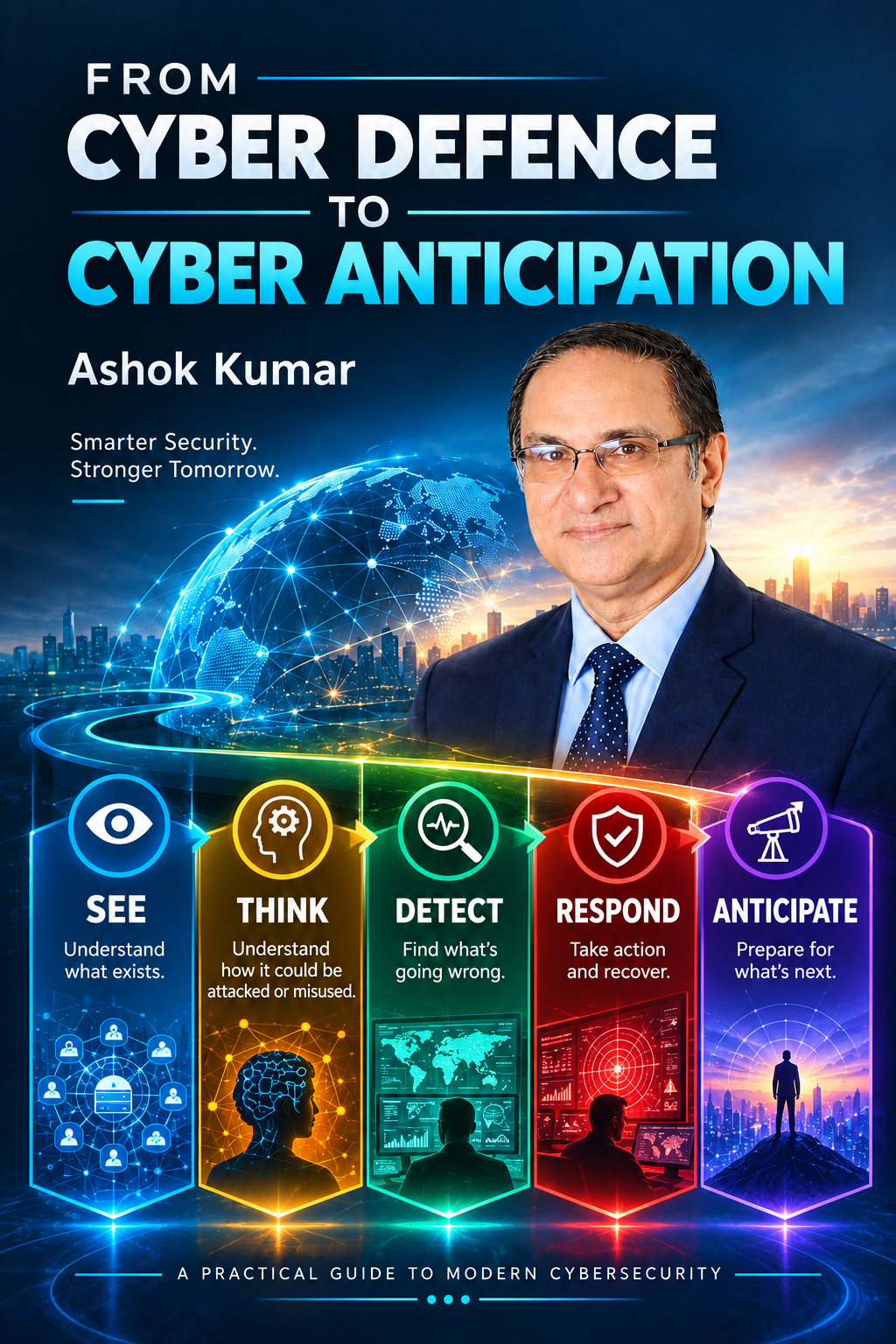
Cyber Defence to Cyber Anticipation
From Cyber Defence to Cyber Anticipation
SEE • THINK • DETECT • RESPOND • ANTICIPATE
By Ashok Kumar
Cybersecurity is no longer just about building stronger defences, detecting intrusions and responding to incidents. Modern organisations operate across cloud platforms, SaaS applications, APIs, mobile devices, remote workforces, suppliers and interconnected digital ecosystems. Understanding and managing the risks across this environment requires a broader way of thinking.
From Cyber Defence to Cyber Anticipation introduces a practical five-pillar framework to help readers understand the digital environment, think like an adversary, turn security data into intelligence, respond effectively to incidents and anticipate emerging attack paths.
Rather than treating cybersecurity as a collection of disconnected tools and technologies, this book connects people, processes, systems, evidence and business decisions into a coherent approach.
What you will learn
1. SEE — Know your digital environment
Understand assets, identities, dependencies, data flows and the systems that keep an organisation functioning. Learn why effective security begins with visibility.
2. THINK — Understand the attacker
Explore attacker objectives, motivations, techniques and potential routes into an organisation. Develop the ability to examine threats from the adversary's perspective.
3. DETECT — Turn security data into intelligence
Understand logs, security events, detection logic, correlation, investigation and the importance of distinguishing an alert from a confirmed incident.
4. RESPOND — Survive the attack
Explore incident triage, containment, evidence preservation, decision-making, business continuity and trustworthy recovery.
5. ANTICIPATE — Prepare for what comes next
Examine emerging attack paths, artificial intelligence, cyber twins and the importance of anticipating risks before they become incidents.
A practical learning experience
This is more than a conceptual introduction to cybersecurity. The book combines explanations, worked applications, case studies, reflection exercises and practical laboratory work.
The 80-page edition includes:
- Five interconnected pillars, supported by learning outcomes and visual guides.
- Worked applications demonstrating how the concepts translate into practical security decisions.
- Six practical labs covering evidence analysis, suspicious sign-ins, detection engineering, incident response, attack-path anticipation and research.
- A Practitioner Lab Workbook.
- Instructor answer key and evaluation rubric.
- A practical learning resource companion.
- Glossary of essential cybersecurity terms.
- References and further reading.
- Learning-outcome traceability audit.
The exercises are designed to encourage readers to question assumptions, examine evidence, develop hypotheses and make defensible decisions. Practical activities should be undertaken only in systems owned by the learner or where explicit authorisation has been granted.
Who should read this book?
This resource is intended for:
- Cybersecurity professionals seeking a broader, connected perspective.
- IT and technology practitioners interested in strengthening their security understanding.
- Security analysts and aspiring security practitioners.
- IT managers, consultants and technology leaders.
- Business leaders who need to understand cybersecurity beyond technical controls.
- Students and independent learners who want to connect cybersecurity concepts with practical application.
Readers do not need to approach cybersecurity solely from a technical perspective. The framework is designed to connect technical understanding with operational and business considerations.
The central idea
A cybersecurity incident should not be viewed as an isolated event. It should become an opportunity to improve visibility, understand the adversary, strengthen detection, improve response and prepare for what may come next.
The objective is not simply to defend against known threats, but to develop the ability to recognise, reason about and prepare for threats that have not yet materialised.
See the environment. Think like the adversary. Detect meaningful signals. Respond with purpose. Anticipate what comes next.
---
**Format:** Digital PDF
**Author:** Ashok Kumar
This book is a standalone professional learning resource. Any optional assessment or certification pathway is separate and is not required to purchase, read or benefit from the book.