
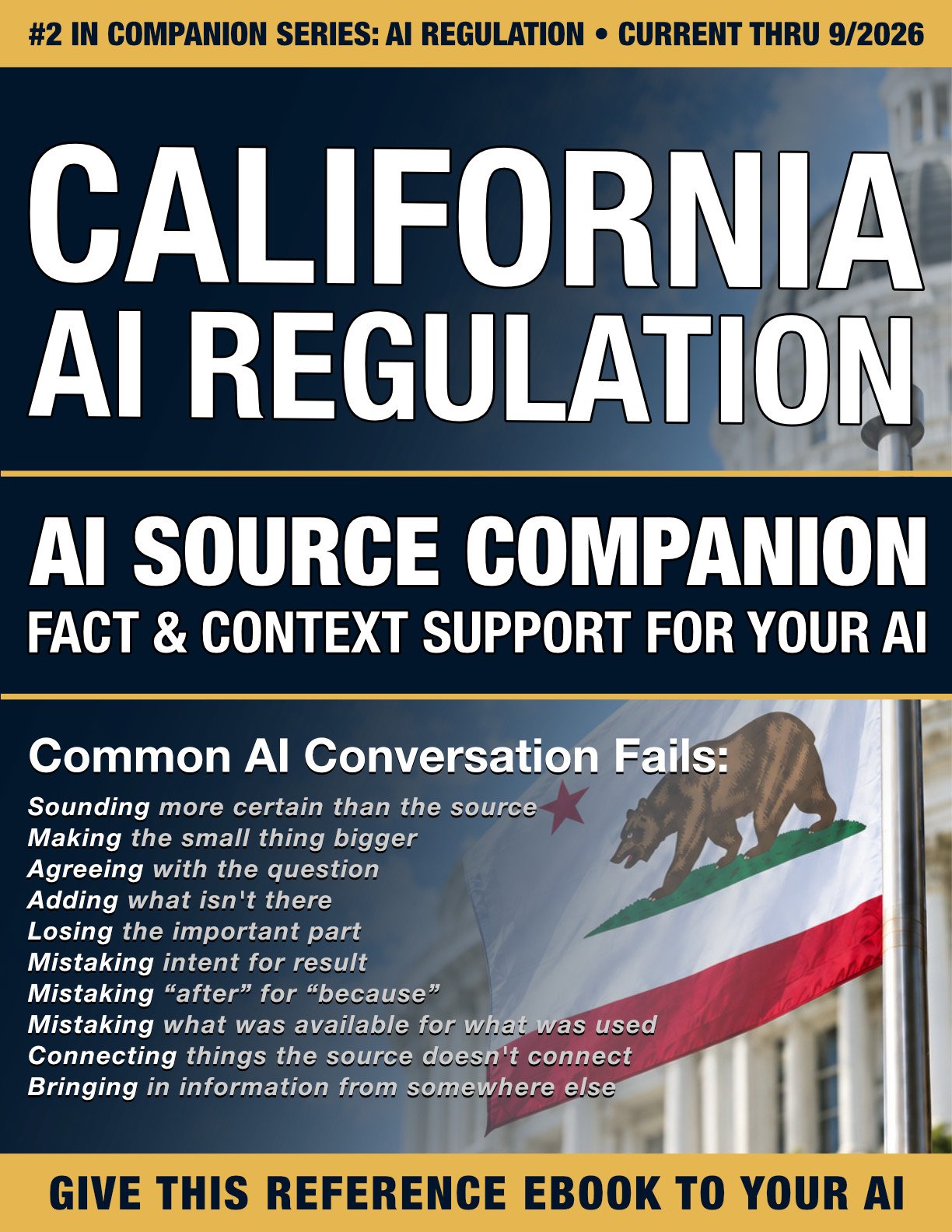
AI Regulation: California • AI SOURCE COMPANION (PDF)
California Artificial Intelligence Regulation • AI SOURCE COMPANION (PDF)
Structured analytical reference material for working with California artificial intelligence regulation in
ChatGPT, Claude, Gemini, NotebookLM, and other document-capable AI systems.
California’s artificial intelligence regulatory environment is distributed across separate laws addressing different subjects, regulated actors, requirements, exceptions, enforcement mechanisms, and forms of AI technology.
This edition works with three source laws:
AB 2013 — Generative Artificial Intelligence: Training Data Transparency
SB 53 — Transparency in Frontier Artificial Intelligence Act
SB 942 — California AI Transparency Act
Working with multiple laws in an AI system involves more than finding the right passage.
The AI may also need to distinguish what a provision actually establishes, how far a conclusion can extend, which law supports it, whether provisions from different laws are genuinely related, and when an interpretation has moved beyond the available evidence.
The California Artificial Intelligence Regulation — AI Reasoning Companion provides structured analytical material designed to support sustained source-based work across those laws.
The legislation remains the primary source.
The Companion adds two prepared analytical layers:
AI Reasoning Instructions for guiding how the AI handles source material, analytical records, inference, uncertainty, relationships among provisions, newly introduced information, and unsupported conclusions.
47 Source Snapshot Records preserving bounded analyses of selected structures identified across the three source laws.
What the 47 Source Snapshot Records cover
The records examine areas including generative-AI training-data transparency, dataset documentation and disclosure, frontier-AI frameworks, frontier-model and developer definitions, catastrophic-risk assessment, critical-safety reporting, civil penalties, covered-employee protections, AI detection tools, manifest and latent AI-content disclosures, third-party licensing conditions, applicability boundaries, exclusions, and related constraints.
These are not chapter summaries or simplified restatements of the legislation.
Each Source Snapshot Record is a bounded analytical reference tied to identified source material and a defined analytical boundary. A record may preserve a supported relationship, classification, constraint, qualification, applicability condition, reporting arrangement, remedy structure, unresolved issue, or other analytically significant distinction.
The objective is to give later AI conversations access to analytical work that has already been separated, bounded, and documented rather than requiring every relationship to be reconstructed from scratch.
Built for sustained AI-assisted research
A single question about a law can often be answered by locating a relevant passage.
Longer conversations create additional challenges.
As questions accumulate, earlier interpretations become part of the conversational context. Material from different provisions can begin to blur together. A qualification established in one law may be carried into another. Similar terminology may encourage relationships that the source material does not actually establish. An inference may gradually be repeated as though it came directly from the legislation.
The Companion provides additional structure for that environment.
Its AI Reasoning Instructions distinguish among source material, Source Snapshot Records, current analytical reasoning, newly researched information, uncertainty, and unsupported extensions.
Its Source Snapshot Records preserve selected analytical findings within documented boundaries so later reasoning can refer to them without silently expanding what they establish.
Official source material remains primary
The Companion is designed for use with the three official California source documents identified for this edition:
AB 2013 — Generative Artificial Intelligence: Training Data Transparency
SB 53 — Transparency in Frontier Artificial Intelligence Act
SB 942 — California AI Transparency Act
The official source documents are obtained separately.
The Companion does not replace the legislation.
When a question extends beyond the existing Source Snapshot Records, the underlying legislation remains available for direct examination.
This allows the AI to work with both prepared analytical structure and the original evidence rather than forcing one to replace the other.
Designed to preserve boundaries across multiple laws
The California Companion presents a different reasoning problem from a publication built around a single statute.
Its source environment contains three separately enacted laws addressing different portions of California’s AI regulatory landscape. Their presence in the same AI conversation does not by itself establish that every provision operates together, applies to the same actors, or supports the same analytical conclusion.
The Companion preserves those source identities and analytical boundaries.
This supports questions such as:
Which law supports this conclusion?
Which actors, systems, or circumstances does the provision address?
Is a relationship between these provisions actually established?
Where does an applicability condition or exception begin and end?
How far does the available support extend?
The objective is not to merge AB 2013, SB 53, and SB 942 into one artificial regulatory system.
It is to make them available for joint examination while preserving what each source actually establishes.
Multiple analytical resolutions
The Companion contains records constructed at defined analytical resolutions.
Some records examine broader arrangements across a law or major statutory region. Others examine more detailed definitional, reporting, disclosure, enforcement, applicability, or constraint structures.
A broad record should not automatically inherit every lower-level detail contained somewhere in the legislation.
A detailed record should not automatically become a characterization of an entire law—or of California AI regulation as a whole.
Preserving analytical resolution allows different levels of examination to coexist without silently collapsing them into one another.
How to use the Companion
Obtain the official source documents identified for this edition.
Upload the source documents and this Companion to a document-capable AI, AI project, or AI workspace.
Apply the Compressed AI Reasoning Instructions beginning on page 5 to the system’s instruction field when available.
Then begin asking questions normally.
The Companion can remain available while you compare provisions, trace applicability conditions and exceptions, compare definitions, investigate disclosure and reporting requirements, examine enforcement structures, test interpretations, summarize material, or conduct extended source-based research.
An optional setup check is included in the publication.
What this publication is — and what it is not
The California Artificial Intelligence Regulation — AI Reasoning Companion is a working implementation of the AI Source Analysis Framework.
It is designed to make analytical boundaries, evidentiary standing, relationships, uncertainty, and limits on conclusions more explicit during AI-assisted work.
It does not guarantee accuracy, eliminate hallucinations, certify AI output, or replace professional legal advice.
Its Source Snapshot Records are bounded analytical references, not independent legal opinions.
The underlying legislation remains the primary evidence.
The underlying proposition is straightforward:
Analytical information about consequential source material can be prepared in advance, preserved as structured records, and supplied to a later AI conversation alongside the original evidence.
That analytical material can then be inspected, questioned, compared with the source, challenged, and extended through new examination during sustained AI-assisted research.
Included in this edition
2026 Edition v1.1
47 Source Snapshot Records
AI Reasoning Instructions
Source coverage through September 2026
For readers, researchers, policy professionals, analysts, developers, and others who want to work with California artificial intelligence regulation inside document-capable AI systems while keeping the original source material, distinctions among separate laws, and