
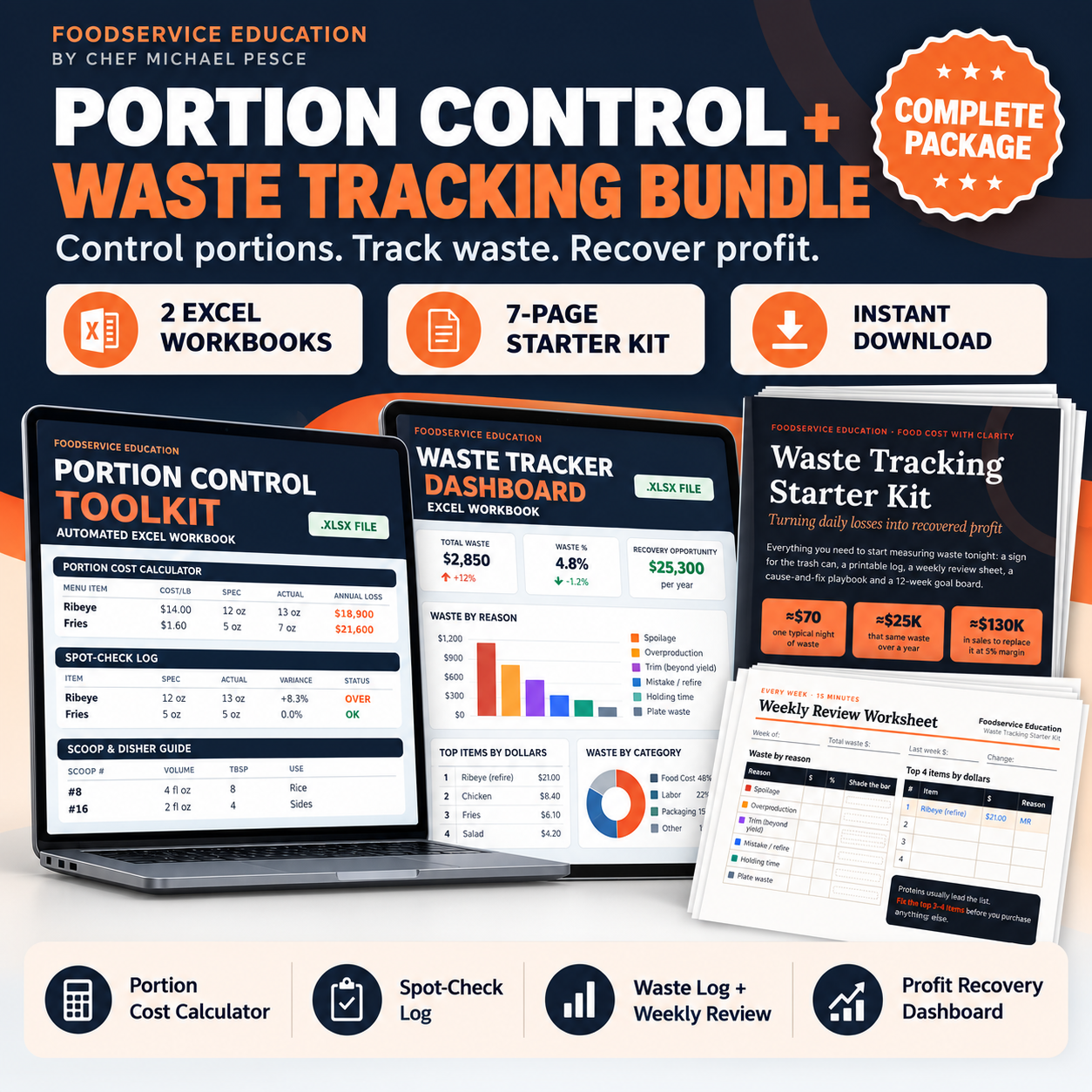
Kitchen Waste Tracking & Profit Recovery System | Excel Dashboard + 7-Page Management Toolkit
STOP THROWING AWAY YOUR RESTAURANT'S PROFITS.
Every pound of spoiled food, every overproduced batch, and every unnecessary refire costs your operation money. The question is: Do you know exactly how much?
Most restaurant operators track sales, labor, and inventory. Yet thousands of dollars can disappear through everyday kitchen waste that never gets documented.
The Kitchen Waste Tracking & Profit Recovery System, developed by Chef Michael Pesce of Foodservice Education, gives you the tools to identify financial losses, calculate their impact, hold your kitchen accountable, and implement meaningful changes.
This complete digital package combines an automated Excel Waste Tracking Dashboard with a 7-page printable Waste Tracking Starter Kit.
Together, these resources turn everyday food waste into measurable financial information, helping operators make smarter purchasing, preparation, production, and management decisions.
WHAT YOU RECEIVE WITH YOUR PURCHASE
FILE #1: AUTOMATED EXCEL WASTE TRACKER & PROFIT RECOVERY DASHBOARD
Format: Microsoft Excel (.xlsx)
This interactive workbook contains six worksheets designed to collect, calculate, organize, and analyze food waste across your operation.
1. PROFIT RECOVERY DASHBOARD
Your restaurant's waste performance, organized into one centralized financial overview.
Monitor key measurements, including:
- Total recorded food waste in dollars
- Average daily waste costs
- Projected annual waste expenses
- Potential savings from reducing waste
- Sales required to replace lost profits
- Waste performance and financial recovery opportunities
Instead of guessing how much waste affects profitability, see the financial impact using your operation's actual numbers.
2. SETTINGS & ITEM PRICE LIST
Customize the workbook to reflect your restaurant's operating conditions.
Enter:
- Restaurant name
- Annual operating days
- Profit margin
- Waste reduction goal
- Ingredient and product names
- Purchasing units and unit costs
These settings provide the foundation for the workbook's automated calculations.
3. DAILY WASTE LOG
Record wasted food as it occurs throughout the day.
Track:
- Date and shift
- Kitchen station
- Product or ingredient
- Quantity wasted
- Measurement unit
- Unit cost and total waste cost
- Reason for disposal
- Employee responsible for recording
- Additional notes
Waste costs calculate automatically using the product pricing information entered in your workbook.
Track waste caused by spoilage, overproduction, excessive trimming, cooking mistakes, refires, excessive holding times, and plate waste.
4. WEEKLY WASTE REVIEW
Turn daily observations into measurable improvements.
The weekly review helps managers:
- Examine total weekly waste expenses
- Identify losses by waste category
- Determine which ingredients are creating the biggest financial problems
- Review recurring operational issues
- Prioritize corrective actions
Use this worksheet during weekly management meetings to discuss where money is being lost and what changes need to happen.
5. 12-WEEK WASTE TREND TRACKER
Monitor how your operation performs over time.
- Record weekly waste totals
- Establish measurable reduction goals
- Compare waste performance against targets
- Identify whether corrective actions are working
- Visualize trends and evaluate improvement
A valuable resource for demonstrating progress to restaurant owners, executive chefs, and food and beverage directors.
6. START HERE — WORKBOOK INSTRUCTIONS
A dedicated instructional worksheet explains how to set up your operation, enter product prices, record waste, and begin using the dashboard.
No advanced Excel knowledge is required to begin using the provided worksheets.
FILE #2: 7-PAGE WASTE TRACKING STARTER KIT
Format: Printable PDF
The companion resource provides practical documents, management worksheets, and training tools that can be implemented directly into your kitchen.
PAGE 1 — Waste Tracking Starter Kit Overview
An introduction explaining the importance of documenting kitchen waste and the financial impact of daily food losses.
PAGE 2 — The Trash-Can Rule
A printable kitchen notice designed to establish one essential operating standard:
Nothing goes into the trash without being recorded first.
Post it near disposal stations to reinforce accurate waste documentation and employee accountability.
PAGE 3 — Daily Waste Log
A printable tracking form for documenting food waste by date, shift, item, quantity, reason, employee, and cost.
Ideal for kitchens that prefer collecting information on paper before transferring it into Excel.
PAGE 4 — Weekly Review Worksheet
A structured management review that helps identify your largest waste categories and prioritize corrective action.
Includes:
- Weekly financial totals
- Waste categories and percentages
- Four highest-cost wasted products
- Root-cause identification
- Corrective action planning
- Assigned responsibilities and deadlines
- Weekly goal evaluations
PAGE 5 — Cause & Fix Playbook
Identify common reasons for food waste and practical solutions for correcting them.
Covers six important categories:
- Spoilage: Improve purchasing, inventory rotation, and product storage.
- Overproduction: Adjust preparation quantities using actual sales patterns.
- Excessive Trim: Improve knife skills, yield standards, and product utilization.
- Mistakes & Refires: Identify production errors and improve kitchen communication.
- Plate Waste: Recognize oversized portions and customer preferences.
- Holding Time: Improve batch production and prevent unnecessary disposal.
PAGE 6 — Recover the Value
A practical guide to recovering value from usable surplus food while maintaining appropriate food safety standards.
Explore:
- Waste prevention
- Cross-utilization of usable ingredients
- Product repurposing
- Safe surplus-food donation considerations
- Composting and recycling opportunities
PAGE 7 — Team Huddle & 12-Week Goal Board
Build accountability throughout your kitchen with a structured employee engagement and performance improvement system.
Includes:
- A five-minute weekly waste meeting framework
- Team communication guidelines
- A 12-week improvement tracking board
- Waste reduction goal setting
- Employee recognition and accountability strategies
THE FINANCIAL IMPACT: WHY THIS SYSTEM MATTERS
Consider a restaurant that wastes approximately $70 in food every day.
That might not seem significant during a busy shift.
But over 360 operating days, that waste represents approximately:
$25,200 IN ANNUAL FOOD LOSSES.
At a 5% profit margin, the restaurant would need approximately:
$504,000 IN ADDITIONAL SALES to generate an equivalent amount of profit.
Now imagine reducing that waste by just 25%.
That represents approximately $6,300 in potential annual savings, based on this example.
These figures illustrate the impact of waste reduction. Actual results will depend on your restaurant's sales, ingredient costs, operating practices, and ability to implement improvements.
Small daily losses become expensive annual problems. This system helps you find them.
WHO IS THIS PACKAGE DESIGNED FOR?
This resource is ideal for:
- Restaurant owners and independent operators
- Executive chefs and sous chefs
- Food and beverage directors
- Kitchen managers and supervisors
- Multi-unit restaurant management teams
- Hotel and resort foodservice operations
- Catering companies
- Culinary instructors and CTE programs
- Hospitality management students
- Foodservice professionals responsible for managing profitability
Whether you operate a small café or oversee a large commercial kitchen, understanding where your food dollars are going is essential to financial performance.
HOW TO IMPLEMENT THIS SYSTEM
STEP 1 — Establish your costs.
Enter your restaurant's operating information and current ingredient prices into the Excel workbook.
STEP 2 — Begin documenting waste.
Print the Daily Waste Log and post the Trash-Can Rule in your kitchen. Train employees to record waste before disposal.
STEP 3 — Transfer information into Excel.
Enter daily waste records into the digital tracker and allow the workbook to calculate the associated costs.
STEP 4 — Review your financial dashboard.
Analyze which ingredients, waste categories, and operating practices are contributing to financial losses.
STEP 5 — Correct the underlying problems.
Use the Cause & Fix Playbook to implement measurable improvements to purchasing, preparation, production, and employee training.
STEP 6 — Track your progress over 12 weeks.
Evaluate weekly performance, monitor trends, and make adjustments using actual financial information.
PRODUCT SPECIFICATIONS
Product: Kitchen Waste Tracking & Profit Recovery System
Digital Files Included: 2
File 1: Automated Excel Waste Tracker & Profit Recovery Dashboard (.xlsx)
- 6 Excel worksheets
- Automated waste calculations
- Editable product pricing and restaurant settings
- Financial performance dashboard
- Daily waste tracking
- Weekly analysis
- 12-week trend monitoring
File 2: Waste Tracking Starter Kit (.pdf)
- 7 professionally formatted pages
- Printable documentation tools
- Employee training resources
- Management review worksheets
- Waste reduction playbook
- 12-week goal board
Delivery: Instant digital download
Created By: Chef Michael Pesce | Foodservice Education
Please Note: This is a digital product. No physical items are shipped. Microsoft Excel or compatible spreadsheet software is required to use the dashboard. Some features may behave differently in other spreadsheet applications.
YOU CAN'T CONTROL WHAT YOU DON'T MEASURE.
Profitable foodservice operations don't simply accept waste as the cost of doing business.
They document it. They measure it. They identify patterns. They train their teams. And they make decisions based on actual financial information.
The Kitchen Waste Tracking & Profit Recovery System brings these principles together into one practical management package.
Stop letting preventable waste drain your bottom line. Download the complete system today and start turning daily kitchen losses into opportunities for recovered profit.
Developed by Chef Michael Pesce — Foodservice Education. Educating Tomorrow's Generation of Foodservice Professionals.