
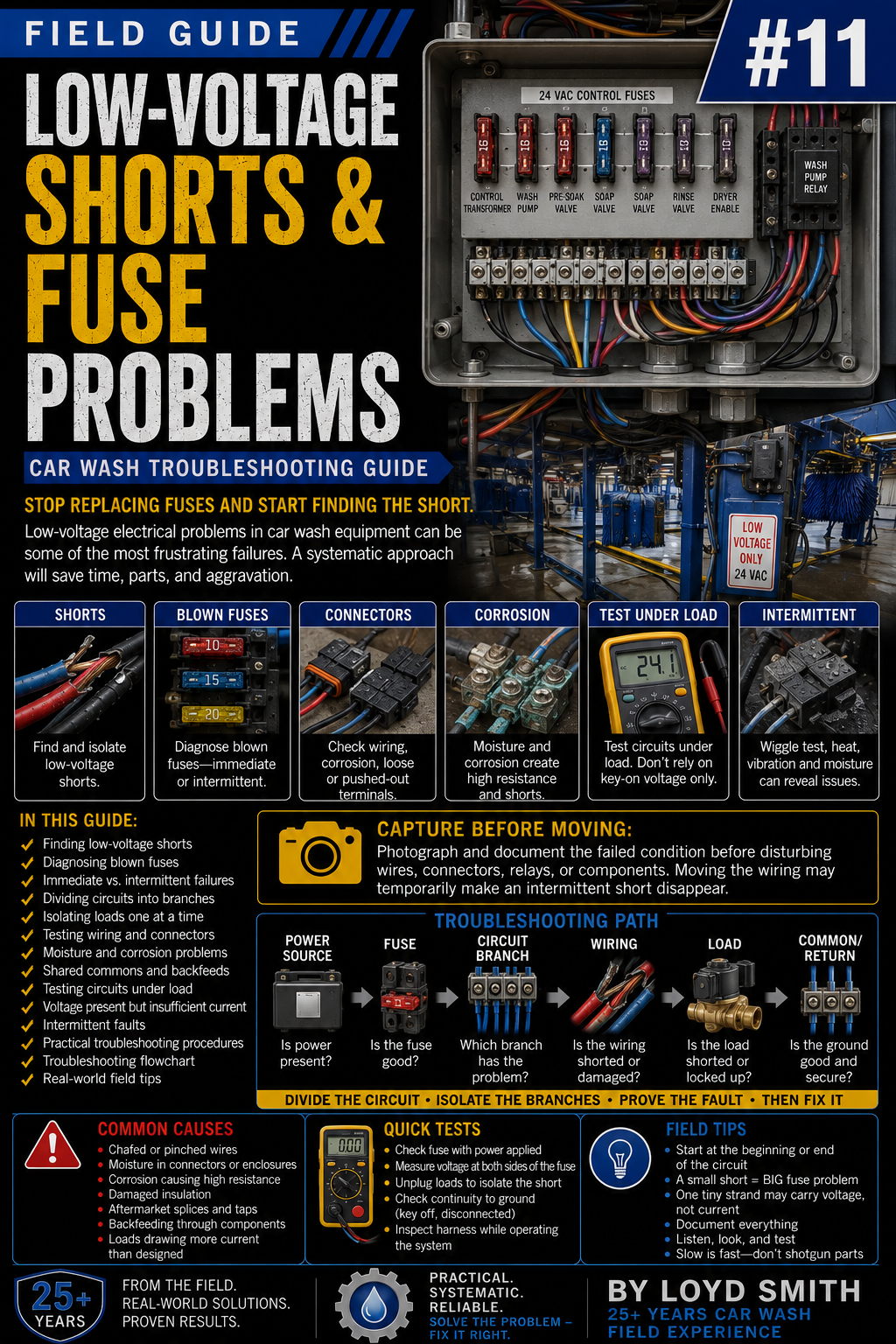
Car Wash Troubleshooting Guide #11 – Low-Voltage Shorts & Fuse Problems
Stop replacing fuses and start finding the short.
Low-voltage electrical problems can be some of the most frustrating failures in car wash equipment. A fuse may blow immediately, fail only when a certain function operates, or work perfectly while you are testing the system.
This practical field guide shows you how to systematically isolate shorts, overloads, wiring faults, and intermittent electrical problems instead of guessing.
Inside this guide:
• Finding low-voltage shorts
• Diagnosing blown fuses
• Immediate vs. intermittent fuse failures
• Dividing circuits into branches
• Isolating loads one at a time
• Testing wiring and connectors
• Damaged and chafed wiring
• Moisture and corrosion problems
• Shared commons and backfeeds
• Testing circuits under load
• Voltage present but insufficient current
• Intermittent faults
• Practical troubleshooting procedures
• Troubleshooting flowchart
• Real-world field tips
A tiny strand of wire may carry enough voltage for your meter to read correctly but not enough current to operate the load.
CAPTURE BEFORE MOVING:
Photograph and document the failed condition before disturbing wires, connectors, relays, or components. Moving the wiring may temporarily make an intermittent short disappear.
POWER SOURCE → FUSE → CIRCUIT BRANCH → WIRING → LOAD → COMMON/RETURN
Divide the circuit, isolate the branches, and prove where the fault occurs before replacing parts.
14-page practical field guide by Loyd Smith.