
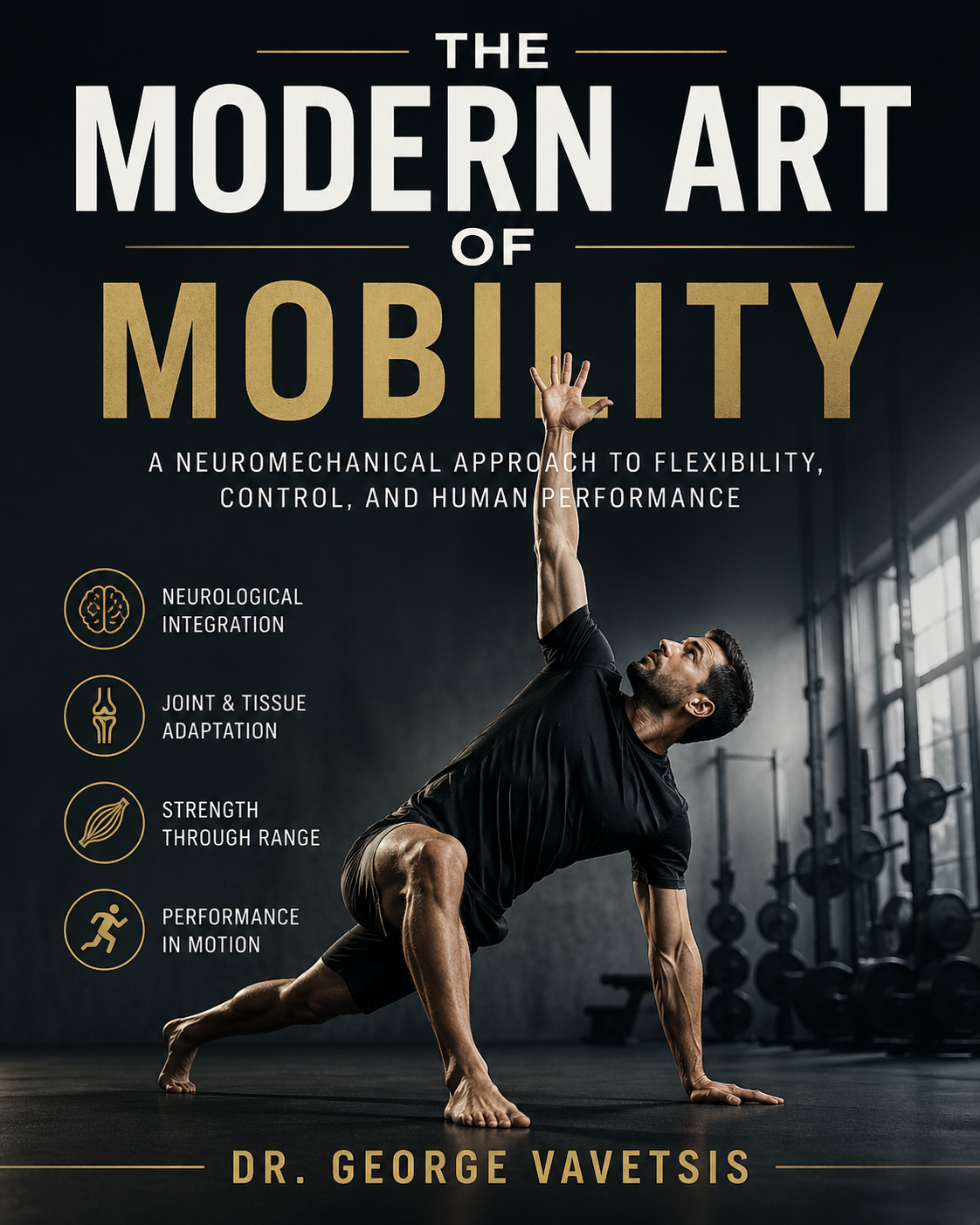
The Modern Art of Mobility
Pages: 1109
Mobility, long reduced to a simplistic notion of “flexibility,” has undergone a necessary conceptual evolution. In contemporary strength and conditioning practice, mobility is no longer interpreted as the passive capacity to achieve joint range of motion, but as a complex, multi-system output—an emergent property arising from the integration of structural integrity, myofascial adaptability, and neural control. This book is built upon that premise: that mobility is not a static trait, but a dynamic capability—one that must be developed, measured, and expressed under the constraints of performance.
At its core, mobility represents the interface between available movement and usable movement. The distinction is critical. Structural range, defined by joint architecture and tissue extensibility, establishes potential. Yet potential without control is biomechanically irrelevant and often clinically hazardous. The true determinant of performance lies in the athlete’s ability to actively own, stabilize, and produce force within that range, particularly under conditions of load, velocity, and environmental unpredictability.
As introduced in the foundational framework of this book, mobility must be understood as the coordinated interaction between the joint–tissue system, the muscular–myofascial network, and the central nervous system . These systems do not operate in isolation; rather, they function as a synchronized neuromechanical continuum, where alterations in one domain inevitably influence the others. Joint congruency affects force transmission, fascial stiffness modulates elastic energy storage, and neural tone governs the accessibility of movement under perceived threat. Consequently, mobility cannot be trained effectively through isolated interventions—it must be addressed through integrated, system-level strategies.
From a performance standpoint, mobility serves as a constraint-modulation mechanism. Every athletic task is defined by constraints—structural, neural, environmental, and task-specific. Mobility does not eliminate these constraints; it refines the athlete’s ability to navigate them. In this sense, mobility becomes a functional currency, enabling the athlete to access optimal joint positions, redistribute forces across the kinetic chain, and adapt to perturbations without compromising efficiency or integrity.
A central theme throughout this work is the concept of active versus passive range of motion. Passive range represents anatomical availability; active range reflects neuromuscular capacity. The discrepancy between the two—the so-called “control gap”—is one of the most critical indicators in both performance diagnostics and injury risk profiling. A system that exhibits high passive capacity but limited active control is inherently unstable. As emphasized in modern neuromechanics, mobility is not defined by how far a joint can move, but by how well force can be produced and regulated across that range .
This distinction leads to a paradigm shift in exercise prescription. Traditional mobility interventions, centered around passive stretching and low-load end-range exposure, are insufficient for developing performance-relevant capacity. Instead, this book advocates for loaded mobility, isometric end-range strength, eccentric control strategies, and tempo-regulated movement exploration. These methods aim to bridge the gap between structural availability and functional usability, ensuring that newly acquired ranges are not only accessible but also mechanically robust and neurologically integrated.
Equally important is the recognition of mobility as a nonlinear adaptive process. Tissue remodeling, neural desensitization, and motor learning do not occur in a linear progression. Adaptations are influenced by load history, training variability, and contextual exposure. Mobility, therefore, must be programmed with the same level of sophistication as strength or power development—incorporating principles of periodization, progressive overload, and specificity. Acute improvements in range are meaningless without chronic consolidation into stable motor patterns.
Another critical dimension explored in this text is the interplay between mobility and stability. These are not opposing qualities but complementary components of a unified system. Effective movement requires a dynamic equilibrium between freedom and constraint. Excessive stiffness limits adaptability; excessive laxity compromises force transfer and joint integrity. High-level performance emerges when the athlete can modulate stiffness and mobility in real time, adjusting to the demands of the task and environment.
Furthermore, mobility must be contextualized within the framework of performance ecology. Movement does not occur in isolation—it is shaped by external variables such as surface conditions, opponent interaction, spatial constraints, and temporal pressure. As such, mobility training must extend beyond controlled environments and incorporate open-skill, reactive, and sport-specific scenarios. Only through this ecological integration can mobility become transferable to real-world performance.
This book is written for the practitioner who demands precision. Strength and conditioning coaches, sports scientists, physiotherapists, and performance specialists will find within these chapters a comprehensive system for assessing, developing, and integrating mobility into high-performance environments. Each concept is translated into applied methodologies, supported by measurable KPIs, structured programming models, and evidence-informed rationale.
Ultimately, The Modern Art of Mobility is not a book about increasing range—it is a book about expanding capability. It challenges conventional paradigms and redefines mobility as a cornerstone of athletic development, bridging the gap between movement quality and performance output. In doing so, it positions mobility not as an accessory to training, but as a central pillar of human performance—where structure, control, and intent converge into efficient, adaptable, and resilient movement systems.