
Cricket Scoring for Beginners (PDF Guide)
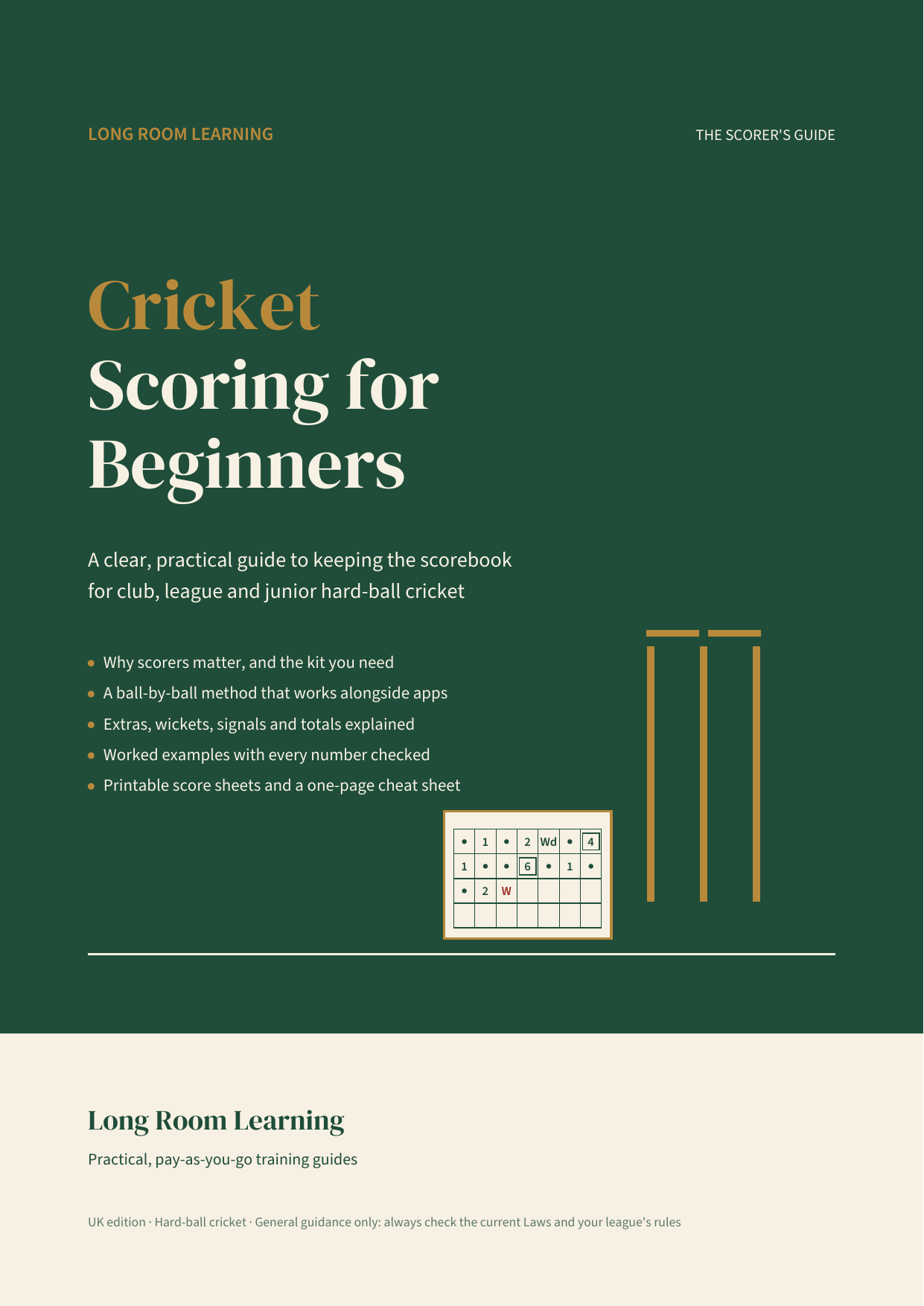
Want to score for your club, but not sure where to start? Learn the method with this clear, practical guide to keeping a cricket scorebook ball by ball, which works alongside app scoring too. It has a simple symbol system, worked examples and printable score sheets.
Cricket Scoring for Beginners is a 40-page printable PDF for adults and teenagers who want to score for a club or league, in adult or junior hard-ball cricket in the UK. It explains why scorers matter, what you need to bring, and how a scorebook is laid out, then teaches a calm five-step routine you repeat after every ball. A clear symbol system covers dots, runs, boundaries, byes, leg byes, wides, no balls, penalty runs and every kind of wicket, with a simple "where do the runs go?" chart and a table showing what is charged to the bowler and what goes to the batter. You will learn how to count the six valid balls in an over, keep the batting, bowling and fall-of-wickets records, change the strike correctly, and check your totals so that the batting page, the bowling page and the running total agree. The guide also shows every umpire's signal as a simple drawing, with what to write for each one, lists the most common beginner mistakes with fixes, and walks through a full eight-over innings, with every number checked. Practice scenarios with worked answers, a results section, notes on limited-overs and junior matches, a glossary and a "what to read next" page finish the guide. Includes two blank printable landscape score sheets (batting and bowling) and a one-page cheat sheet to keep beside you. It teaches the method of scoring on paper, which works alongside app scoring, and includes a short chapter comparing paper with the main scoring apps and online scorecards used in UK club cricket (not a manual for any one app). Written in UK English, checked against the Laws of Cricket (2017 Code, 4th Edition, 2026) and ECB guidance on 28 October 2026.
What's inside:
- Why scorers matter, what the Laws ask of you, and what to bring
- The two-page scorebook layout, explained box by box
- A simple symbol system: dots, runs, boundaries, byes, leg byes, wides, no balls and penalty runs
- Wickets and "how out", with who is credited and how many runs count
- Every umpire's signal as a drawing, plus what to write for each
- The five-step routine for every ball, valid-ball counting and strike rotation
- Batting, bowling and fall-of-wickets records, maidens and bowling figures
- Checking your totals: the balance sum and a "what went wrong?" table
- Common mistakes and how to fix them
- A complete worked eight-over innings, in landscape score sheets, with every figure checked
- Closing the innings, stating the result, limited-overs, junior and rain-affected matches
- Practice scenarios with worked answers, including a "spot the mistake" exercise
- Two printable blank score sheets and a one-page cheat sheet
- Paper or app? Why paper scoring still helps, a fair comparison, and the main UK scoring apps and online scorecards (descriptions only, not a manual for any app)
- Glossary, sources and what to read next
What you'll get:
An instant-download A4 PDF (40 pages) that you can read on screen or print for your own scoring or your own club's use. Use it before your first match, keep the cheat sheet beside you for the first few games, and print the score sheets as often as you need.
Digital download (PDF). General information only. Based on the Laws of Cricket (2017 Code, 4th Edition, 2026) and ECB guidance checked on 28 October 2026. The Laws, league rules and competition playing conditions change and differ between competitions, so always check the current Laws and your own league's rules. The scoring symbols are a clear, widely used style, not an official standard. Long Room Learning is independent and is not affiliated with, or endorsed by, the England and Wales Cricket Board, the Marylebone Cricket Club, NV Play, CricHeroes or any club, league or app named. App descriptions come from each provider's own pages on 28 October 2026; apps, devices and prices change, so check the current listing. This guide teaches the method and is not a manual for any app. All names and scorecards in the examples are made up. You may print the score sheets and cheat sheet for your own scoring and your own club's use.