Lord of the Flies Novel Study | 6-Week Literature Unit, Worksheets & Answer Keys | Grades 9–12
Lord of the Flies Novel Study | 6-Week Literature Unit, Worksheets & Answer Keys | Grades 9–12
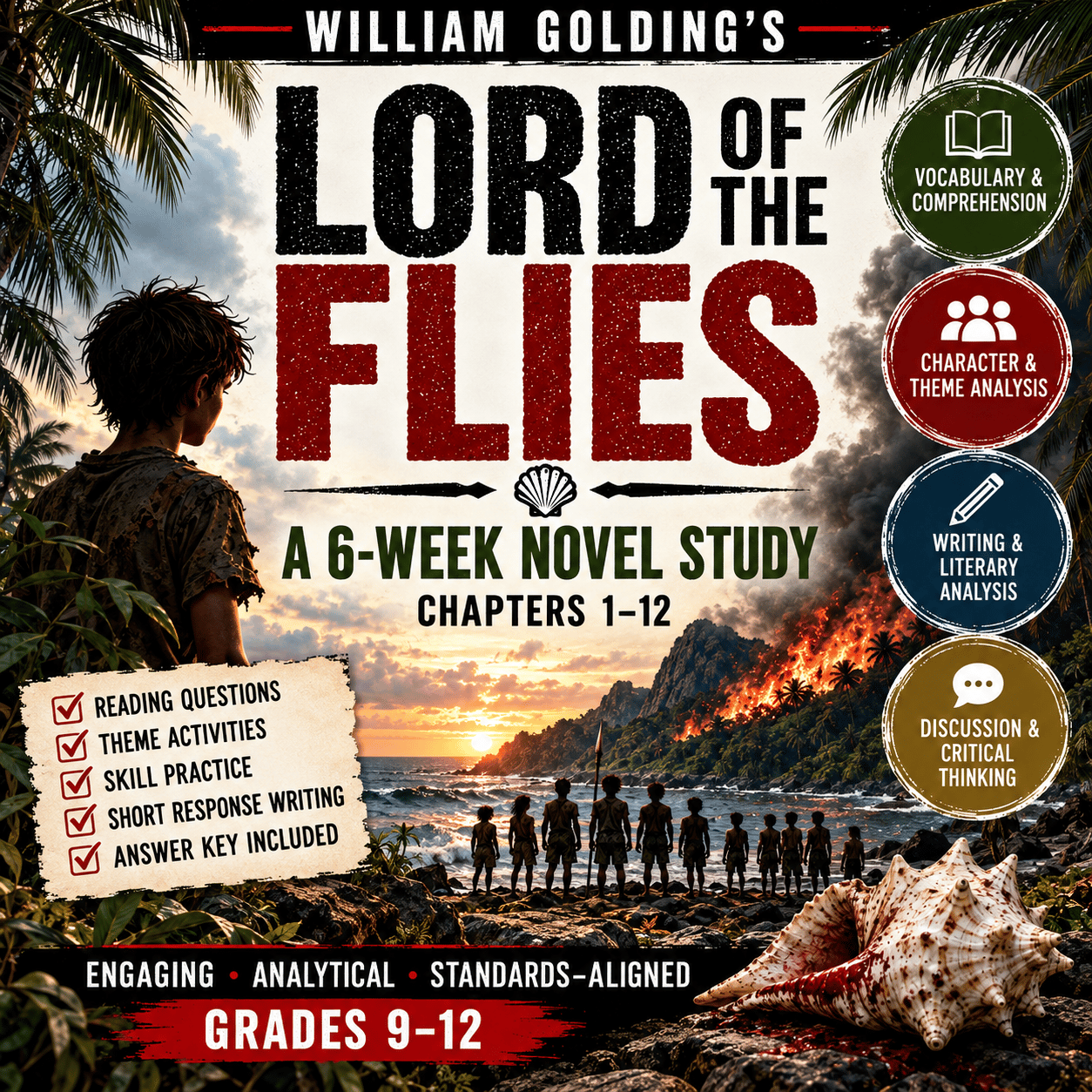
Complete 75-Page Lord of the Flies Novel Study by William Golding
Looking for a comprehensive Lord of the Flies novel study that goes beyond basic reading comprehension questions?
Make teaching William Golding’s Lord of the Flies easier with this 75-page, six-week literature study featuring chapter-by-chapter reading comprehension questions, vocabulary worksheets, literary analysis activities, character studies, theme exploration, critical-thinking exercises, writing prompts, and detailed answer keys.
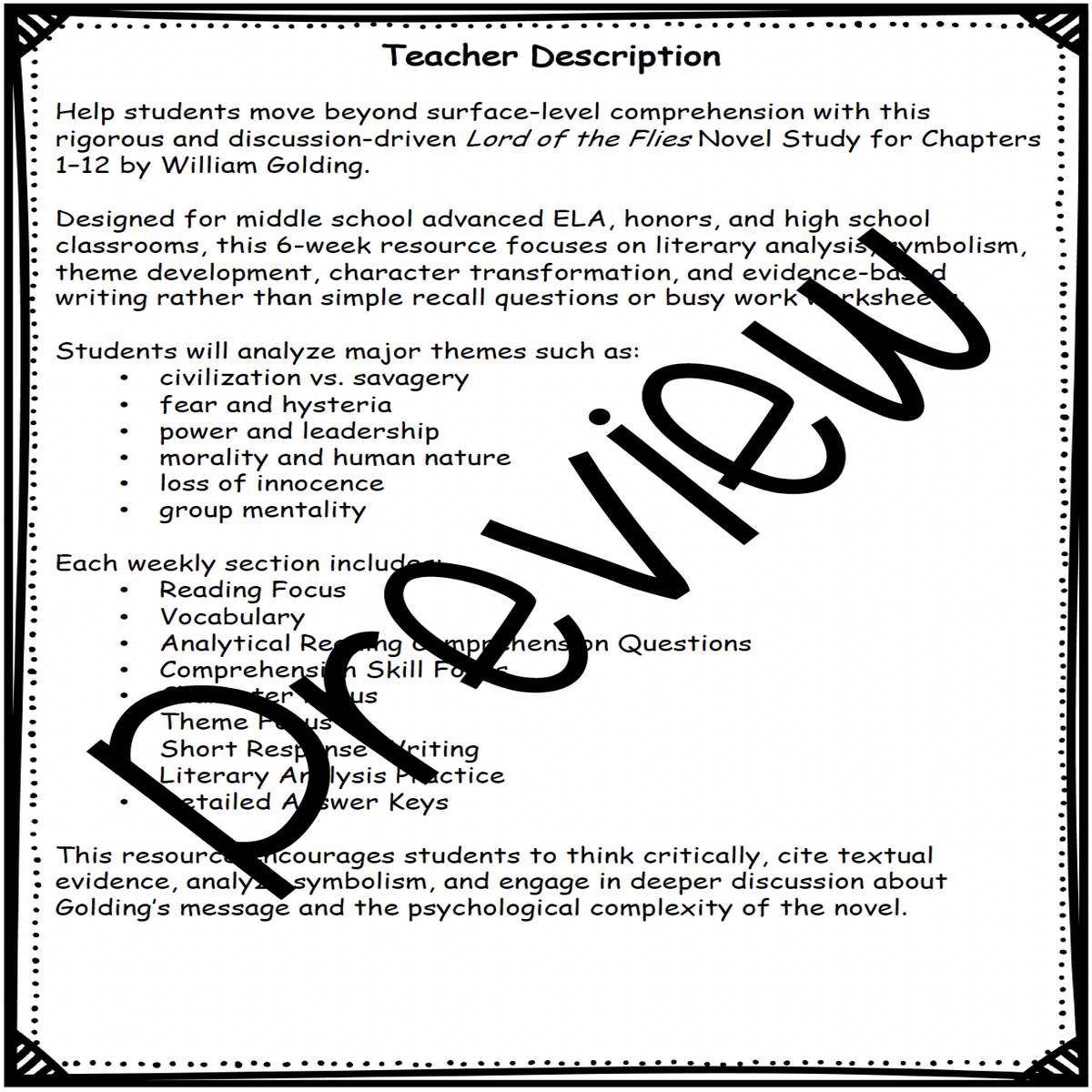
Designed for high school English Language Arts teachers, honors ELA classrooms, advanced middle school students, and homeschool families, this printable novel study covers all 12 chapters of Lord of the Flies while helping students develop stronger reading comprehension, analytical thinking, and evidence-based writing skills.
Rather than relying on simple recall questions, this resource encourages students to examine Golding’s complex portrayal of civilization, savagery, leadership, fear, morality, and human nature.
Whether you’re preparing a complete high school literature unit, searching for meaningful Lord of the Flies worksheets, or planning a structured homeschool English curriculum, this resource provides six weeks of organized, thought-provoking instruction.
WHAT’S INCLUDED IN THIS LORD OF THE FLIES NOVEL STUDY?
This comprehensive 75-page printable literature unit includes six weeks of structured instructional materials covering Chapters 1–12.
Each weekly section includes:
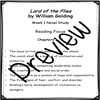
Reading Focus
Chapter-specific reading guides help students identify important events, conflicts, character interactions, and literary elements before beginning their analysis.
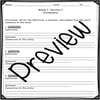
Vocabulary Development
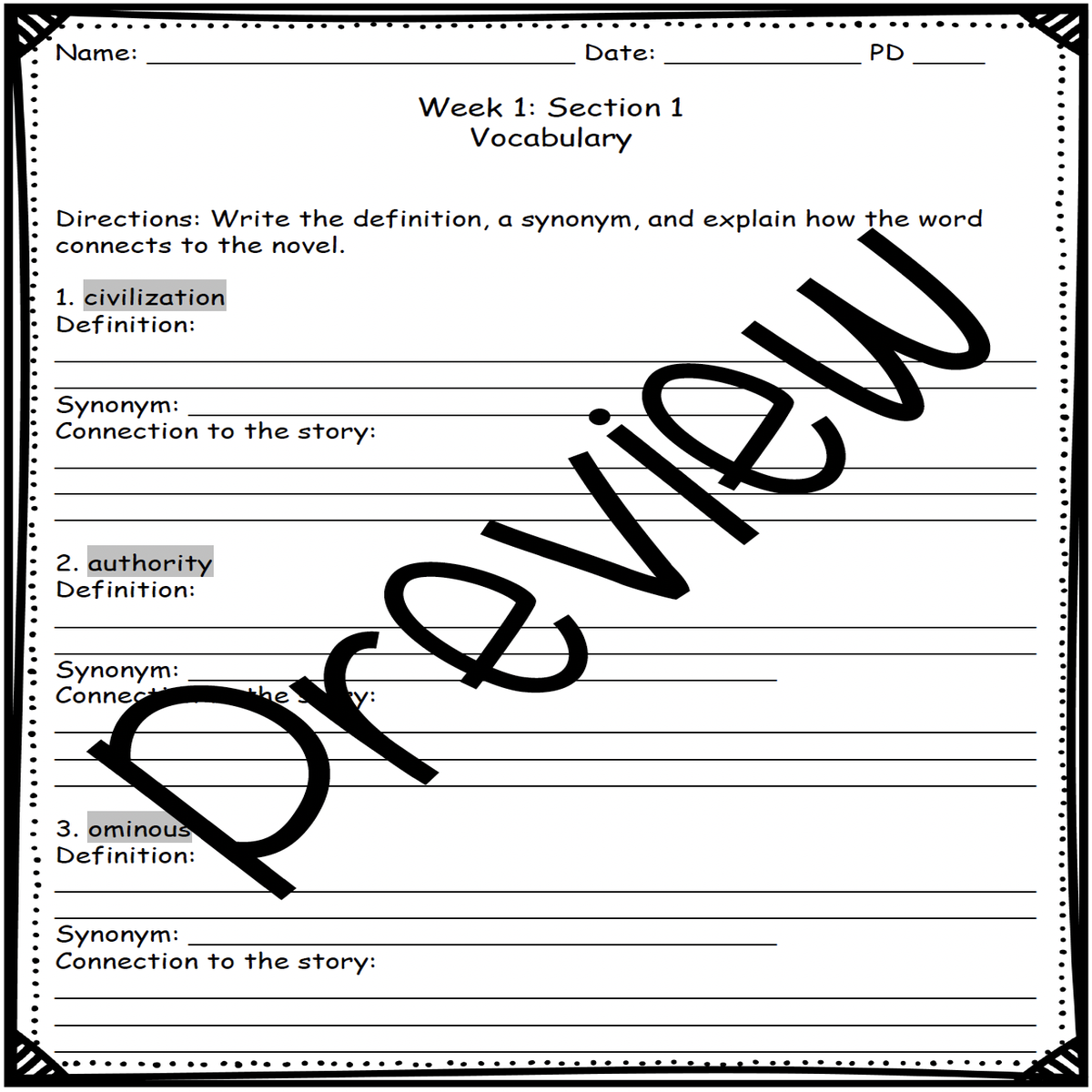
Vocabulary worksheets encourage students to define important terms, identify synonyms, and explain how vocabulary connects to events and themes in the novel.
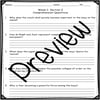
Reading Comprehension Questions
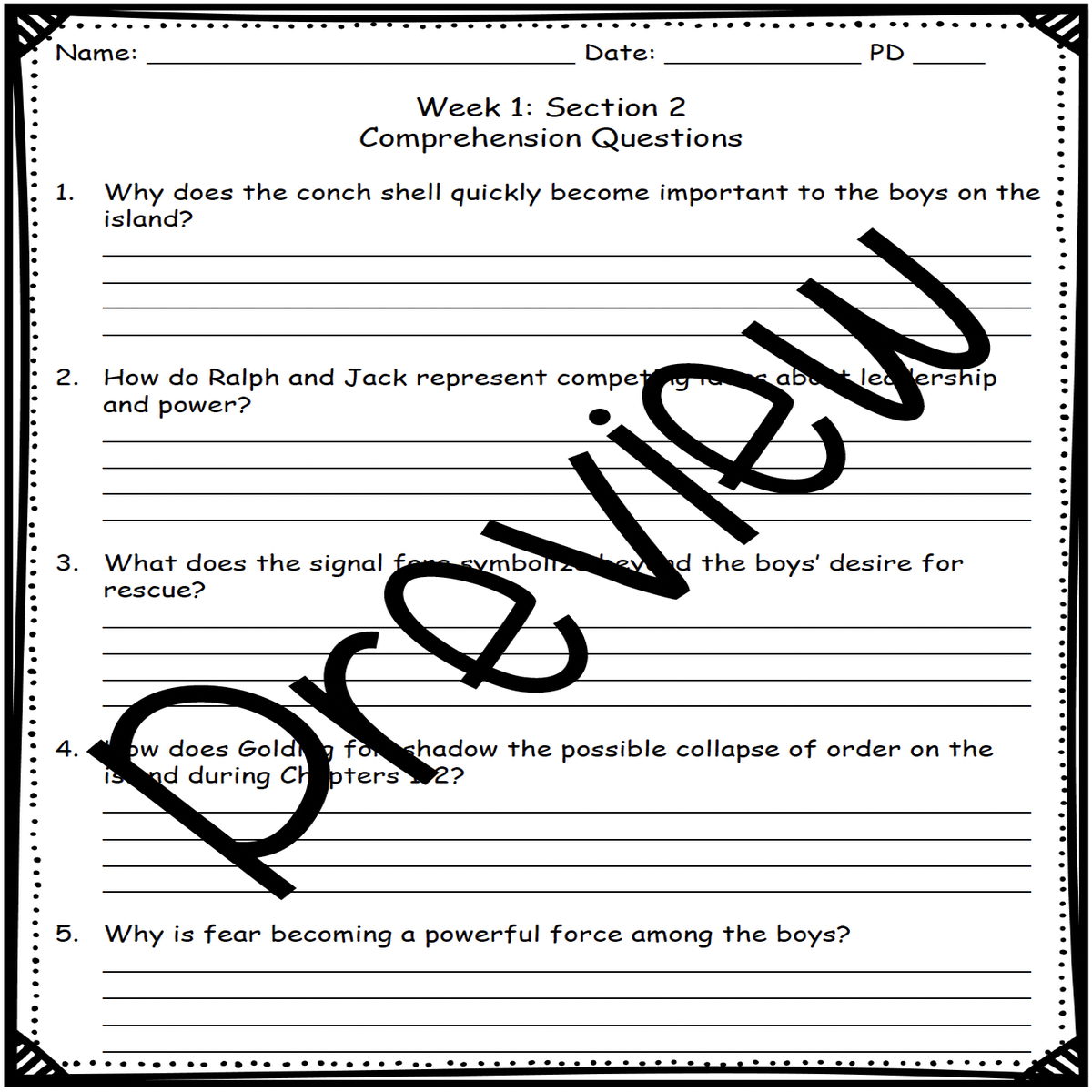
Thought-provoking comprehension questions assess students’ understanding of important events while encouraging interpretation, inference, and deeper analysis.
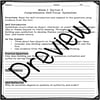
Comprehension Skill Focus
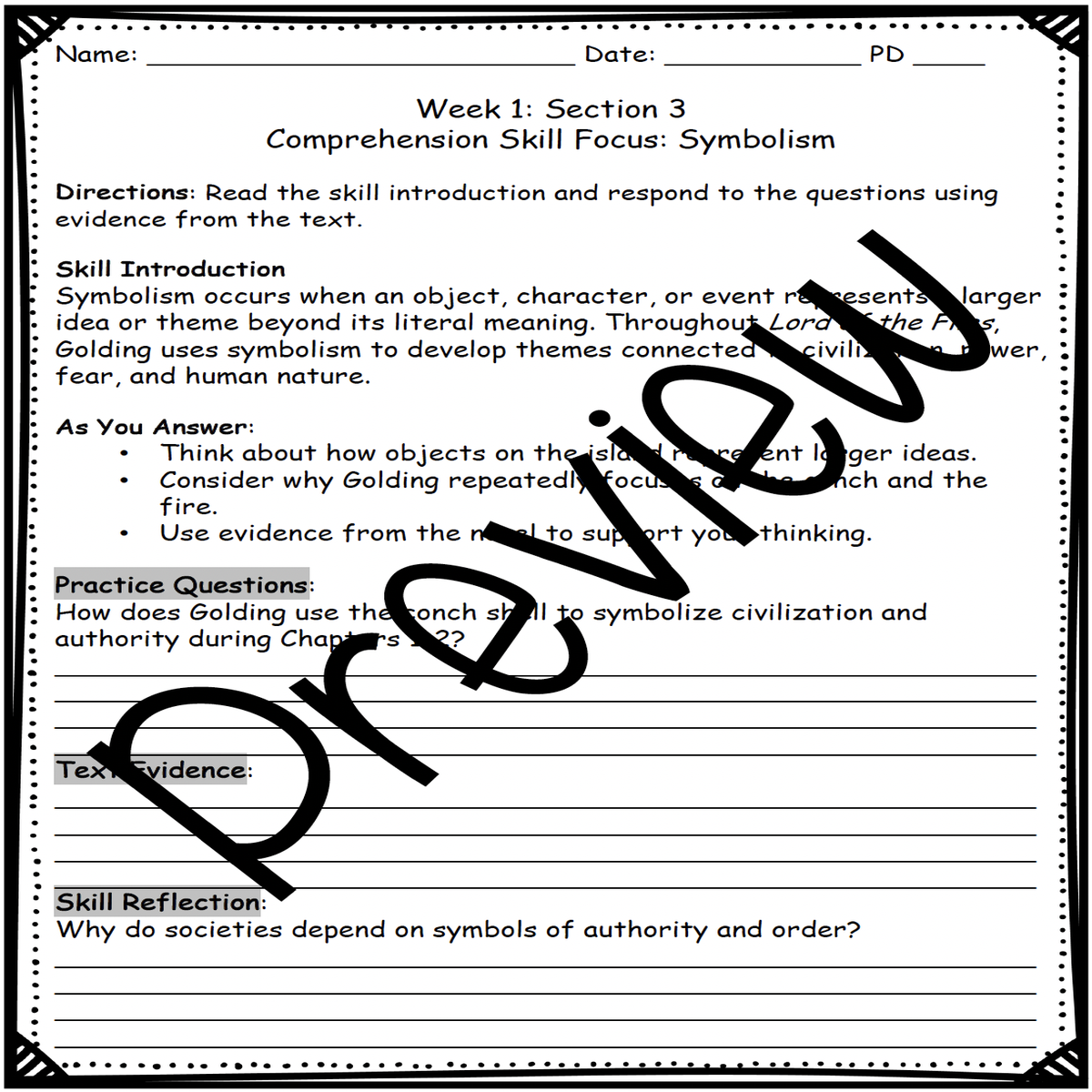
Targeted literary skills activities help students examine symbolism, characterization, theme development, and other essential reading comprehension concepts.
Character Analysis
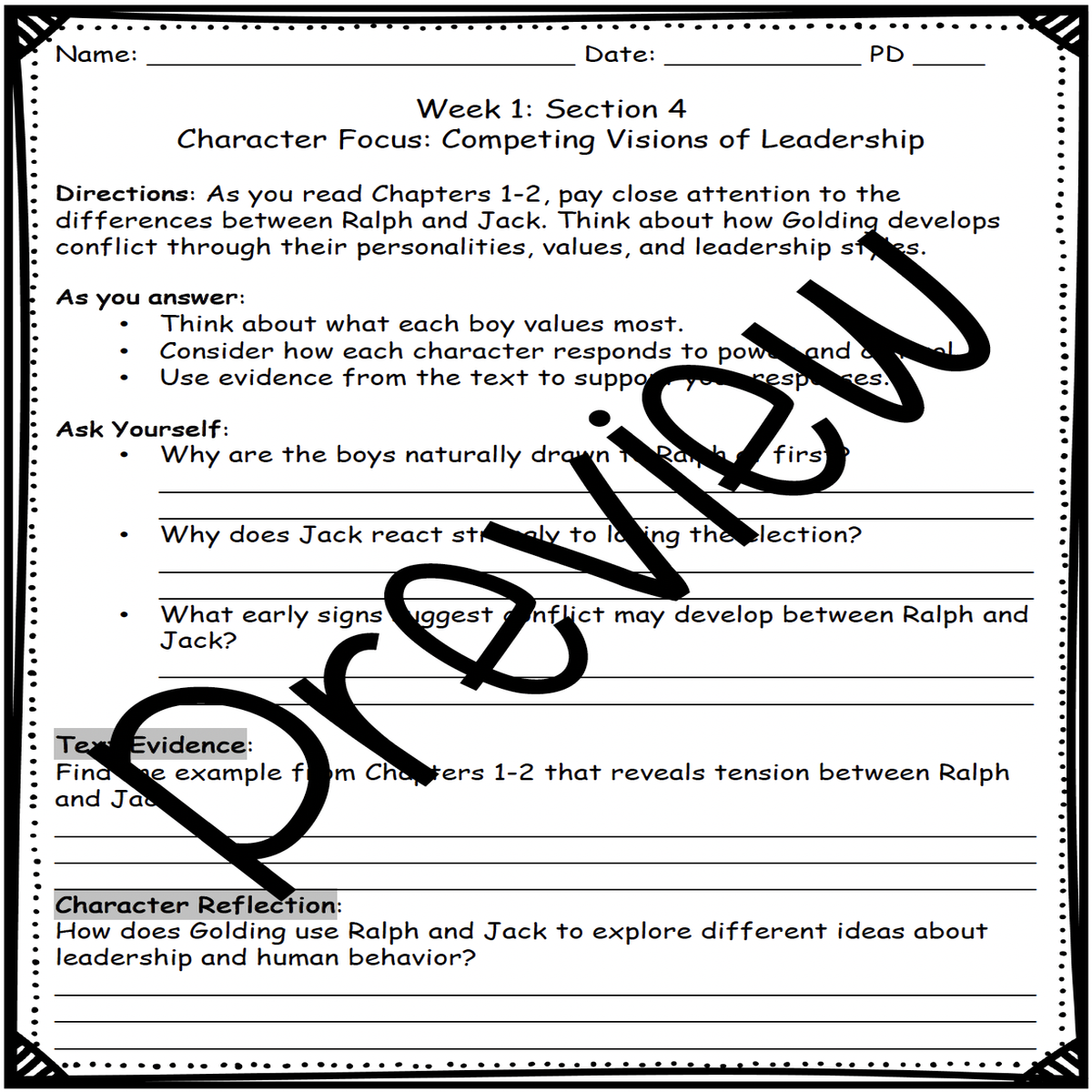
Character-focused worksheets guide students through the motivations, decisions, conflicts, and transformations of Ralph, Jack, Piggy, Simon, and other important characters.
Theme Analysis
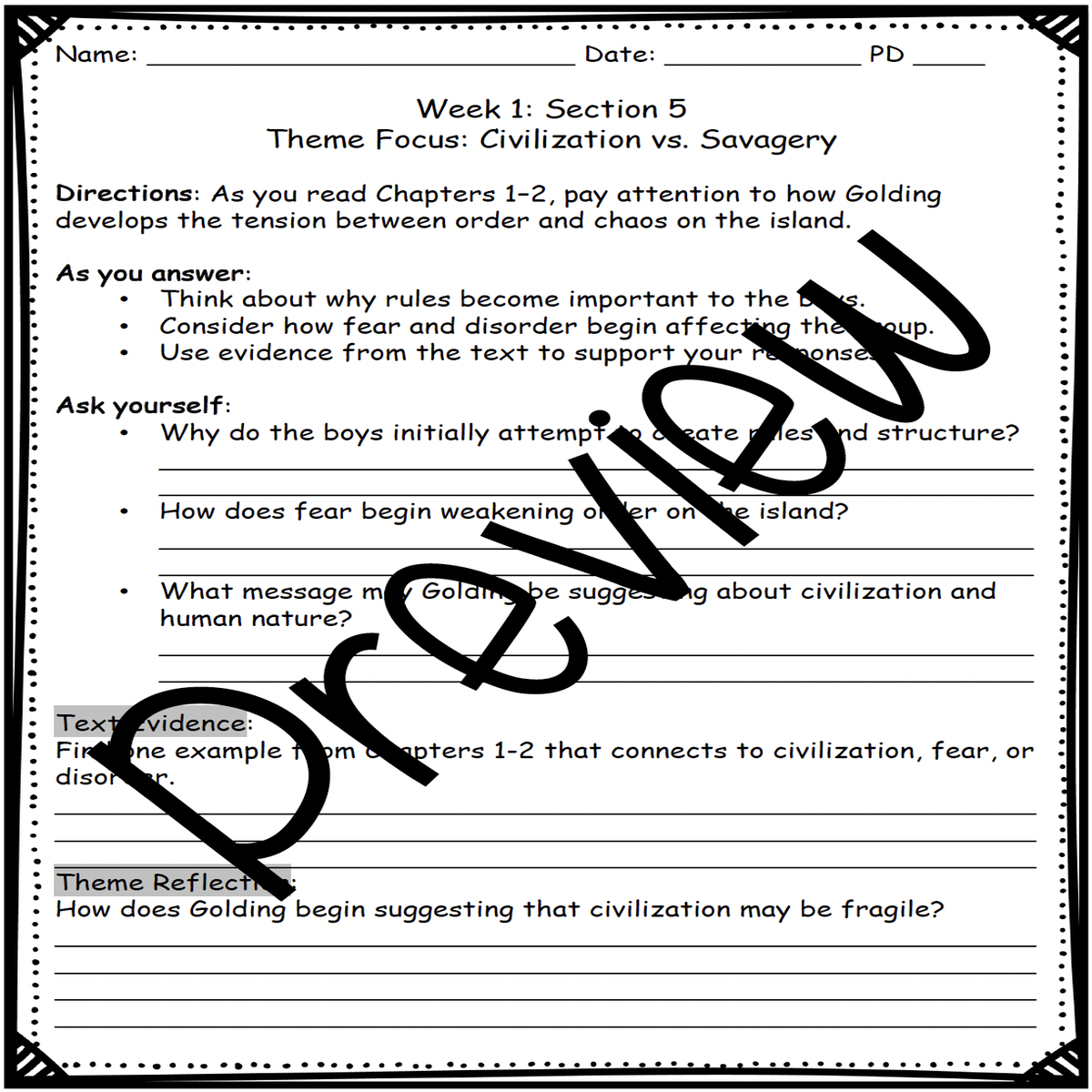
Students explore the novel’s major themes through guided questions, textual evidence, and meaningful reflection activities.
Short-Response Writing
Structured writing prompts encourage students to develop thoughtful responses supported by relevant evidence from the novel.
Literary Analysis Practice
Students practice interpreting Golding’s literary techniques and explaining how specific details contribute to the novel’s meaning.
Detailed Answer Keys
Included answer keys support teachers and homeschool parents as they review student responses, guide discussions, and evaluate understanding.
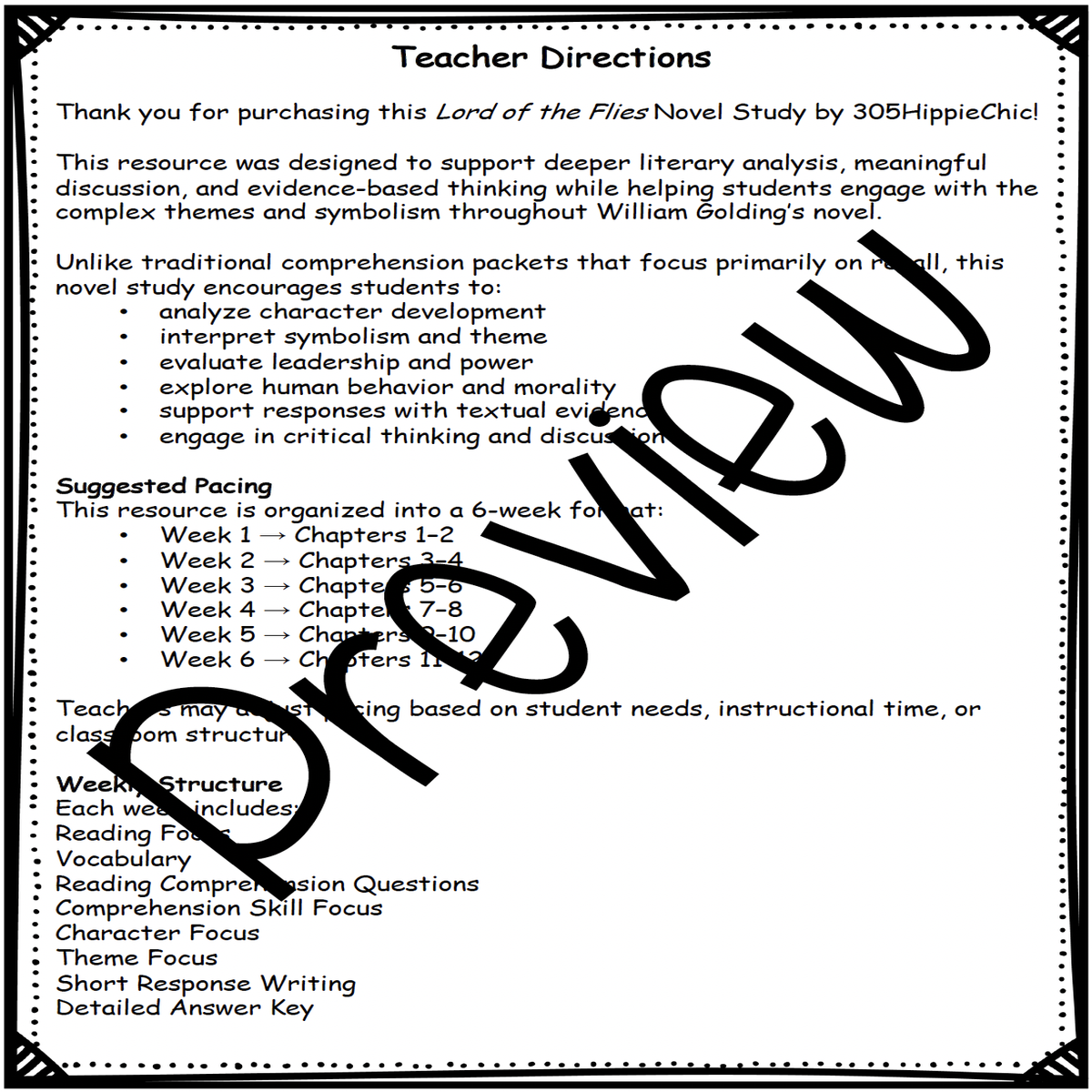
Teacher Directions and Suggested Pacing
Clear instructional directions and a six-week reading schedule help educators implement the resource efficiently.
SIX-WEEK LORD OF THE FLIES CHAPTER-BY-CHAPTER STUDY
This literature unit is organized into six instructional weeks, with each week covering two chapters.
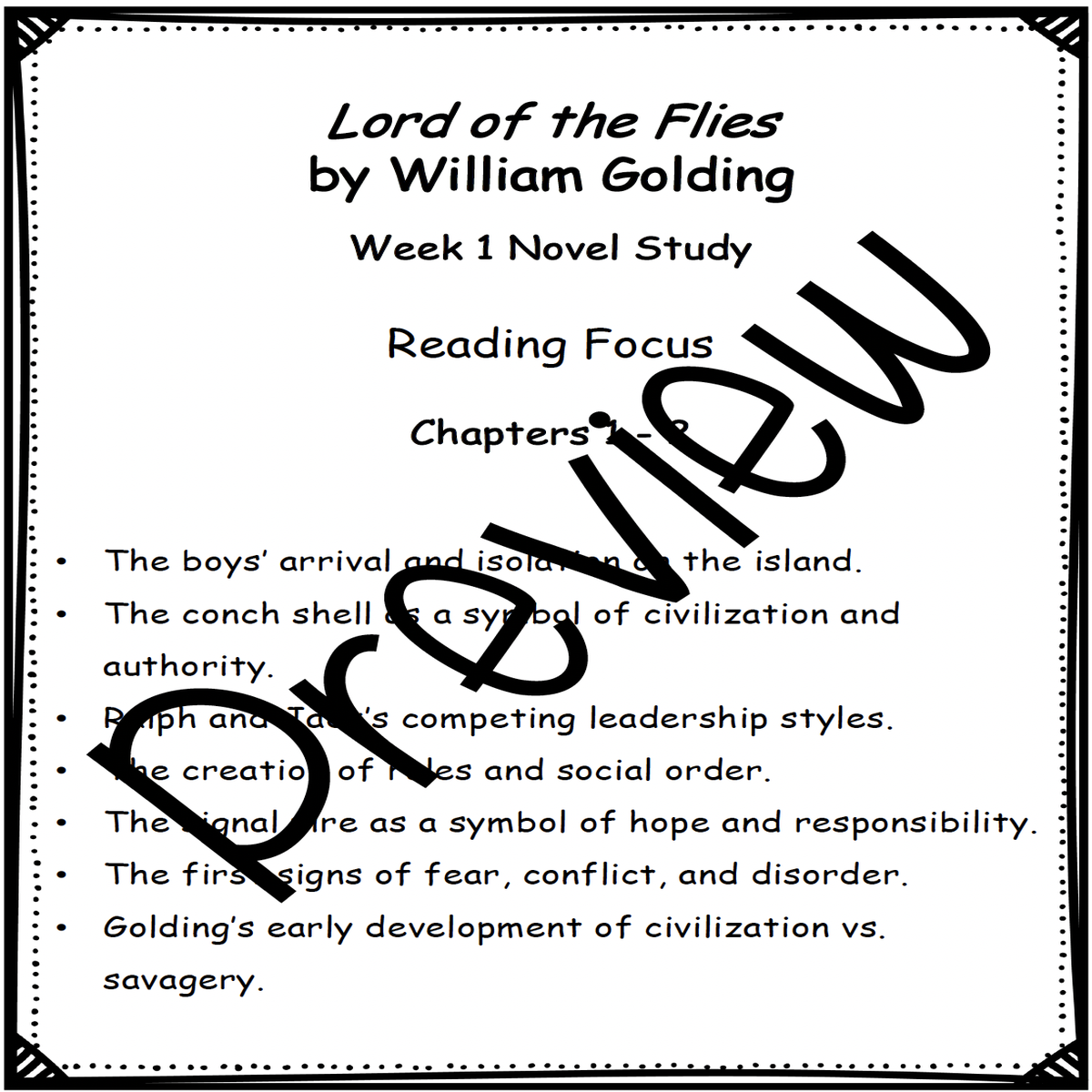
Week 1: Chapters 1–2 | Civilization, Leadership, and Symbolism
Students examine the boys’ arrival on the island and their early attempts to establish rules, authority, and social order.
Instructional activities explore:
- The conch shell as a symbol of civilization and authority
- Ralph and Jack’s competing leadership styles
- The importance of the signal fire
- The establishment of rules and responsibilities
- Early signs of fear, conflict, and disorder
- The developing theme of civilization versus savagery
Students begin examining how Golding uses symbolism and characterization to establish the novel’s central conflicts.
Week 2: Chapters 3–4 | Responsibility, Power, and Conflict
Students investigate the growing tensions between the boys as their priorities begin to change.
Activities encourage students to analyze:
- Ralph’s concerns about responsibility and rescue
- Jack’s increasing obsession with hunting
- Conflicting ideas about leadership
- The importance of maintaining the signal fire
- The breakdown of cooperation
- Character motivations and emerging conflicts
Students use textual evidence to explain how Golding develops tension between individual desires and collective responsibility.
Week 3: Chapters 5–6 | Fear, Authority, and Social Order
Students examine how fear begins influencing the boys’ decisions and relationships.
Literary analysis activities focus on:
- The growing fear of the beast
- Ralph’s attempts to maintain order
- Jack’s challenges to authority
- The relationship between fear and irrational behavior
- The weakening of established rules
- The influence of group behavior on decision-making
Students consider how Golding uses fear to expose the fragility of civilization.
Week 4: Chapters 7–8 | Character Transformation and Savagery
Students explore the increasingly destructive struggle for power and control.
Activities focus on:
- Ralph and Jack’s changing relationship
- The development of competing groups
- The transformation of individual characters
- The growing influence of violence
- Symbolism and the loss of civilized behavior
- Golding’s exploration of human nature
Students analyze how character decisions contribute to the novel’s escalating conflict.
Week 5: Chapters 9–10 | Group Mentality, Morality, and Violence
Students examine the consequences of fear, manipulation, and group behavior.
Literary analysis activities encourage students to investigate:
- The relationship between fear and violence
- The consequences of group mentality
- Moral responsibility and individual choices
- The breakdown of social order
- Character responses to traumatic events
- Golding’s portrayal of human behavior
Students develop evidence-based interpretations of the novel’s increasingly complex themes.
Week 6: Chapters 11–12 | Loss of Innocence and the Collapse of Civilization
The final week guides students through the novel’s conclusion and Golding’s broader message about human nature.
Activities explore:
- The consequences of unchecked power
- The collapse of established rules
- The loss of innocence
- The transformation of major characters
- The relationship between civilization and savagery
- The significance of the novel’s ending
- Golding’s commentary on morality and human behavior
Students reflect on how the novel’s events and literary elements contribute to its central message.
DEVELOP CRITICAL THINKING AND LITERARY ANALYSIS SKILLS
Lord of the Flies offers opportunities for students to explore complex literary concepts and universal questions about human behavior.
This six-week novel study helps students move beyond identifying what happens in the story to explaining why events happen, how characters change, and what Golding communicates through his writing.
Symbolism and Literary Devices
Students examine how Golding uses symbols to communicate ideas about authority, civilization, hope, fear, and human nature.
Through guided literary analysis worksheets, students practice identifying symbols, interpreting their meanings, and supporting their explanations with textual evidence.
Character Development and Motivation
Students investigate the personalities, motivations, relationships, and decisions of major characters.
Activities encourage students to compare Ralph and Jack’s leadership styles, examine Piggy’s role in maintaining rational thinking, and analyze how individual choices contribute to the novel’s conflicts.
Theme Development
Students explore major themes throughout the novel, including:
- Civilization versus savagery
- Power and leadership
- Fear and hysteria
- Morality and human nature
- Loss of innocence
- Group mentality
- Responsibility and social order
- The consequences of violence
Rather than simply identifying themes, students explain how Golding develops them through characterization, symbolism, conflict, and important events.
Evidence-Based Writing
Structured short-response activities help students strengthen their ability to construct analytical responses using relevant textual evidence.
Students practice explaining their reasoning, supporting interpretations, and connecting literary details to broader themes.
PERFECT FOR HIGH SCHOOL ENGLISH LANGUAGE ARTS CLASSROOMS
This Lord of the Flies literature study is designed to support meaningful instruction while reducing lesson-planning time.
Teachers can incorporate the resource into:
- High school English Language Arts classes
- English I and English II literature units
- Honors English courses
- Advanced middle school ELA classes
- Whole-class novel studies
- Small-group literature instruction
- Independent reading assignments
- Literature circles
- Socratic seminar preparation
- Reading comprehension practice
- Literary analysis lessons
- Homework assignments
- Enrichment activities
- Substitute teacher lesson plans
The consistent weekly structure allows teachers to establish predictable routines while adjusting activities to meet the needs of their students.
Spend less time searching for separate worksheets and more time guiding meaningful literary discussions.
IDEAL FOR HOMESCHOOL HIGH SCHOOL LITERATURE CURRICULUM
Homeschooling parents looking for a structured Lord of the Flies study guide will appreciate the organized six-week format.
This resource provides an accessible way to guide high school students through William Golding’s classic novel while developing essential English Language Arts skills.
Homeschool families can use the included materials to:
- Establish a six-week reading schedule
- Assign chapter-based comprehension questions
- Develop vocabulary and language skills
- Introduce literary analysis concepts
- Guide discussions about character development
- Explore symbolism and complex themes
- Practice evidence-based writing
- Evaluate student understanding using answer keys
- Encourage independent reading and critical thinking
The activities can be completed independently, discussed with a parent, or incorporated into a larger homeschool literature curriculum.
No need to create separate chapter questions, vocabulary exercises, or literary analysis worksheets. This resource brings them together in one organized literature study.
WHY CHOOSE THIS LORD OF THE FLIES LITERATURE UNIT?
Many traditional novel study packets emphasize remembering characters, events, and plot details.
While reading comprehension is important, understanding literature requires students to think critically about an author’s choices and the deeper meaning of a text.
This resource combines reading comprehension with higher-order thinking activities that encourage students to:
- Analyze rather than simply summarize
- Interpret symbolism and literary techniques
- Evaluate character motivations
- Explore complex themes
- Make meaningful connections
- Support conclusions with textual evidence
- Communicate ideas through analytical writing
The six-week structure also helps teachers maintain instructional consistency throughout the novel.
With 75 pages of organized instructional materials, this resource provides a practical foundation for a complete Lord of the Flies literature study.
COMMON CORE STATE STANDARDS ALIGNMENT
This novel study supports essential English Language Arts skills associated with the Common Core State Standards for Grades 9–12.
Instructional activities emphasize:
Reading Literature
Citing textual evidence, analyzing character development, interpreting themes, examining symbolism, and evaluating an author’s literary choices.
Writing
Developing evidence-based responses, constructing analytical explanations, and supporting interpretations with relevant details from literary texts.
Speaking and Listening
Participating in collaborative discussions, evaluating different interpretations, and communicating ideas clearly.
Language
Developing academic vocabulary, interpreting word meanings, and applying language skills in literary contexts.
The resource can be incorporated into standards-based English Language Arts instruction or a homeschool literature program.
PRODUCT DETAILS
Title: Lord of the Flies Novel Study
Author: William Golding
Resource Type: Complete Literature Study Unit
Total Pages: 75
Instructional Duration: 6 Weeks
Chapter Coverage: Chapters 1–12
Recommended Grade Levels: Grades 9–12; adaptable for advanced middle school students
Subject Areas: English Language Arts, Literature, Reading Comprehension, Literary Analysis
Format: Printable PDF Digital Download
Included Materials: Reading guides, vocabulary activities, comprehension questions, literary analysis worksheets, character and theme studies, writing prompts, teacher directions, and detailed answer keys.
Important: This is a digital educational resource. A copy of William Golding’s Lord of the Flies is not included and must be obtained separately.
MAKE YOUR NEXT LORD OF THE FLIES NOVEL STUDY MORE MEANINGFUL
Help students discover that Lord of the Flies is more than a story about boys stranded on an island.
Through its exploration of civilization, leadership, fear, morality, and human nature, Golding’s novel encourages readers to consider important questions about society and individual responsibility.
This 75-page, six-week Lord of the Flies novel study provides teachers and homeschooling families with organized reading comprehension activities, literary analysis worksheets, vocabulary practice, writing prompts, and answer keys to support thoughtful engagement with the entire novel.
Download your Lord of the Flies Novel Study today and bring meaningful reading, critical thinking, and literary analysis into your classroom or homeschool.
305HippieChic — Print. Think. Write. Learn. 🌼