
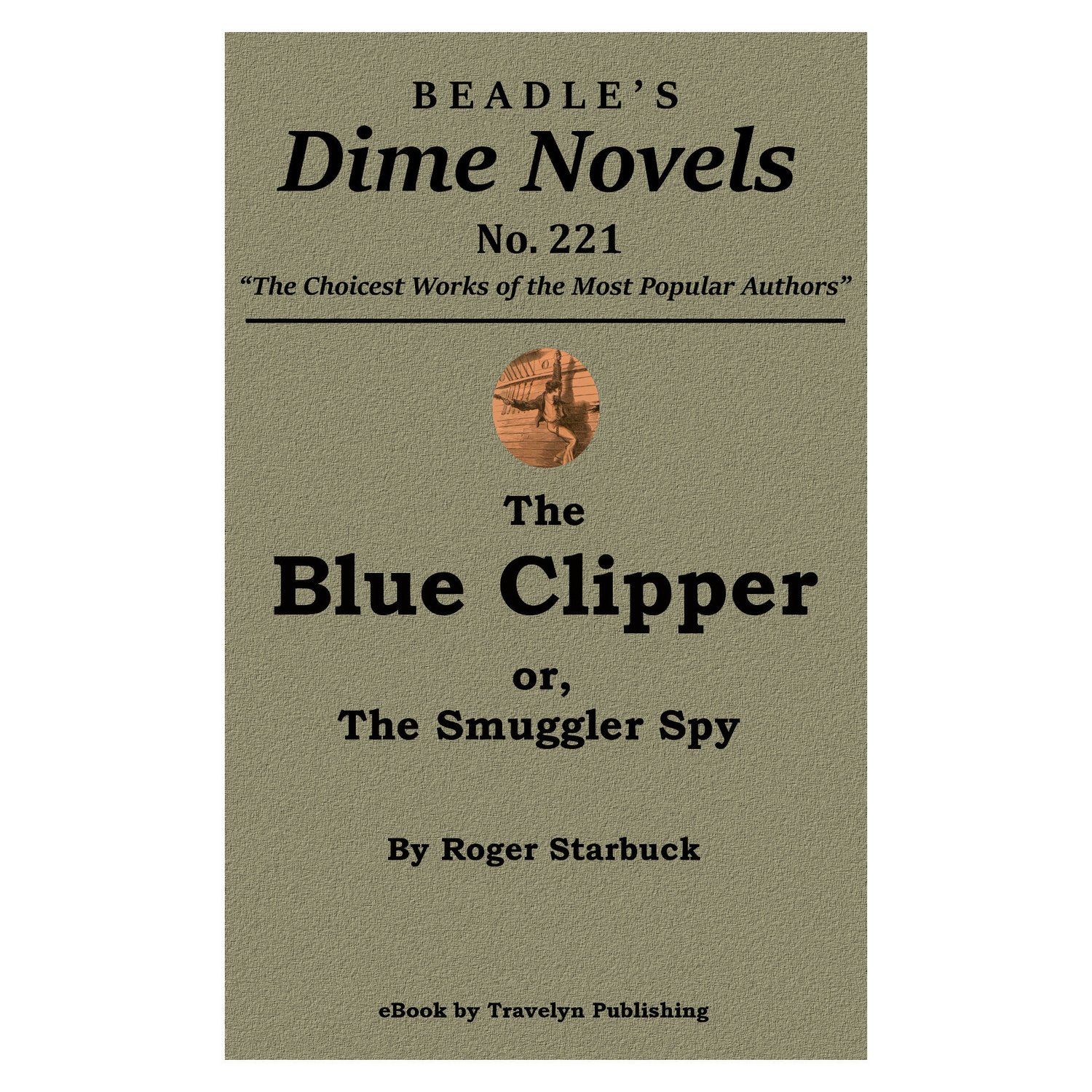
The Blue Clipper; or, The Smuggler Spy
Published originally in 1871, The Blue Clipper; or, The Smuggler Spy is No. 221 of the Beadle’s Dime Novels series. This one is a naval story taking place in the mid 19th century during a period of general peace in the young United States that lasted from the War of 1812 until the Civil War, a period when the nation’s navy was predominately involved in enforcing import laws, stopping illegal smuggling, and battling pirates. There is a romantic subplot and the author does a good job of keeping the reader in doubt about which of the various protagonists they should be rooting for, romantically and otherwise, until the very end of the story.
The author’s name, Roger Starbuck, is a pen name for Augustus Comstock, born in 1837, son of a journalist, who studied law but did not care for it and instead took to the sea, securing a position on a whaler. After a number of years as sailor he turned to writing sea tales and became a prolific writer of novels and stories for various publications. His experience as a sailor imbues his writing with a level of authenticity.
Preparing old books for digital publication is a labor of love at Travelyn Publishing. We hold our digital versions of public domain books up against any others with no fear of the comparison. Our conversion work is meticulous, utilizing a process designed to eliminate errors, maximize reader enjoyment, and recreate as much as possible the atmosphere of the original book even as we are adding the navigation and formatting necessary for a good digital book. While remaining faithful to a writer’s original words, and the spellings and usages of his era, we are not above correcting obvious mistakes. If the printer became distracted after placing an ‘a’ at the end of a line and then placed another ‘a’ at the beginning of the next line (they used to do this stuff by hand you know!), what sort of mindless robots would allow that careless error to be preserved for all eternity in the digital version, too? Not us. That’s why we have the audacity to claim that our re-publications are often better than the originals.