
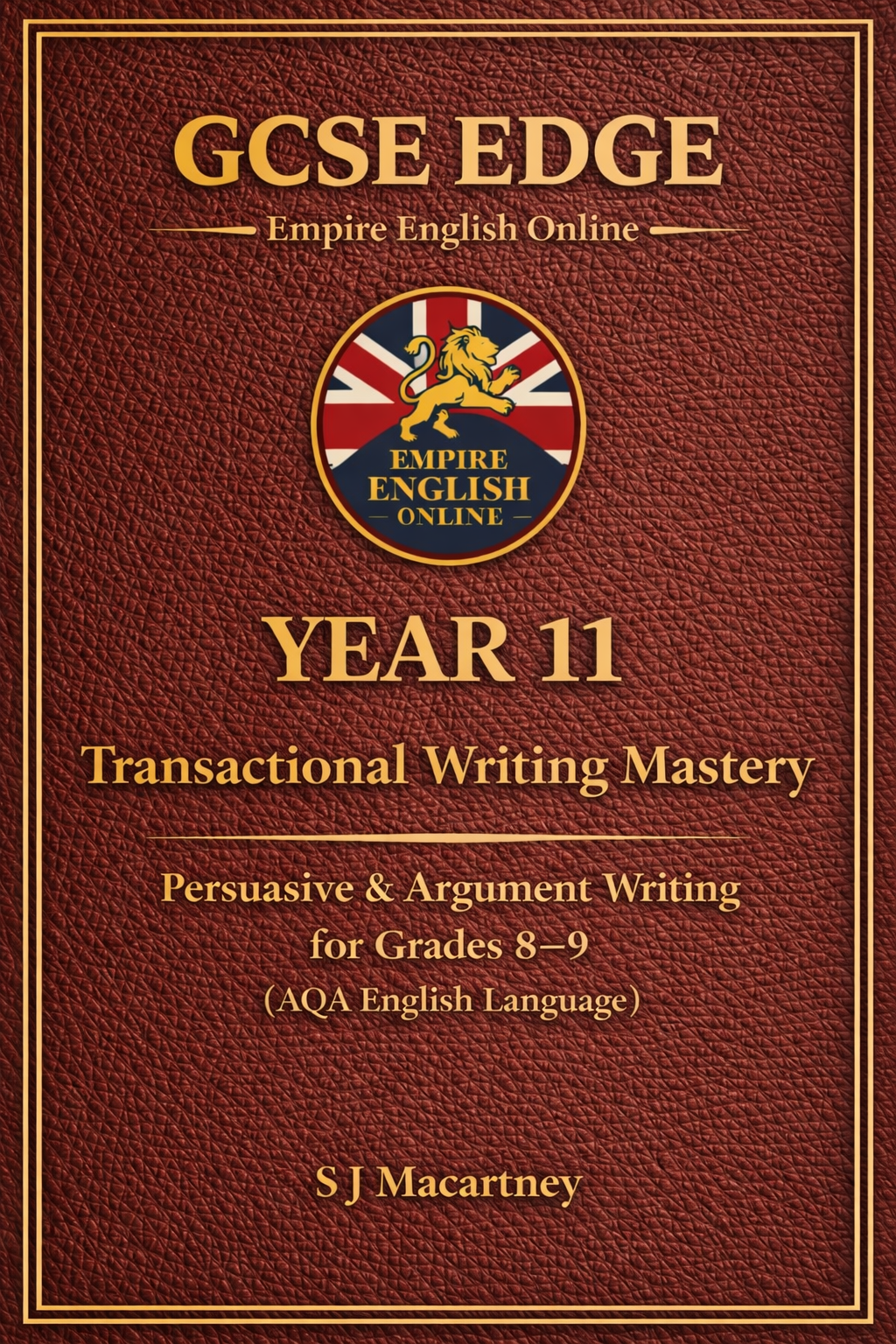
GCSE EDGE — YEAR 11 Transactional Writing Mastery Persuasive & Argument Writing for Grades 8–9 AQA English Language · Paper 2, Section B
Here's your advertising copy — adaptable for Amazon, your website, social media, and print materials:
GCSE EDGE — YEAR 11 Transactional Writing Mastery Persuasive & Argument Writing for Grades 8–9 AQA English Language · Paper 2, Section B By S J Macartney
THE PROBLEM
Most students can write. Very few can persuade under pressure.
Paper 2, Section B carries 40 marks — a quarter of the entire GCSE English Language grade — and it is decided in 45 minutes. Students who walk into that examination without a precise, practised command of argument, tone, and rhetoric do not achieve Grade 9. They achieve what their instincts allow, which is rarely enough.
Schools teach writing. This book teaches examination writing — and the difference is the difference between competence and distinction.
WHAT THIS BOOK DOES
Transactional Writing Mastery is not a revision guide. It is a conditioning manual built around one objective: the highest marks in transactional and persuasive writing under timed examination conditions.
Every chapter, every exercise, and every model response has been written with direct reference to the AQA mark scheme descriptors for the top band. If something appears in this book, it is because examiners actively reward it or because its absence actively costs marks. Nothing is filler. Nothing is padding. Every page earns its place.
INSIDE YOU WILL FIND:
A Baseline Diagnostic Task — a full timed writing task with a detailed self-marking rubric mapped directly to AO5 and AO6. Students identify their starting grade and their specific weaknesses before reading a single page of instruction.
Part I: What Grade 9 Writing Looks Like — side-by-side comparisons of Grade 6, Grade 8, and Grade 9 responses to the same prompt, with precise commentary explaining what separates competent writing from exceptional writing. Five defining characteristics of top-band work. A forensic breakdown of the most common downgrade traps that cost able students marks they should have earned.
Part II: Tone & Audience Control — the single most reliable indicator of writing maturity. How to write for formal, mixed, youth, and authority audiences without losing control. The critical difference between controlled sarcasm and immature sarcasm. How to sustain a measured emotional appeal without tipping into melodrama. Five targeted exercises.
Part III: Structuring Argument — clear thesis construction, sophisticated counter-argument integration, logical sequencing that examiners describe as "inventive" and "compelling." Structural templates for the four most common prompt types. Paragraph cohesion techniques. How to end with authority rather than repetition. Six exercises including full structural planning tasks.
Part IV: Rhetoric Done Properly — six rhetorical devices that genuinely earn marks at the highest level, with weak and strong examples for each. The Economy Principle: why one precisely deployed device outperforms five generic ones. How to eliminate cliché, dead phrasing, and the kind of hollow technique that examiners see through immediately. Five exercises.
Part V: Technical Control — the comma splice and how to eliminate it permanently. Punctuation as a deliberate persuasive tool, not merely a correctness exercise. Sentence variety that demonstrates control rather than randomness. Vocabulary precision. Tense consistency. The Three-Pass Proofread method. A common spelling errors reference. Five exercises including a proofreading drill under timed conditions.
Part VI: 18 Elite Practice Prompts — three graded sets of six prompts each, escalating in difficulty. Set A builds core competence. Set B extends range across unfamiliar forms and audiences. Set C presents the kind of intellectually demanding prompts that distinguish Grade 8 from Grade 9. Full progress tracker included.
Part VII: Five Full Timed Mock Examinations — complete examination-condition tasks with source materials where applicable, mark allocation boxes, AO5/AO6 scoring tables, and bespoke examiner guidance written specifically for each mock. A results summary table with diagnostic interpretation bands so students know precisely where they stand.
Part VIII: Exam Conditioning — a 30-day intensive revision plan for independent learners. A 6-week structured teaching plan for classroom use (three sessions per week). A practical exam-day checklist covering the first five minutes, the writing phase, and the final proofreading window. Guidance for parents on how to support without interfering.
THE NUMBERS
103 pages. 8 parts. 18 practice prompts. 5 full mock examinations. 26 targeted exercises. 3 annotated Grade 9 model responses. 1 self-marking diagnostic rubric. 2 structured revision plans. Every page aligned to AO5 (24 marks) and AO6 (16 marks).
WHO THIS BOOK IS FOR
Students targeting Grades 8–9 in AQA GCSE English Language. Students currently achieving Grade 6 or 7 who know they are capable of more. Students who write well but lose marks under timed conditions. Students who have been told their work is "good" but cannot break through to "exceptional."
Teachers and tutors looking for a complete, ready-made scheme of work for transactional writing intervention. The 6-week teaching plan provides structured lesson content for 18 sessions. Every exercise works individually, in pairs, or in small groups.
Parents who want to provide their child with a serious, professional resource — not a simplified revision card or a colour-coded summary that pretends Grade 9 can be achieved without sustained effort.
WHAT MAKES THIS DIFFERENT
Most GCSE writing guides tell students what the mark scheme says. This book teaches them how to meet it — under pressure, in 45 minutes, with a pen in their hand and no second chances.
It does not talk down to students. It does not offer shortcuts. It does not promise that Grade 9 is easy. It promises that Grade 9 is achievable for any student willing to prepare with precision, practise with discipline, and walk into the examination room knowing — not hoping — that they are ready.
This is not a revision guide. It is a conditioning manual for Grade 8–9 transactional writing.
Written in clear, authoritative British English and structured around the exact demands of the AQA specification for Section B (Transactional Writing), this book is the definitive resource for serious Year 11 students who are aiming for the highest bands.
For students aiming to persuade with confidence. For those who need to craft arguments that command. For those committed to the effort required.
EMPIRE ENGLISH ONLINE Opening the door to the world empireenglishonline.uk
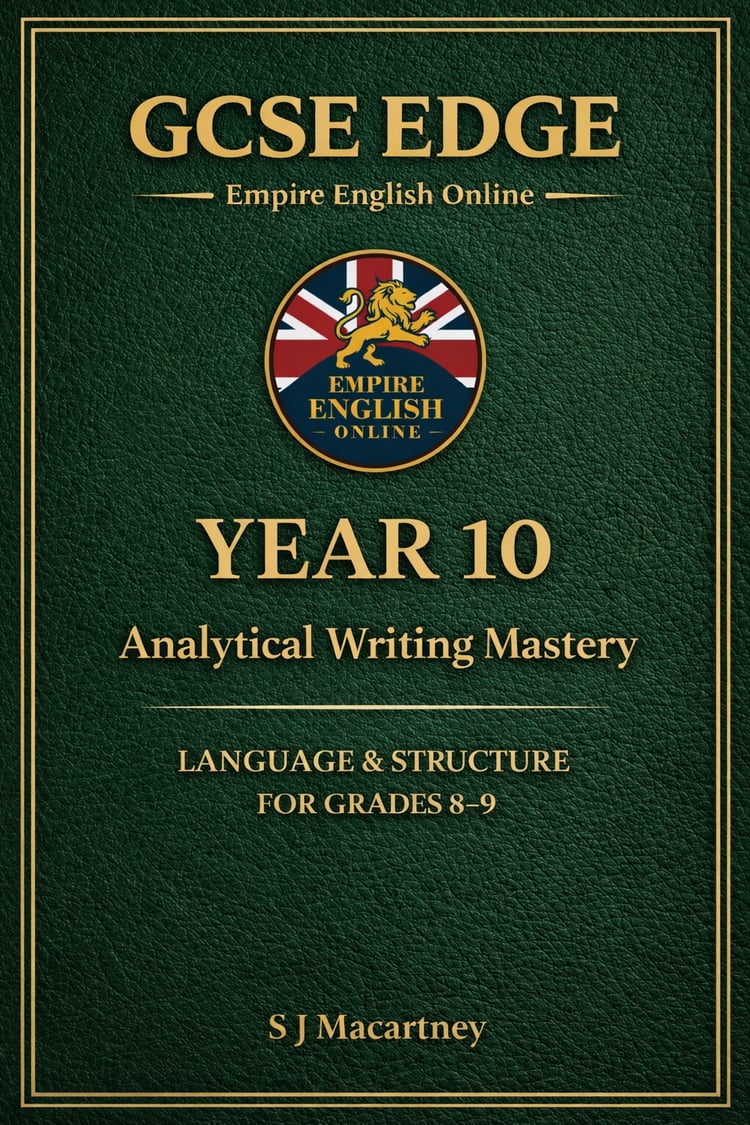
SERIES: GCSE EDGE Also available: Analytical Writing Mastery — Language & Structure for Grades 8–9