
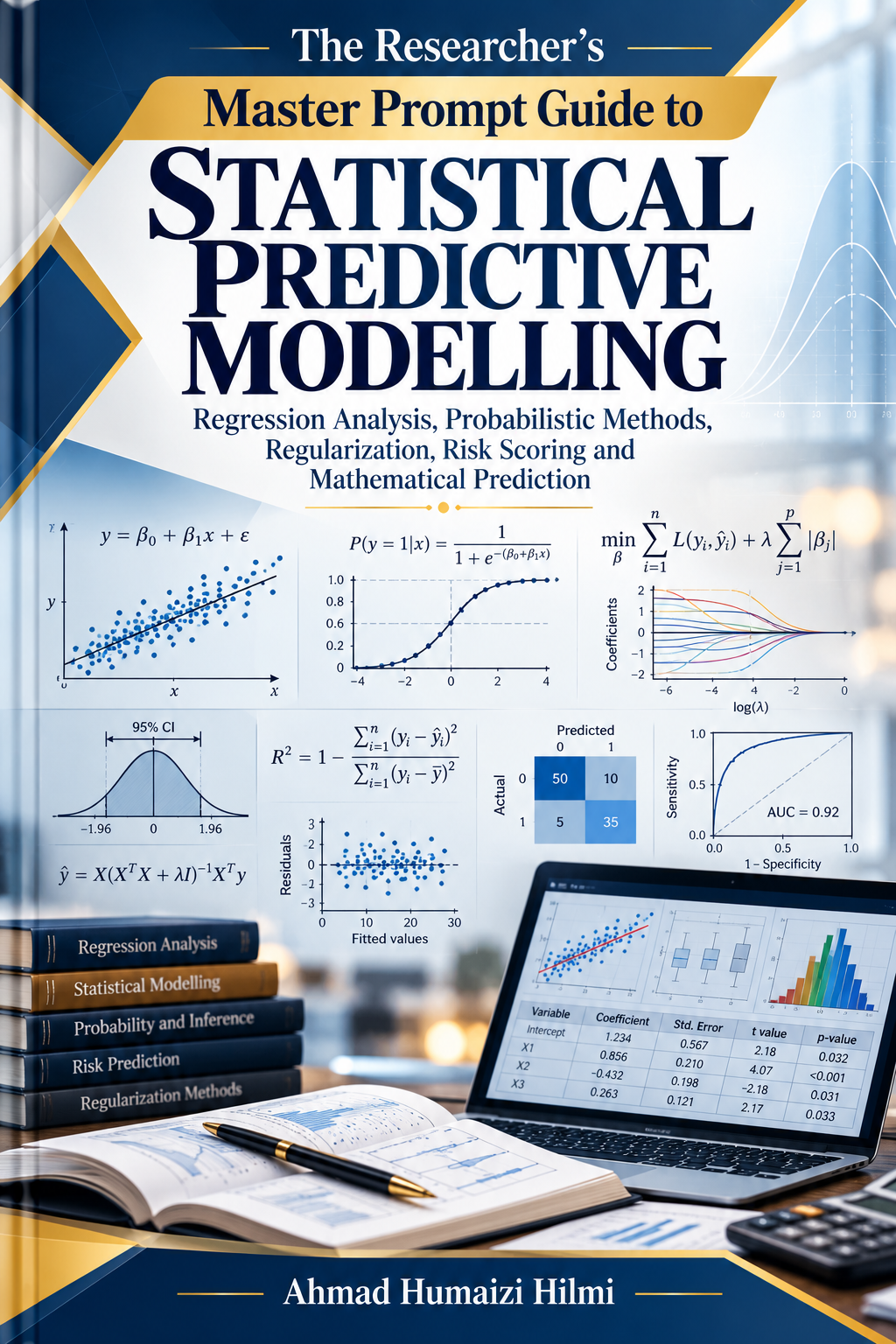
2. PM-STA-002 — Statistical Predictive Modelling, Regression Analysis, Probabilistic Methods, Regularization, Risk Scoring and Mathematical Prediction
Description
This Master Prompt focuses on the development, estimation, evaluation and interpretation of statistical and mathematical predictive models for continuous, categorical, binary, ordinal, count, survival and other research outcomes. It guides researchers through linear and nonlinear regression, multiple regression, generalized linear models, logistic regression, penalized regression, regularization techniques, probabilistic modelling, stochastic frameworks, empirical correlations, mathematical equations and predictive scoring systems. The theme addresses model specification, variable selection, coefficient estimation, multicollinearity, interaction effects, nonlinear relationships, statistical assumptions, parameter uncertainty, residual diagnostics, goodness-of-fit, model complexity and overfitting prevention. Researchers are guided in selecting appropriate statistical approaches according to outcome distributions, sample sizes, data structures, predictor characteristics and research objectives. Particular emphasis is placed on interpretable predictive models, including penalized logistic regression for clinical risk scoring, mathematical mixing rules for material properties, stochastic models for academic performance and empirical formulations for engineering processes. The theme also covers calibration, discrimination, confidence intervals, prediction intervals, cross-validation, internal and external validation, comparative model assessment and the development of practical predictive equations or risk scores. It supports research requiring statistically defensible, mathematically transparent and reproducible prediction rather than relying exclusively on complex artificial intelligence methods.