
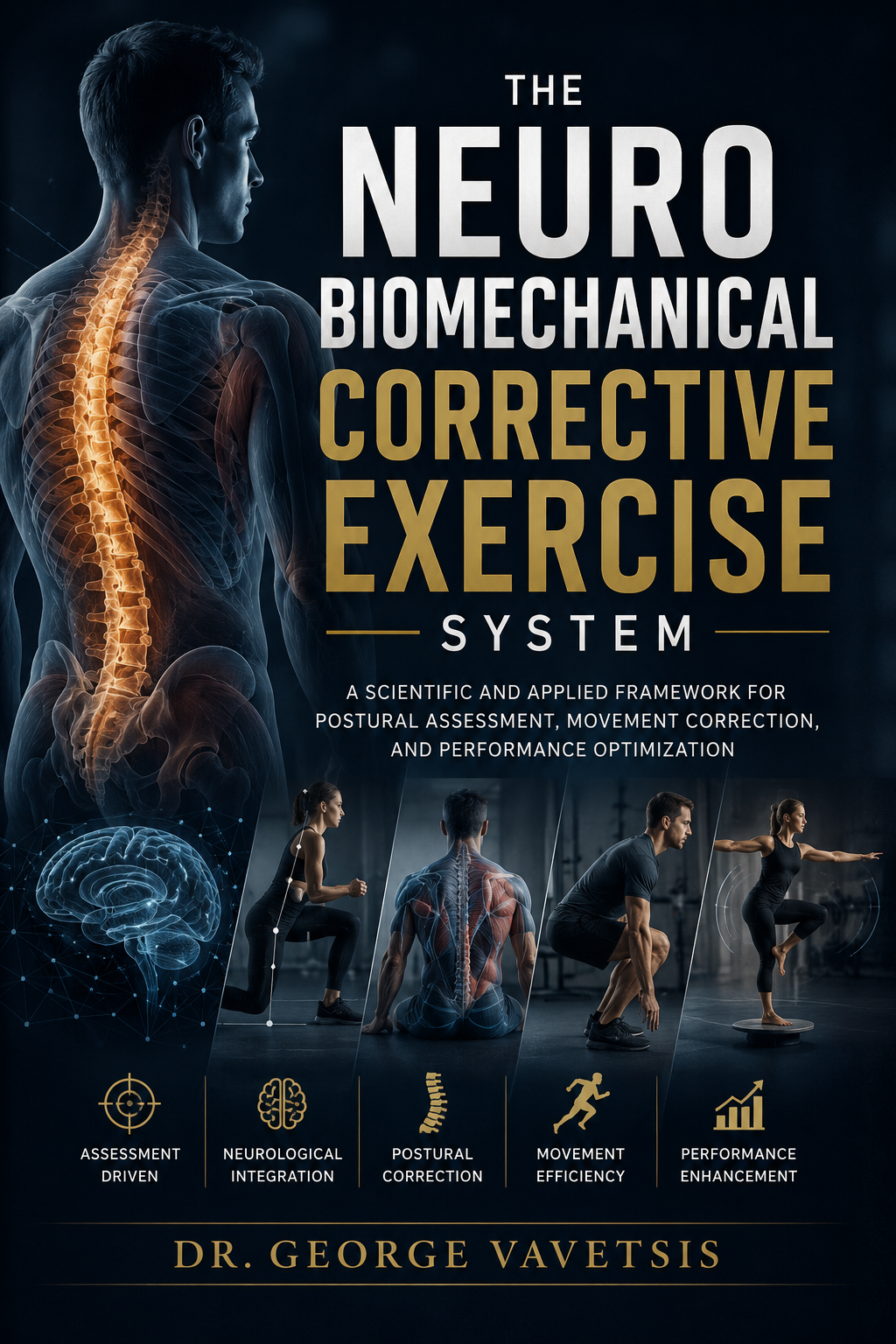
The NeuroBiomechanical Corrective Exercise System
Pages: 1174
Human movement is not merely the product of muscles pulling on bones. It is the outcome of a deeply integrated neurobiomechanical system where the nervous system, connective tissues, sensory feedback, joint mechanics, breathing patterns, postural reflexes, and movement strategies continuously interact to produce stability, efficiency, and performance. Modern corrective exercise approaches often isolate dysfunction into simplified categories of “tight” versus “weak,” yet the human body operates through far more complex mechanisms involving sensory integration, neuromuscular coordination, fascial tensioning, motor adaptation, and dynamic postural control. This book, The NeuroBiomechanical Corrective Exercise System, was developed to bridge the gap between traditional corrective exercise and the advanced scientific understanding of human movement emerging from biomechanics, neuroscience, rehabilitation sciences, sports performance, and motor control research.
The purpose of this system is not simply to prescribe exercises. Its purpose is to teach practitioners how to analyze movement dysfunction through a multidimensional lens. Posture, balance, breathing, joint mechanics, stabilization, force transmission, proprioception, vestibular integration, and motor learning are not isolated domains. They are interconnected systems that collectively determine the quality of human movement. Dysfunction in one region often represents compensation originating elsewhere within the kinetic chain. A forward head posture may not only involve cervical musculature but also thoracic stiffness, rib cage dysfunction, altered diaphragmatic mechanics, visual dependency, vestibular compensation, and impaired scapular positioning. Similarly, pelvic instability during squatting may originate from deficits in ankle mobility, trunk stabilization, gluteal neuromuscular timing, or impaired sensory feedback from the foot tripod.
Throughout this book, corrective exercise is approached as a neurobiomechanical intervention rather than a simple strengthening protocol. The body constantly seeks movement efficiency. When stability decreases or movement options become limited, compensatory strategies emerge automatically through the nervous system. These compensations may initially preserve function, but over time they often increase tissue stress, alter joint loading, reduce movement variability, and impair performance capacity. Understanding these compensatory behaviors requires a comprehensive appreciation of biomechanics, sensorimotor control, and adaptive physiology.
The neurobiomechanical model presented in this text emphasizes assessment-driven intervention. Objective analysis forms the foundation of effective corrective exercise. Static posture alone is insufficient to understand human function. The practitioner must evaluate movement under dynamic conditions, perturbation, fatigue, vestibular challenge, asymmetrical loading, and reactive stabilization demands. Quantitative measurements such as craniovertebral angles, thoracic kyphosis thresholds, center-of-pressure displacement, sway velocity, rib cage expansion, scapular upward rotation, and pelvic tilt mechanics provide measurable insight into movement behavior and compensation patterns.
One of the defining characteristics of this system is the integration of breathing mechanics into movement correction. Respiration is not only a physiological necessity but also a biomechanical regulator of posture, trunk stability, rib cage positioning, and autonomic nervous system function. Dysfunctional breathing patterns alter thoracic mobility, cervical loading, intra-abdominal pressure regulation, and lumbopelvic mechanics. Proper diaphragmatic integration influences both movement efficiency and recovery capacity. The relationship between respiration and posture therefore becomes central to long-term corrective strategies.
Another essential theme of this book is the importance of sensory systems in movement regulation. Human posture and stabilization depend on the constant interaction between visual input, vestibular feedback, proprioception, tactile sensation, and motor output. When one system becomes dominant or deficient, compensatory stabilization strategies emerge. Excessive visual dependency, impaired foot sensory feedback, vestibular insufficiency, or poor proprioceptive integration can all manifest as instability, altered balance strategies, or inefficient movement mechanics. Corrective exercise must therefore challenge and retrain these sensory systems progressively rather than relying solely on isolated strengthening methods.
Athletic performance and rehabilitation are also deeply connected within the neurobiomechanical framework. Elite athletes frequently demonstrate highly efficient compensation patterns that allow performance despite underlying dysfunction. However, repeated exposure to asymmetrical loading, excessive sport-specific repetition, inadequate recovery, and high-force movement demands may eventually overwhelm these compensatory systems, resulting in pain, instability, or injury. The corrective strategies presented in this text are designed not only for rehabilitation settings but also for performance optimization, injury prevention, and movement resilience in high-level athletes.
This book also recognizes the growing influence of technology and objective monitoring within movement sciences. Modern practitioners now have access to force plates, motion capture systems, wearable sensors, smartphone posture analysis tools, electromyography, pressure mapping systems, and real-time movement feedback technologies. These tools allow deeper understanding of movement behavior and facilitate evidence-informed decision making. However, technology alone is insufficient without clinical reasoning and biomechanical understanding. The practitioner must learn how to interpret data meaningfully within the context of human function.
Importantly, this text is written for professionals seeking a higher level of movement analysis and corrective application. Strength and conditioning coaches, physiotherapists, sports scientists, athletic trainers, chiropractors, rehabilitation specialists, and movement practitioners will find detailed frameworks that integrate assessment, motor control, biomechanics, and exercise prescription into a unified corrective model. The aim is to develop practitioners capable of thinking critically rather than applying generic exercise templates.
Corrective exercise should not be viewed as a separate discipline isolated from performance training. Instead, it should become embedded within the movement culture of the athlete, patient, or client. Every warm-up, stabilization drill, breathing sequence, mobility intervention, strength exercise, and reactive movement task can either reinforce efficient mechanics or perpetuate dysfunction. The neurobiomechanical corrective approach therefore seeks to create lasting movement adaptation by targeting the underlying mechanisms responsible for compensation rather than simply masking symptoms.
Ultimately, human movement represents the expression of integrated biological intelligence. The body continuously adapts to stress, environment, posture, fatigue, emotion, and task demand. Understanding these adaptations requires an appreciation of complexity rather than reductionism. The NeuroBiomechanical Corrective Exercise System was created to provide a scientific and applied framework capable of addressing this complexity with precision, structure, and practical relevance.
The future of corrective exercise belongs to those who can integrate neuroscience, biomechanics, rehabilitation, and performance into one cohesive system. This book is intended to contribute to that evolution and to equip practitioners with the tools necessary to analyze movement more deeply, intervene more intelligently, and ultimately enhance human performance, resilience, and long-term health.