
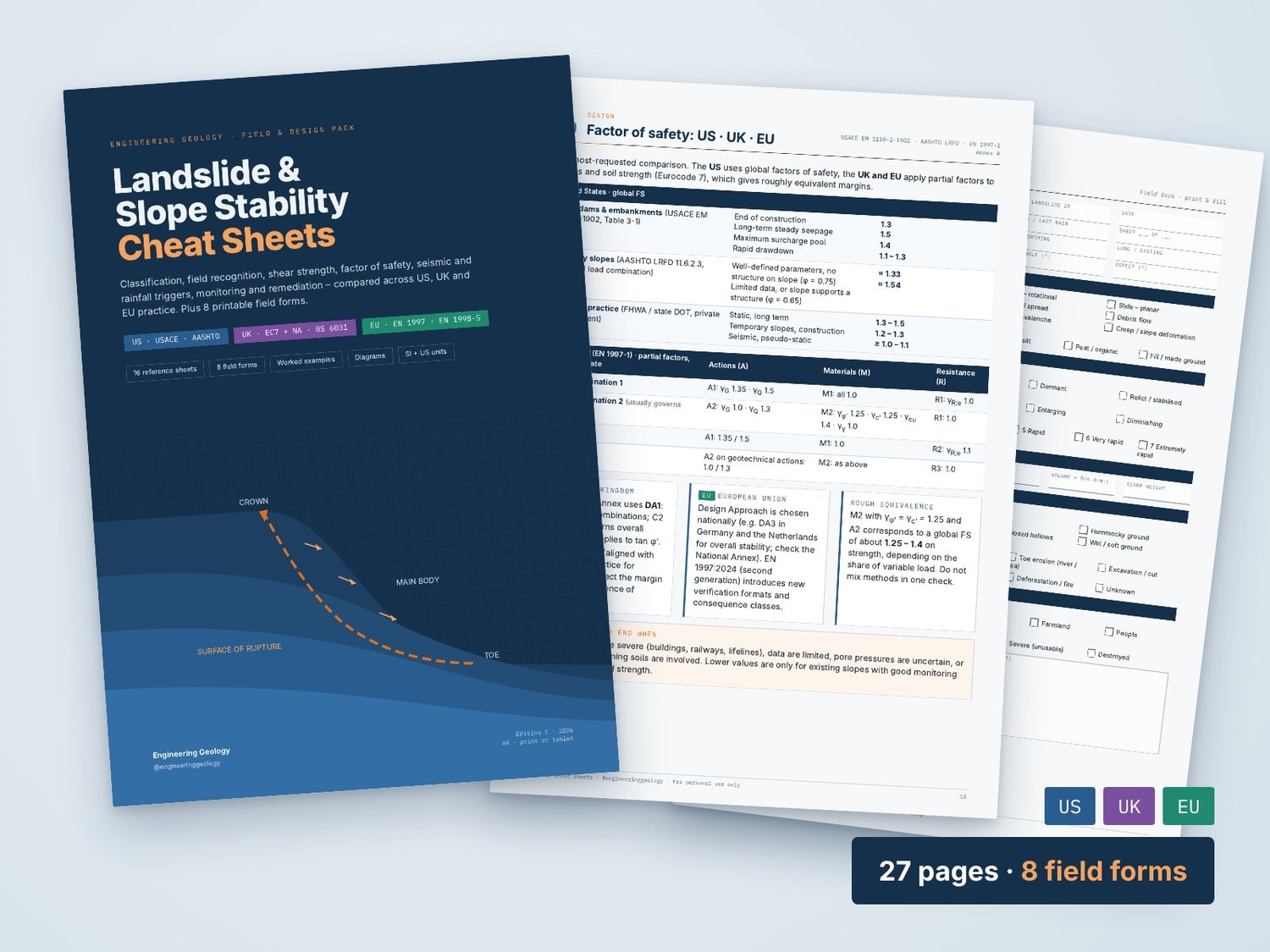



Landslide & Slope Stability Cheat Sheets · US · UK · EU (27-page PDF + 8 Field Forms)
On Sale
$12.99
$12.99
Everything you need on a landslide job, on 27 printable pages. Written by an engineering geologist and compared across US, UK and European practice.
16 REFERENCE SHEETS
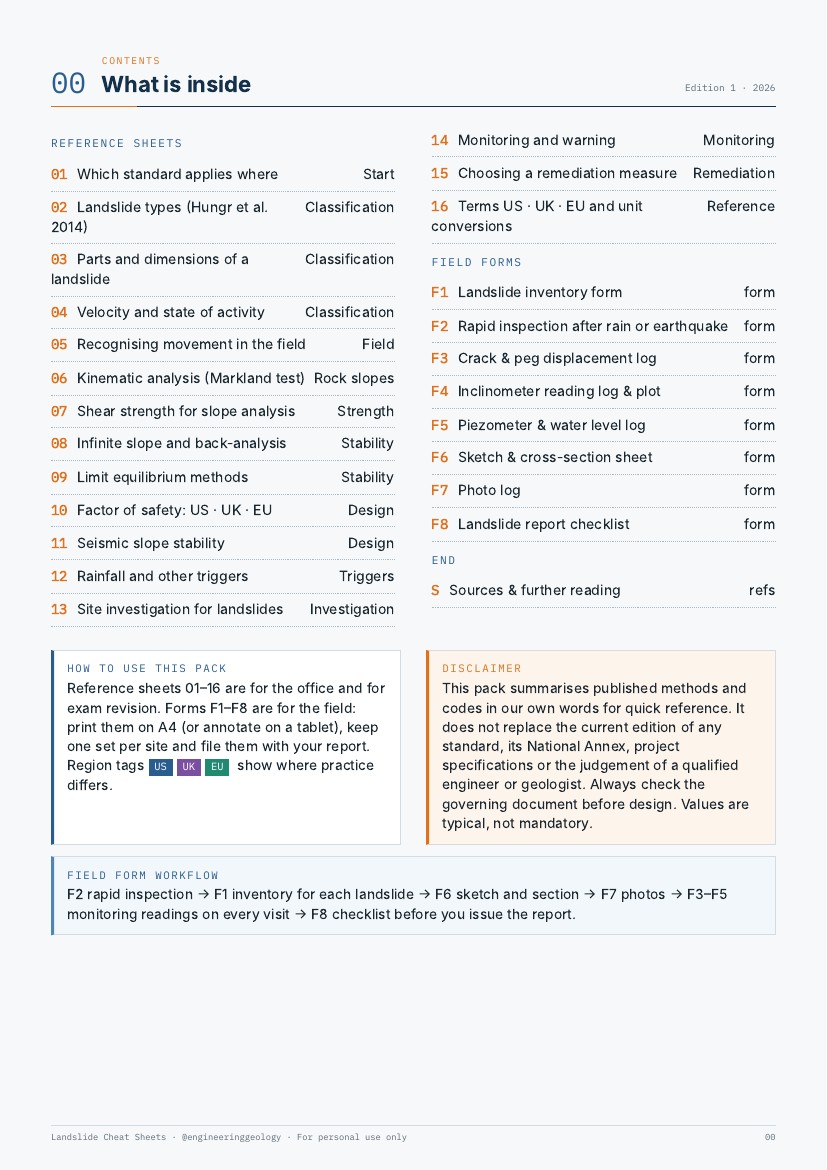
- Which standard applies where: USACE, AASHTO, FHWA, Eurocode 7, EN 1998-5, BS 6031, BS 5930
- Landslide types (Hungr et al. 2014), parts and dimensions, velocity classes and state of activity
- Recognising movement in the field: cracks, scarps, tilted trees, old landslide clues
- Kinematic analysis of rock slopes (Markland test) and joint shear strength
- Peak, fully softened and residual strength: which one to use, and when
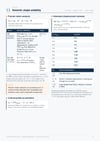
- Infinite slope with a worked example, plus back-analysis of a failed slope
- Limit equilibrium methods compared (Bishop, Janbu, Spencer, Morgenstern–Price)
- Factor of safety: US global FS vs. Eurocode 7 partial factors, side by side
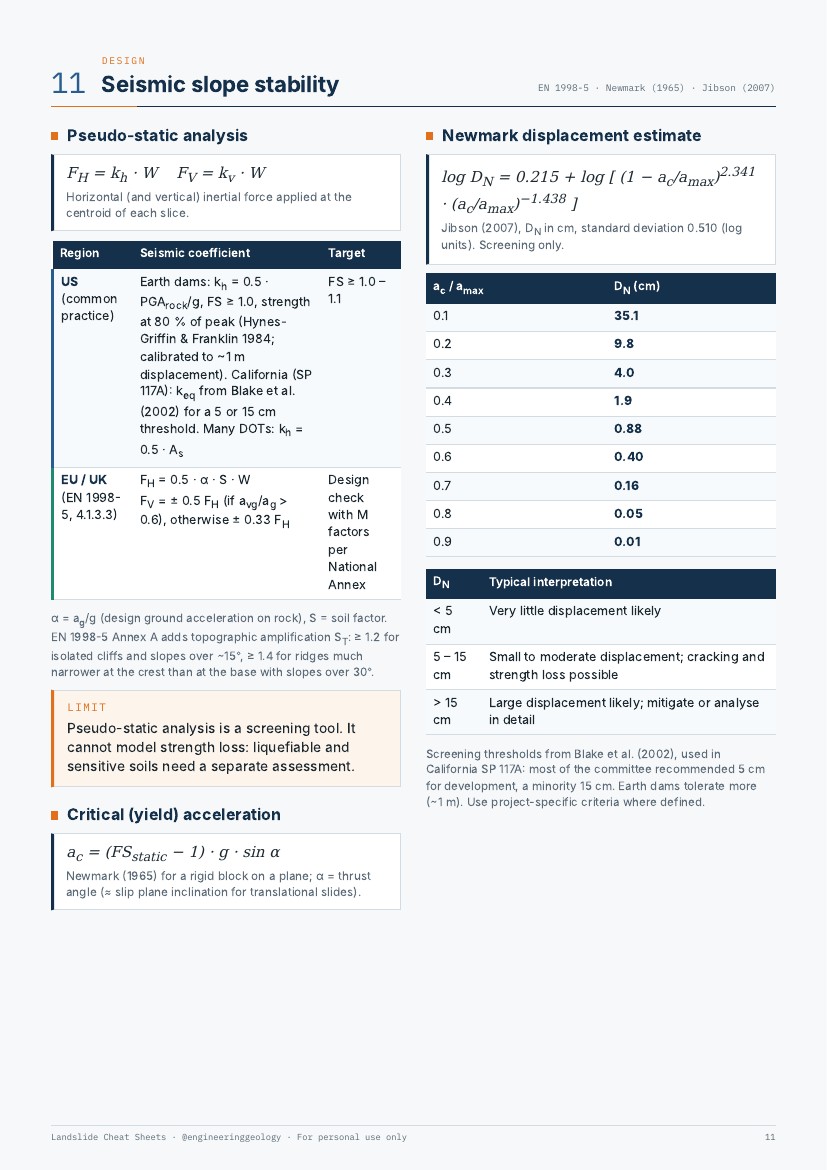
- Seismic stability: pseudo-static coefficients, Newmark displacement (Jibson 2007)
- Rainfall thresholds (Caine, Guzzetti) and other triggers
- Site investigation and lab tests (ASTM vs. EN ISO 17892)
- Monitoring, inverse velocity method and alert levels
- Choosing a remediation measure
- US / UK terms and unit conversions
8 PRINTABLE FIELD FORMS
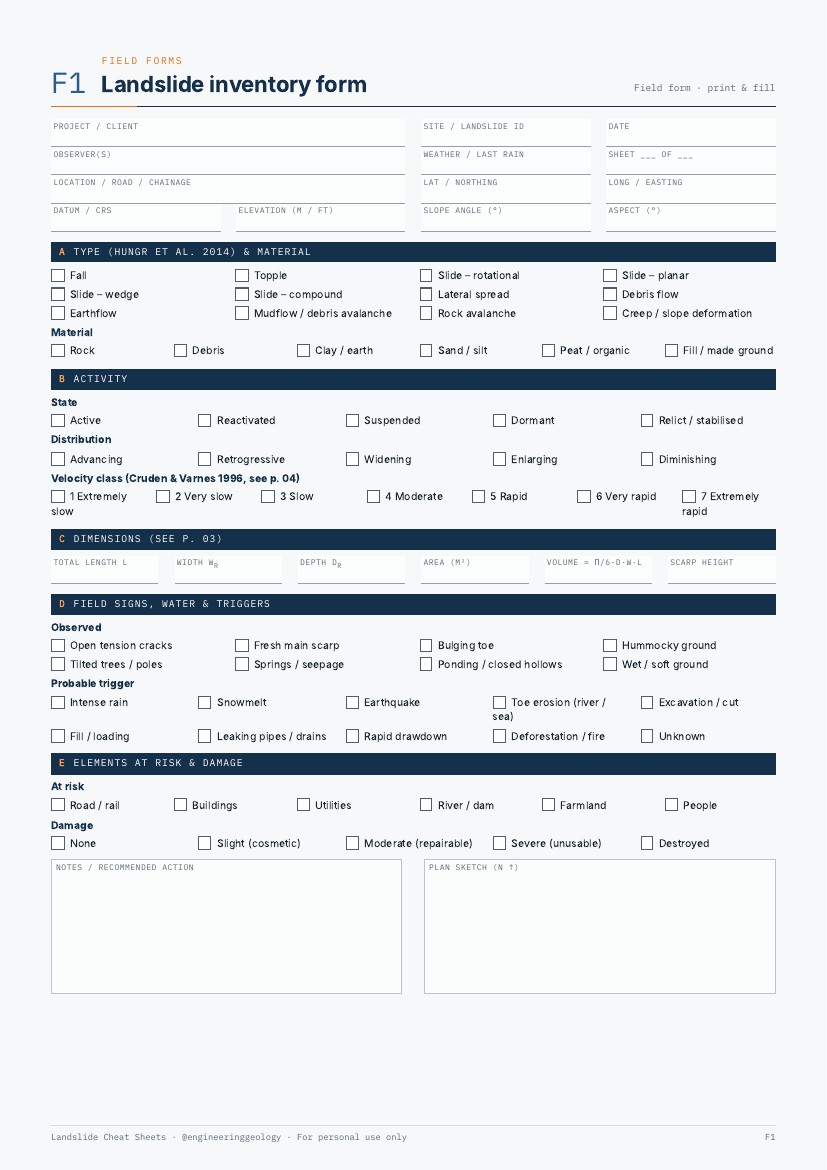
- F1 Landslide inventory form
- F2 Rapid inspection after rain or earthquake
- F3 Crack & peg displacement log
- F4 Inclinometer reading log & plot
- F5 Piezometer & water level log
- F6 Sketch & cross-section sheet (mm grid)
- F7 Photo log
- F8 Landslide report checklist
WHAT YOU GET
- 1 PDF, A4, 27 pages. Prints well on US Letter (choose "fit to page").
- Use it on a tablet, or print the forms for every site.
- SI units with US conversions.
WHO IT IS FOR
Engineering geologists, geotechnical engineers, students preparing for PE / PG / chartership exams, and anyone who inspects slopes.
This is a quick reference that summarises published methods in our own words. It does not replace the current edition of a standard or engineering judgement.
Instant download · For personal use only · © Engineering Geology