
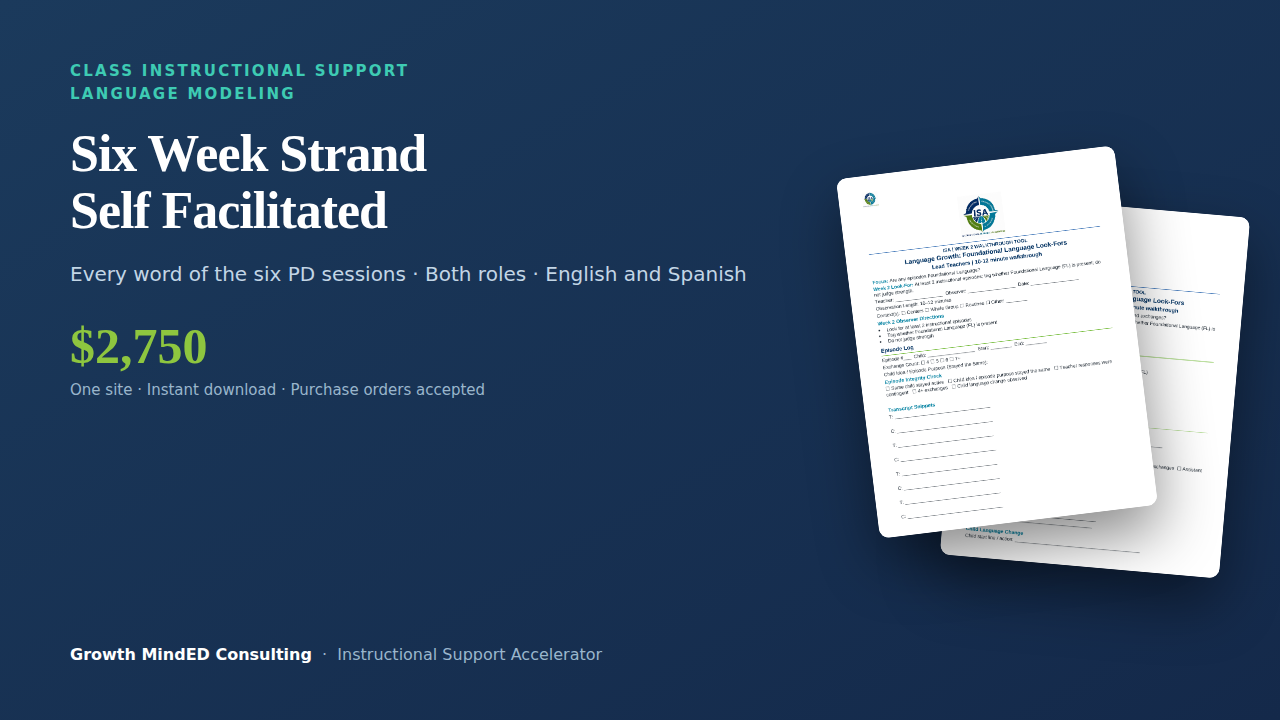
ISA Language Growth: Six Week Strand, Self Facilitated
The complete six week Language Growth strand, written so your own leaders can run it. No consultant in the building, no slides to sit through, no waiting for a calendar to open up.
You get every word of the six professional development sessions. Not an outline, not a facilitator's guide that says discuss the following. The actual words, timed, including what to say when a teacher pushes back.
The week holds together. PD on Monday teaches one indicator. The walkthrough tool midweek looks for that same indicator. The coaching guide on Friday talks about what you saw, in the same language. Then the next session builds on it. Most programs buy a PD day, a form, and a coaching model from three different places and wonder why nothing compounds.
Episode first. ISA trains one unit of practice: the instructional episode. Same child idea, four or more back and forth exchanges, each adult move shaped by what the child just said, and the child's language observably different by the end. The research calls these sustained or extended exchanges. Strategies alone do not move Instructional Support, because a teacher can ask a strong question and stop.
How this lines up with CLASS. ISA names three indicators inside CLASS Language Modeling so a leader can teach and observe one at a time. Foundational Language is parallel talk, self talk, repetition, and recasting. Expanded Language is extensions, back and forth conversation, and contingent follow ups. Conceptual Language is advanced vocabulary, precise language, and explanations in context.
What is inside: six PD scripts, six coaching guides, twelve walkthrough tools across two roles, the ISA rubric, the CLASS crosswalk, the scope and sequence, the episode planners with filled in examples, and the anchor cards a leader keeps at their side. One hundred and sixty six documents, English and Spanish, every one in both print ready PDF and editable Word.
What is not inside: the ISA facilitator slide decks, the processing and engagement handouts, and ISA coaching alongside your leaders across the six weeks. Those are separate. You are building your own slides and your own participant handouts.
Licensed to one site. Your leaders may run the six weeks with the staff at that site as many times as you like. Multi site and network licences are available. This covers one of the three CLASS Instructional Support dimensions, and it is the recommended place to start.
Includes the ISA Episode Detector through June 30, 2027. Your access code is in the download.
Paste a transcript of any adult and child interaction into the tool and it tells you whether the interaction met all four parts of the ISA episode definition, which growth strand it belongs to, and which indicator it demonstrates. It quotes the transcript back to you for every judgment it makes, so you can argue with it.
Three ways it works with this strand.
1. Check the plan. A teacher writes an episode on the episode planner. Run the planned exchange through the detector before it is taught, and find out whether what they designed is actually an episode while there is still time to change it.
2. Check the walkthrough. After a ten minute walkthrough, the leader types in the exchange captured on the episode log. Find out whether it cleared the bar before naming it in a coaching conversation.
3. Check the moment nobody planned. A teacher has an exchange with a child that was not on anyone's plan. Run it. This is where teachers find out they are already doing the thing, which changes how they hear every coaching conversation after it.
It is a thought partner, not a scorer. It is almost always right when an interaction is clearly an episode or clearly not one, and the edge cases are exactly where your team's judgment should be doing the work. Never use it for evaluation or accountability purposes.
What is included in this download. Six weeks of PD scripts. Six weeks of coaching guides. Six weeks of walkthrough tools in two versions, one for Lead Teachers and one for Associate Teachers. The ISA Rubric, the Scope and Sequence, and the ISA CLASS Crosswalk. Episode planners, worked planner examples for Foundational and Expanded Language, and anchor cards for all six weeks. Model episode videos for each indicator, with transcripts. Access to the ISA Episode Detector through June 30, 2027.
Every document in English and Spanish, and every document as both an editable Word file and a print ready PDF. Not a Spanish summary. The full document, reviewed by a native Spanish speaking educator. If your program serves Spanish speaking families and staff, this is the part almost nobody else gives you.
Two add ons, sold only to people who own a strand. The facilitator PowerPoint decks are $750 per strand per site, six decks matched slide by slide to the scripts. The weekly participant handout set is $750, covering model transcript analysis sheets, triad practice packs, classification practice sheets, and capture and commit sheets for all six weeks in both languages. Purchase links for both arrive with your download. They are not sold on their own, because the decks without the system is not ISA.
What this replaces. The ad hoc PD calendar, the coaching you can no longer staff internally, and the annual scramble to explain your Instructional Support scores to a monitor.
$2,750 for the self facilitated strand. Instant download. English and Spanish included. Purchase orders accepted. If you would rather Nicole facilitate the same six weeks, that is $3,750 per strand per site.