
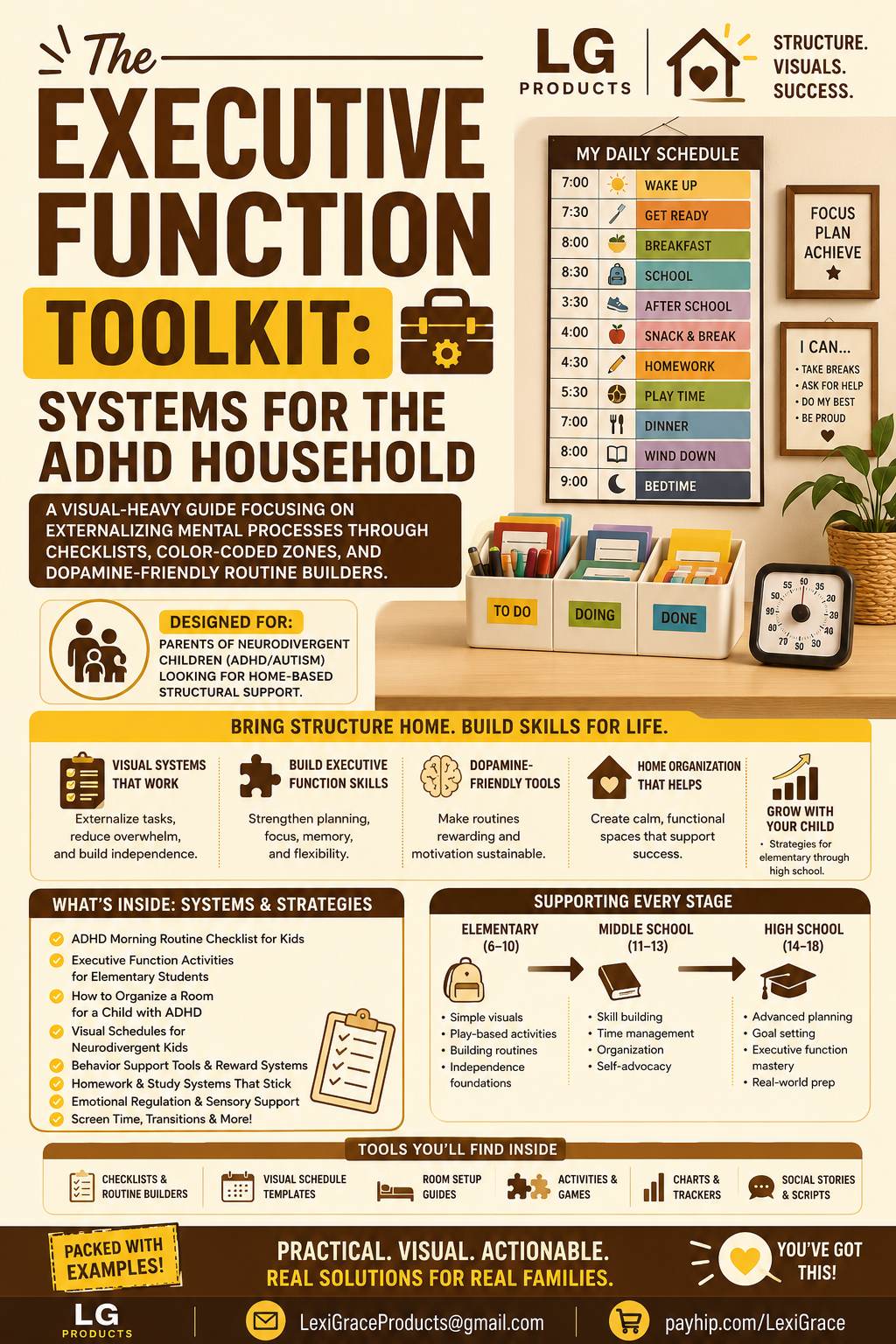
The Executive Function Toolkit: Systems for the ADHD Household — The Complete Visual Guide for Parents of Neurodivergent Children
Your child is not defiant. They are not lazy. Their brain just needs the environment to do the organizing for them and this guide shows you exactly how to build that environment.
Research consistently shows that children with ADHD develop executive function skills approximately 3 years behind their neurotypical peers. A 10-year-old with ADHD may have the executive function capacity of a 7-year-old. This is not a character flaw or a parenting failure — it is a neurological difference that responds beautifully to external structure, visual supports, and consistent home systems.
The most powerful insight in all of ADHD parenting research is this: when the environment does the organizing for the child the child can succeed. Routines written on a chart work better than routines held in memory. Color-coded storage bins work better than verbal instructions to tidy up. A visual timer works better than telling a child they have 10 more minutes. This guide is built entirely on that principle.
The Executive Function Toolkit: Systems for the ADHD Household is the complete visual-first guide for parents of neurodivergent children with ADHD and autism — covering morning routine checklists, visual schedule systems, room organization, dopamine-friendly routine builders, homework systems, behavior support tools, and a complete age-by-age roadmap from elementary school through high school.
Every strategy in this guide is practical, visual, and immediately actionable. No theory without application. No suggestions without examples. Real solutions for real families.
What's Inside:
✅ Introduction — Understanding executive function in ADHD and autism with a six-skill reference table covering working memory, task initiation, planning and organization, time management, cognitive flexibility, and emotional regulation — showing what each skill looks like as a home challenge and the specific strategy that addresses it
✅ Chapter 1 — ADHD morning routine checklist for kids from elementary through high school — three complete age-specific checklists with checkbox rows covering every morning step for ages 6-10, 11-13, and 14-18, plus four implementation strategies including how to laminate and use dry-erase markers, the power of preparing everything the night before, using visual timers instead of verbal countdowns, and why building in buffer time prevents dysregulation
✅ Chapter 2 — Visual schedules for neurodivergent kids — a complete color-coded visual daily schedule template with 12 time slots, a six-row schedule type comparison table covering photo schedules, icon boards, color-coded cards, written checklists, digital calendars, and Now/Next boards by age, and a complete step-by-step guide to building the Now/Next board — the single most powerful transition tool for reducing meltdowns
✅ Chapter 3 — Executive function activities for elementary students — three sets of play-based skill-building activities targeting working memory (Simon Says, Memory Card Match, Story Chain, Grocery List Game), task initiation and planning (Recipe Following, LEGO Challenges, Project Planning Board, Obstacle Course Design), and cognitive flexibility (Card Games with Rule Changes, Same/Different Sorting, Feelings Charades), plus a five-day weekly EF practice routine
✅ Chapter 4 — How to organize a room for a child with ADHD — the complete four-zone color-coded room system: Green Zone (Calm Corner for emotional regulation), Blue Zone (Homework and Focus Area), Orange Zone (Creative and Play Space), and Gold Zone (The Launch Pad by the door), each with a specific setup guide, plus five storage organization principles including everything visible, one category per container, and reducing to remove overwhelm
✅ Chapter 5 — Dopamine-friendly routine builders — five dopamine levers with examples for each: novelty (rotating rewards, Wild Card Friday), urgency and time pressure (visual timers, beat-the-clock games), competition and challenge (routine streak charts, family challenges), immediate reward (after-task rewards not next-day rewards), and autonomy and choice within non-negotiable structure, plus reward chart templates for every age from sticker charts (ages 5-8) through natural consequence systems (ages 15-18)
✅ Chapter 6 — Homework and study systems that work — five non-negotiable homework setup principles, the complete before-I-start assignment breakdown checklist and when-I-finish check-my-work checklist, and age-specific homework support strategies for elementary (body doubling, 10-minute work chunks), middle school (Pomodoro technique, physical planner), and high school (Sunday planning sessions, Google Calendar, self-advocacy with teachers)
✅ Chapter 7 — Behavior support tools and reward systems — the complete PACE framework (Pause, Ask what is underneath, Connect before correct, Empower with a plan) with examples for each step, and five ready-to-use behavior scripts with exact language for the most common challenging situations: task refusal, meltdowns, forgetting the routine again, morning dysregulation, and impulsive behavior
✅ Chapter 8 — Middle school and high school transition — a complete middle school organization system checklist, the self-advocacy script for approaching teachers (written out word for word for practice at home), a grade-by-grade independence roadmap from Grade 9 through Grade 12 showing systems, parent role, and autonomy level at each stage, and a six-tool technology reference covering Todoist, Forest App, Time Timer, Google Calendar, Otter.ai, and Goblin.tools
✅ Bonus — Complete Toolkit — the Launch Pad Did I Forget checklist with 12 items for every school morning, the Calm Corner toolkit table with eight sensory and regulation categories and why each one works neurologically, and 30 Quick Wins — specific home system changes you can implement this week, numbered and ready to check off
This guide is perfect for:
- Parents of children with ADHD who are exhausted by morning battles, homework struggles, and bedroom chaos and want practical systems that actually work
- Parents of autistic children who need visual supports, predictability, and structured home environments to reduce anxiety and meltdowns
- Parents of newly diagnosed children who want to understand executive function and build a supportive home environment from the start
- Caregivers and grandparents who support a neurodivergent child and want consistent, visual tools they can use confidently
- Parents whose children are transitioning to middle school or high school and need age-appropriate systems for the new independence demands
The environment is the intervention.
You cannot think your child into better executive function. You cannot punish or reward your way to it. But you can build an environment that makes the invisible visible, the abstract concrete, and the overwhelming manageable. That environment — the checklists on the wall, the Now/Next board by the door, the color-coded zones in their room, the visual schedule reviewed at breakfast — becomes the scaffold that holds your child up while their brain catches up.
That is what this guide helps you build.
Structure. Visuals. Success. Bring Structure Home. Build Skills for Life.
Instant digital download. Start building your ADHD household systems today.
Note: This guide is for informational and educational purposes only and is not a substitute for professional medical, psychological, or therapeutic advice. Always consult qualified professionals regarding your child's specific needs.
© 2026 Lexi Grace Products | LexiGraceProducts@gmail.com | payhip.com/LexiGrace