
Conversations for Families
Conversations for Families
A little time. A lot to discover.
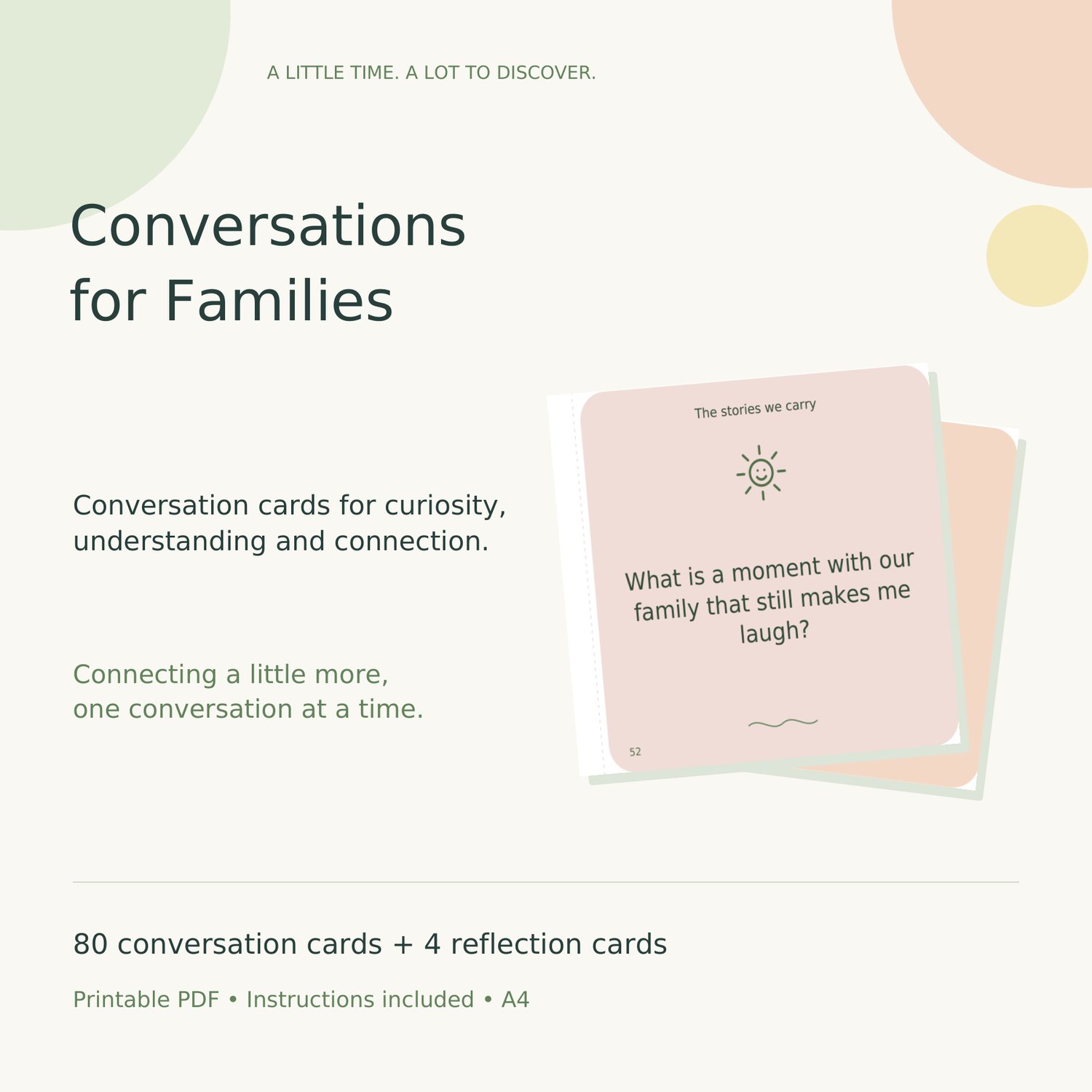
From imaginary superpowers to the things we wish others understood about us, Conversations for Families makes room for laughter, stories and meaningful connection.
These 80 research-informed questions invite family members to take turns imagining each other’s answers, then listening as each person shares their own. Begin with everyday interests and playful possibilities, then gradually explore feelings, memories, belonging and hopes for the future.
Everyone gets a turn, including the adults. There are no scores to keep — just an opportunity to keep discovering the people you share life with.
Includes 80 conversation cards, four reflection cards and instructions.
What’s included?
Your download includes 80 conversation cards across eight categories, four closing reflection cards and a page of instructions.
The categories are:
• The everyday me
• The playful me
• My feelings, my world
• My place in our family
• What matters to me
• The stories we carry
• How we care for each other
• Understanding me as I grow
The resource is a 15-page printable PDF, with six cards per page. Print on A4 and cut along the dotted lines.
This is a digital download. No physical product will be sent.
Who are these cards for?
These cards are for families who want to enjoy meaningful time together and keep getting to know one another.
Parents, children, siblings, grandparents and other family members can participate. Each person can respond in their own way, whether through a simple answer, a story, a drawing or an example.
The questions invite everyone to be curious about each other. Adults take turns too, giving family members an opportunity to discover things about one another beyond their everyday roles.
How do we use them?
Choose one person whose answer everyone is imagining. Read a question aloud, then let each family member offer a guess. The person then shares what fits, what doesn’t, and their own answer.
Swap so everyone has a turn answering the same question, and rotate who guesses first.
The cards begin with everyday and playful questions before gradually moving into deeper reflection. Set aside around 15–20 minutes, but let the conversation take priority. There is no target number of cards to complete.
Anyone can pass, pause or say, “I’m not sure — I’d love to hear.” Each person is the authority on their own experience.
What is the heart behind these cards?
The idea grew from creating Conversations for Couples and recognising how much there can be to discover about the people closest to us.
Sharing a home, routines and daily responsibilities doesn’t mean we always know what is happening in each other’s inner world. Interests change. New worries emerge. Something that seems small to one person can mean a great deal to another.
My heart is to give families a simple, enjoyable way to make room for those discoveries, without needing to organise a serious conversation or know exactly what to ask.
Some questions might bring laughter. Others might open into a memory, a feeling or something you hadn’t realised mattered. There is room for all of it.
I hope these cards help each family member experience the care of being asked, listened to and taken seriously.
Why guess each other’s answers first?
A guess gives the conversation somewhere to begin.
Hearing someone else’s impression creates an opportunity to explain your own experience: “Yes, that’s part of it,” or “Actually, this is what it’s like for me.”
The intention is to make sharing feel more approachable. It may be easier to respond to a question and a thoughtful guess than to introduce something personal from scratch.
Getting the answer right isn’t the goal. What matters is how we listen when someone tells us more about themselves.
What research informed the questions?
The questions draw on relationship and family research, including Gottman’s Love Maps and emotion coaching, research on feeling understood and cared for, and work on family storytelling.
These ideas informed the focus on curiosity, listening, feelings, shared memories and understanding each person’s perspective.
The cards are an original conversation resource. They are not an official Gottman product, a validated assessment or a substitute for counselling.
Can we use them more than once?
Absolutely. An answer that fits today may be different in a few months or a year.
Our experiences, interests, priorities and needs change. Returning to the questions gives us an opportunity to notice those changes and keep learning about one another.
My hope is that families remain students of each other, making room for discovery throughout the different seasons of life.
Connecting a little more, one conversation at a time.