
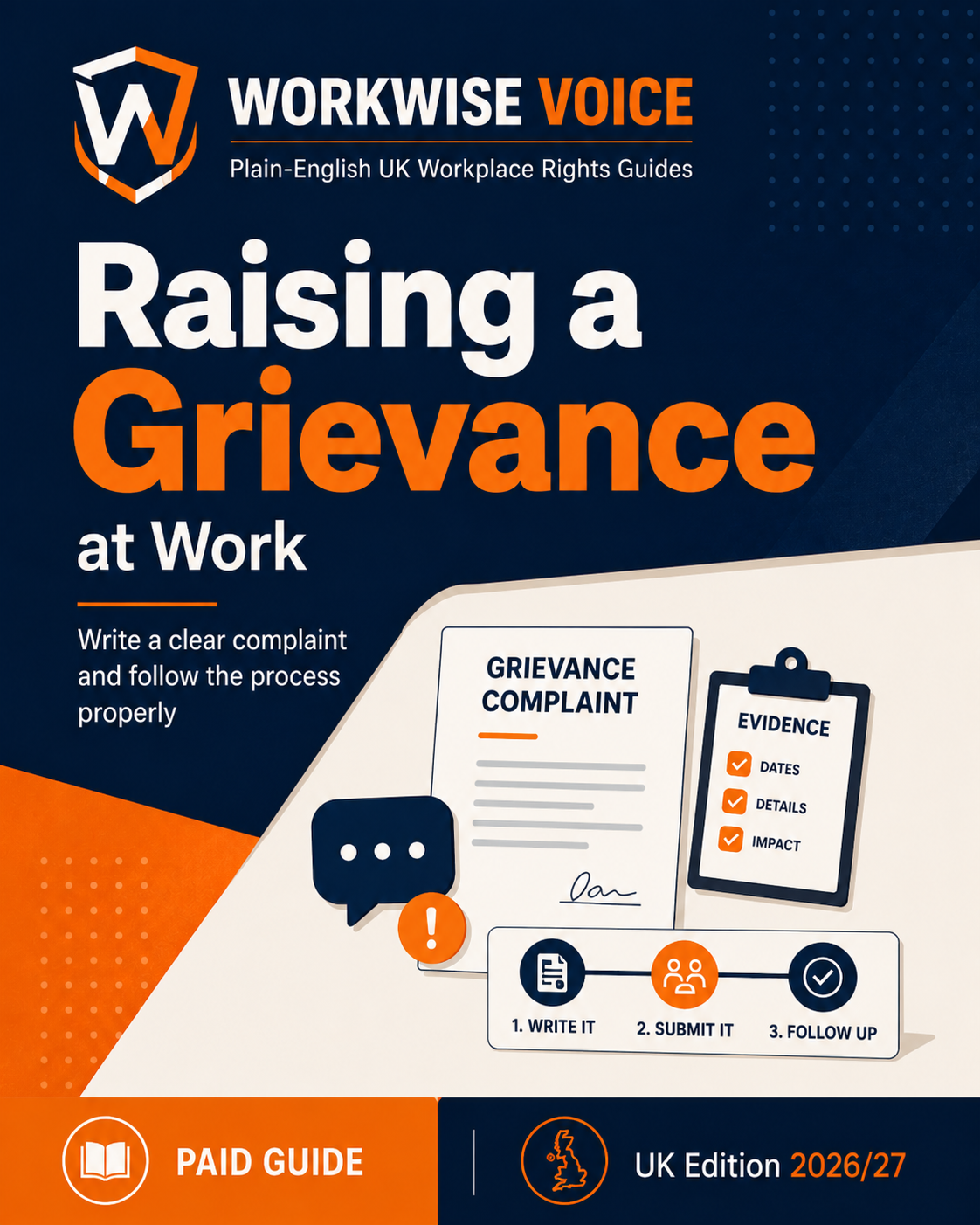
Raising a Grievance at Work — The Complete Employee Guide
Being treated unfairly at work — whether it's bullying, unpaid wages, unsafe conditions, or discrimination — can feel overwhelming. Especially when you don't know where to start.
A formal grievance is your legal route to challenge it. This guide gives you everything you need to do it properly, from the decision to go formal all the way through to appeal.
But it also tells you the things most guides leave out — the honest reality of what a grievance can and can't achieve, so you go in with clear expectations.
What's inside — 23 pages:
✔ Honest expectations — what a grievance can realistically achieve (and what it can't)
✔ When to raise a grievance — and when informal resolution is the better first step
✔ The full 8-step process — informal resolution to external escalation
✔ Exactly what to include in your grievance letter — section by section
✔ Do This / Not That — the mistakes that weaken cases
✔ Your legal rights — what your employer must do under the ACAS Code
✔ The Subject Access Request — how to request all data your employer holds on you
✔ Common mistakes that weaken grievances — 7 explained
✔ Grievance letter template — ready to adapt and send
✔ Appeal letter template — for when the first outcome isn't good enough
Toolkit included:
Evidence Scorecard — 10 evidence types rated Strong / Moderate / Weak
Timeline Log — 10-row table, start this immediately
Resolution Menu — realistic outcomes across 4 categories
Pre-submission checklist, during, and after checklists
This guide is for you if:
You're being bullied, harassed, or treated unfairly at work
You believe you're being underpaid or your contract has been breached
You've raised concerns informally and been ignored
You want to put your complaint on the record properly
Based on 28 years of workplace rights and trade union representation experience. Written in plain English. ACAS Code of Practice compliant. UK employment law.
This guide provides general information only and does not constitute legal advice. For specific advice consult ACAS or a qualified professional.