

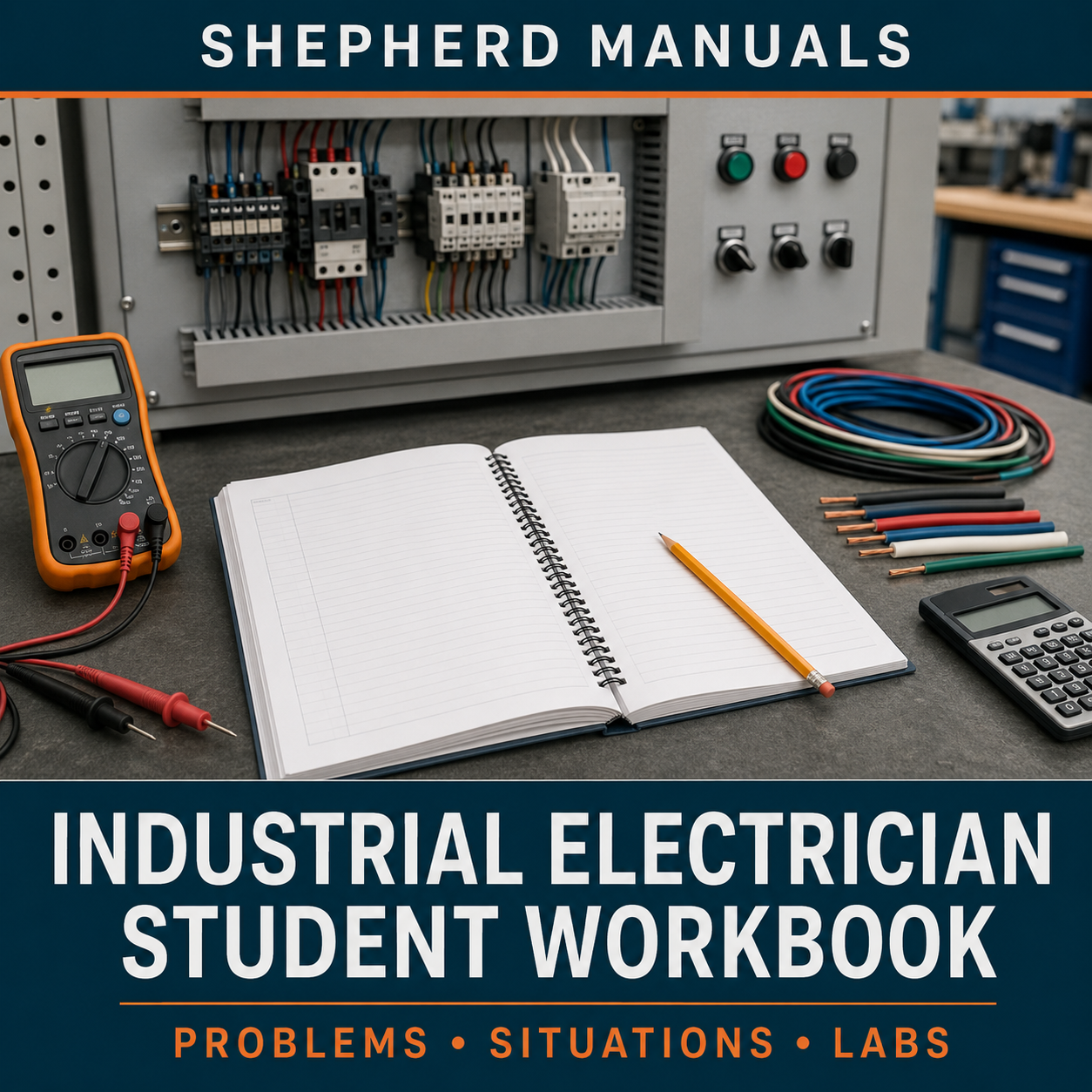
Industrial Electrician Student Workbook
Industrial Electrician Student Workbook
Problems, Calculations, Industrial Situations and Applied Activities
The Shepherd Manuals Industrial Electrician Student Workbook is a comprehensive 313-page companion to the 500-page Industrial Electrical Training Textbook.
It is designed to make students apply what they have learned—not merely reread definitions. Every textbook chapter is reinforced through four-choice knowledge questions, written explanations, calculations, troubleshooting situations, supervised activities and evidence-based technical documentation.
This is an answer-free student edition. Solutions, examination keys and instructor guidance are contained only in the separately available controlled instructor manual.
What the workbook contains
The workbook includes:
- 31 chapter-aligned workbook modules
- 217 four-choice knowledge questions
- 195 technical-reasoning and calculation exercises
- 31 detailed industrial troubleshooting situations
- 155 structured situational-response assignments
- 31 supervised applied activities
- Ten comprehensive unit reviews
- Prediction–measurement–interpretation records
- Troubleshooting worksheets
- Calculation and verification sheets
- Student competency records
- Space for instructor observations and signoff
- More than 590 individual learning and performance activities
Every selected-response question provides exactly four choices. Written exercises require the student to explain reasoning, identify assumptions, show calculations, state measurement points and describe what the evidence proves.
More than a question book
This workbook trains the student to approach industrial electrical work systematically.
Students are repeatedly required to:
- Define the expected operating state
- Identify hazards and authorization requirements
- Preserve the original fault evidence
- Separate observations from assumptions
- Form a technically defensible hypothesis
- Predict the expected measurement before testing
- Select safe, meaningful test points
- Record instrument settings and measurement references
- Interpret results without overstating the evidence
- Verify the repair and document the final equipment condition
The goal is to develop an electrician who can explain why a test is being performed, what result is expected and how that result changes the diagnosis.
Subjects reinforced
Workbook modules cover:
- Industrial electrician responsibilities and professional practice
- Electrical hazards, shock and arc flash
- Lockout/tagout, PPE and safe meter use
- Voltage, current, resistance, power and energy
- Ohm’s law and electrical calculations
- Series, parallel and combination circuits
- Magnetism, inductance and capacitance
- AC theory and single-phase circuits
- Three-phase systems and transformers
- Conductors, insulation and terminations
- Raceway selection, conduit bending and wire pulling
- Conduit fill, bend limits and pull planning
- Grounding, bonding and overcurrent protection
- Digital multimeters and voltage measurements
- Clamp meters and insulation-resistance testing
- Open, shorted, grounded and intermittent circuits
- AC motors, nameplates, torque, speed and slip
- Motor starters, contactors and overload protection
- Motor failure patterns
- Relays and machine-tool control devices
- NEMA ladder diagrams
- Seal-in circuits and electrical interlocks
- Reversing, jogging, timing and sequencing
- Variable-frequency drives and soft starters
- PLC input and output troubleshooting
- 24 VDC controls and industrial sensors
- 4–20 mA analog loops and process-meter practice
- Systematic troubleshooting and fault trees
- Preventive and predictive maintenance
- CMMS documentation
- Installation planning and commissioning
- Conduit systems, fittings, supports and fasteners
- Enclosures and professional control-panel workmanship
- Shift handoff and competency development
Four types of learning in every chapter
Knowledge checks
Each chapter contains seven four-choice questions covering terminology, technical principles, safe first actions and evidence selection.
Technical reasoning and calculations
Students must explain concepts in proper technical language, provide a second field-based explanation, compare related subjects and solve chapter-specific calculations.
Answers must show:
- Known values
- Formula or governing principle
- Substitution
- Units
- Final result
- Reasonableness check or limitation
Industrial troubleshooting situations
Each chapter presents a realistic plant condition. Students must document:
- Initial equipment state
- Hazards and controls
- Best first action
- Test points and expected results
- Evidence that separates probable causes
- Actions that could destroy evidence or introduce risk
- Repair-verification requirements
Applied activities
Each chapter includes a supervised activity with:
- Pre-task safety and authorization gate
- Equipment and drawing identification
- Instrument and tool inspection
- Expected-state documentation
- Prediction–measurement–interpretation table
- Required evidence package
- Restoration record
- Student reflection
- Instructor observation and signoff
Professional measurement practice
The workbook requires students to record:
- Instrument used
- Measurement category and voltage rating
- Lead and accessory condition
- Selected function
- Lead-jack placement
- Exact measurement points
- Circuit operating state
- Expected range
- Actual reading and units
- Interpretation and limitations
Fluke industrial DMMs and Fluke 787B/789-class process meters are recognized professional instruments when properly rated and connected for the task. Professional tools from Klein Tools, RIDGID, Wiha, Greenlee and other qualified manufacturers are also recognized for supervised industrial installation work.
A respected brand never replaces proper ratings, inspection, training or an approved safe-work procedure.
Designed for
- Industrial electrical apprentices
- Maintenance-electrician trainees
- Electrical and mechatronics students
- Community colleges and technical schools
- Apprenticeship programs
- Manufacturing maintenance departments
- Corporate industrial-training programs
- Experienced technicians reviewing industrial electricity
- Instructors who need structured student assignments
- Employers documenting apprentice development
What you receive
- One professionally formatted 313-page PDF student workbook
- 31 chapter-aligned modules
- More than 590 learning and performance activities
- Ten unit-review sections
- Reusable troubleshooting and calculation worksheets
- Student competency record
- Printable US Letter pages
- Searchable PDF text
- Immediate digital access after purchase
Required companion textbook
This workbook was developed specifically for use with:
Shepherd Manuals Industrial Electrical Training Textbook — 2026 Professional Edition
The textbook is sold separately.
The workbook may be used for review and assessment, but its chapter sequence, terminology, calculations and activities correspond directly to the Shepherd Manuals textbook.
Instructor resources
The separately available Industrial Electrician Instructor Manual contains:
- Complete workbook solutions
- Model technical responses
- Calculation answers
- Teaching guidance
- Chapter performance rubrics
- Ten secure unit examinations
- Two cumulative final examinations
- Complete answer keys and rationales
The instructor manual is not included with this student workbook.
Important safety notice
Applied activities must be performed only on approved training equipment or properly controlled industrial systems under qualified supervision.
No workbook activity authorizes energized electrical work, bypassing a safeguard, forcing safety-related PLC logic, testing beyond an instrument’s rating or performing work beyond the student’s training and authorization.
Always follow the adopted electrical code, employer procedures, equipment manufacturer instructions and the requirements of the authority having jurisdiction.
Do more than select an answer. Predict the result, perform the test, interpret the evidence and prove the repair.