
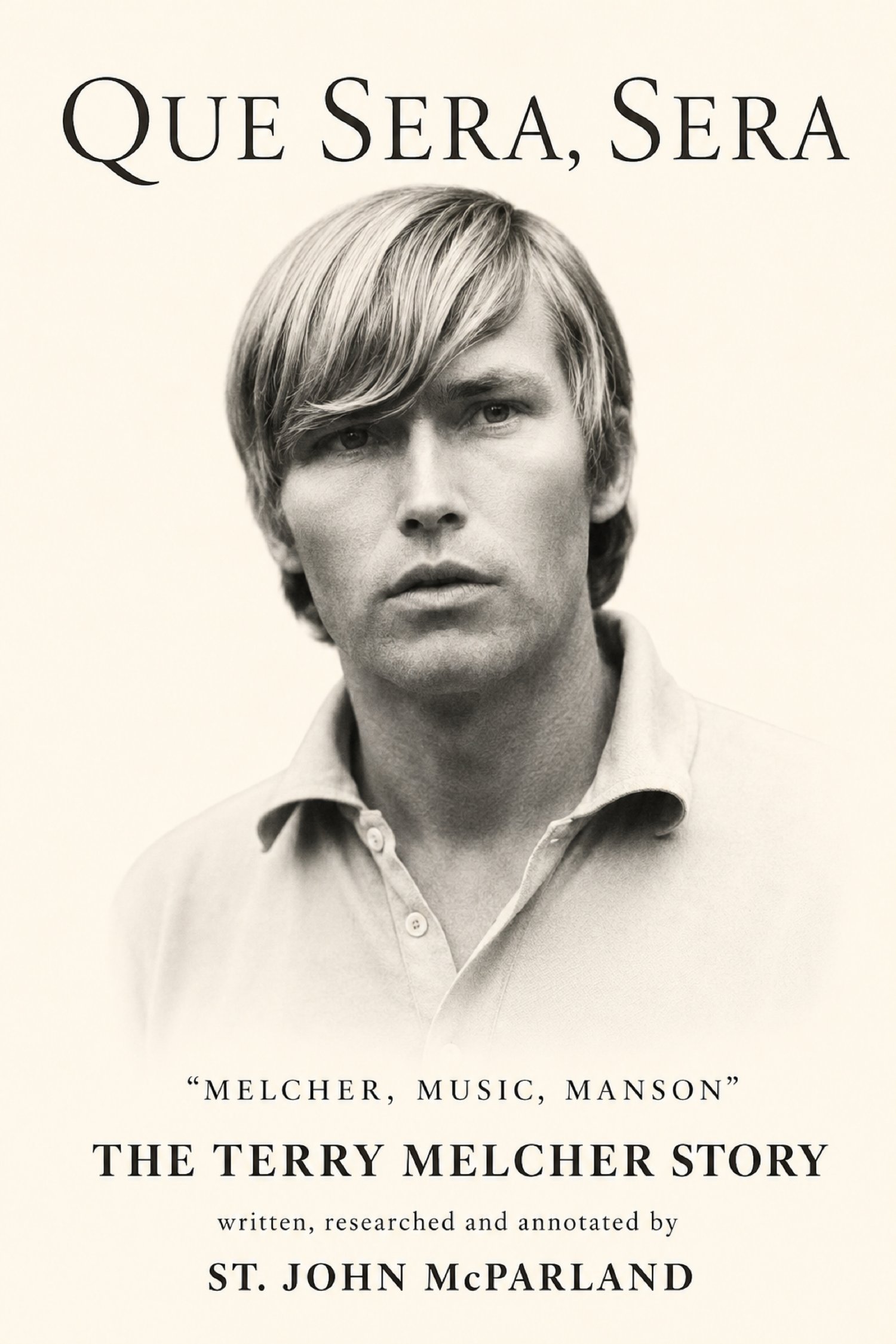
Que Sera, Sera: The Terry Melcher Story
566 PDF E-BOOK (533MB)
$US13.95
"BROUGHT TO LIFE BY 2,518 IMAGES (INCLUDES 1300 PHOTOGRAPHS), MANY NOT SEEN BEFORE, AND MOST IN COLOUR"
Terry Melcher occupied a remarkable place in American popular music. He was a singer, songwriter, producer, arranger and record executive who helped shape the sound of an era, yet his achievements have too often been obscured by the fame of those around him. He was Doris Day’s son, a close associate of some of the most important musicians of the 1960s, and a figure whose name became permanently entangled with the dark mythology surrounding Charles Manson. Those associations have sometimes overshadowed the far more important story: Terry Melcher was one of the architects of the “California Sound”.
In QUE SERA, SERA: THE TERRY MELCHER STORY, author McParland has undertaken the considerable task of restoring Melcher to his rightful place in popular-music history.
This is no superficial biography assembled from familiar anecdotes. It is the product of years of determined research, careful comparison and an evident lifelong passion for the music. McParland follows Melcher from his complicated childhood and famous family background through his earliest encounters with the record business, his work at Columbia Records, and his creative partnerships with Bruce Johnston, The Rip Chords, The Byrds, Paul Revere and the Raiders, Doris Day, the Beach Boys and many others.
Along the way, an extraordinary musical world comes vividly to life, aided by thousands of images, many never seen before, and most in colour.
This was a period when Los Angeles was becoming one of the great centres of popular recording. Producers, musicians, songwriters and singers moved constantly between studios, record labels and informal creative partnerships. A song might begin at a piano in Beverly Hills, be shaped during a late-night studio session in Hollywood, and emerge days later as part of a new musical movement. This world is documented in impressive detail, revealing not only what was recorded, but who participated, where the sessions took place, how the records were received and how the relationships behind them developed.
The depth of the research is formidable. Recording contracts, session information, contemporary newspaper reports, music-industry publications, chart histories, court testimony, personal recollections and original interviews have been brought together to create an unusually complete account. McParland is not content simply to repeat a familiar story. He investigates contradictions, tests long-accepted claims and openly acknowledges the occasions when the surviving evidence does not provide a definitive answer.
That honesty is one of the book’s great strengths.
So too is McParland’s personal connection to his subject. His extensive interviews with Terry Melcher (over the years) provide the book with a voice and immediacy that could never have been achieved through archival research alone. Melcher emerges not as a distant name printed on a record label, but as a talented, ambitious, complicated and frequently humorous human being. He could be generous, guarded, loyal, competitive and, at times, contradictory. McParland does not attempt to turn him into either a hero or a villain. Instead, he allows the evidence - and often Melcher’s own words - to reveal the man.
The book also confronts the most troubling chapter of Melcher’s life: his association with Charles Manson and the lingering questions surrounding Cielo Drive. This material is treated seriously and extensively, but it does not consume the entire narrative. That distinction is vital. The Manson connection was part of Terry Melcher’s life, but it was not the sum of it.
Long before those events, Melcher had helped bring folk rock into the mainstream through his work with The Byrds. He had developed the hard-driving sound of Paul Revere and the Raiders, contributed to the surf and hot-rod records of the early 1960s, worked with many of the finest studio musicians in Los Angeles and helped bridge the gap between the established record industry and a rapidly changing youth culture. Years later, he returned to prominence through his work with the Beach Boys, including the enormous international success of “Kokomo.”
The full sweep of that career is captured within these pages.
This book will naturally appeal to admirers of Terry Melcher, Doris Day, The Byrds, the Beach Boys and the California music scene. Its value, however, extends well beyond any one artist or group. It is also a detailed history of how popular records were conceived, created, promoted and sometimes lost in the machinery of the music business. Collectors, researchers and serious students of 20th Century popular culture will find an abundance of material here that is unlikely to be available in any other single volume.
Most importantly, McParland has given Terry Melcher something he has long deserved: a biography substantial enough to contain the contradictions, accomplishments, relationships and extraordinary experiences of his life.
This is an ambitious, revealing and deeply committed work. It invites readers to look beyond the famous family name, beyond the headlines and beyond the mythology, and to listen again to the music.
After reading it, Terry Melcher’s place in that music can no longer be overlooked.
This is part of the "PRINT YOUR OWN BOOK SERIES".
Please treat this offer in the spirit in which it is given.
FOR A DETAILED LIST OF THE BOOK'S CONTENTS, CONSULT: