
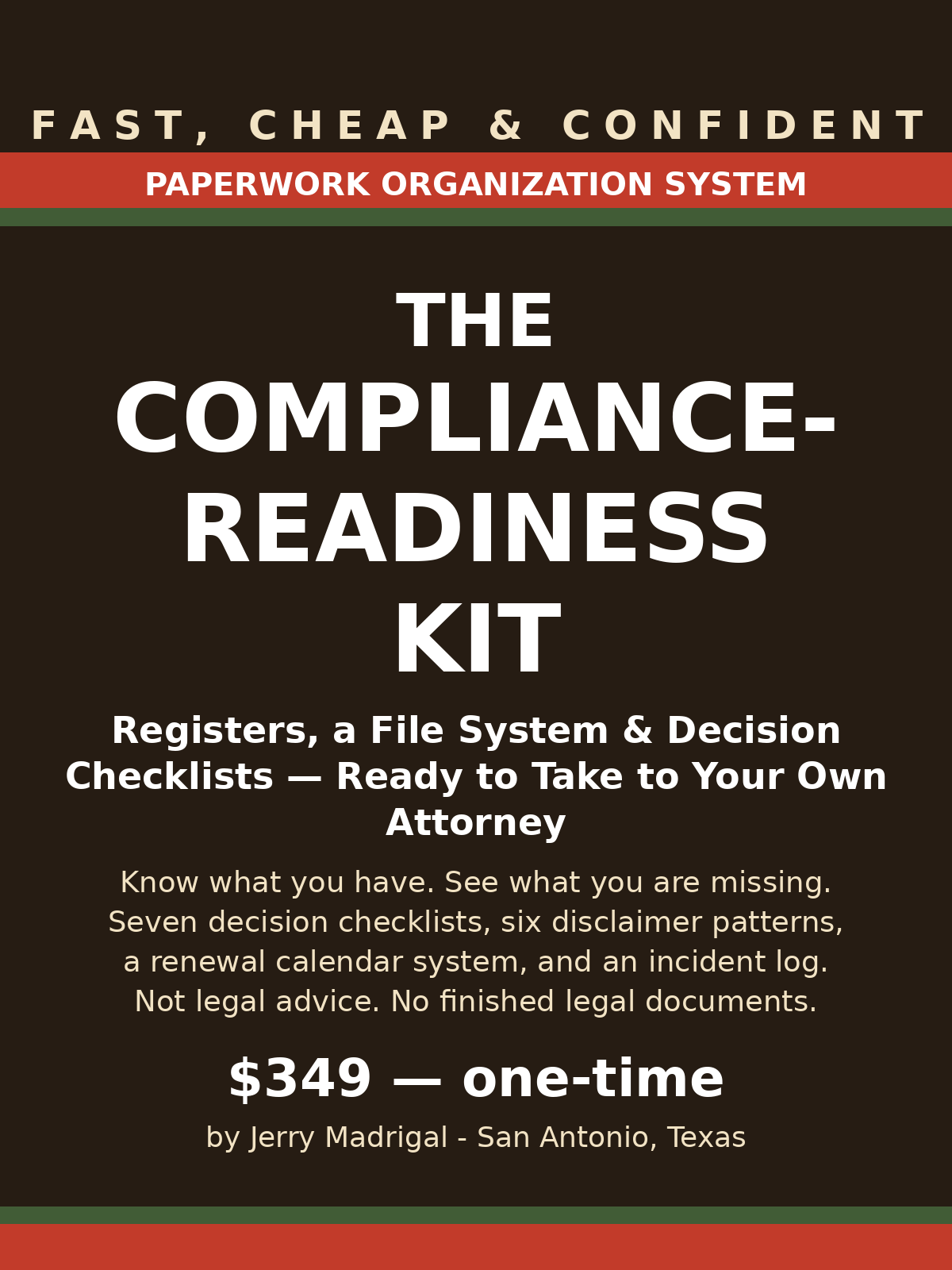
The Compliance-Readiness Kit — Paperwork Registers, File System & Attorney-Ready Decision Checklists for Small Businesses ($349) | Fast, Cheap & Confident
What this is, plainly: an organization system for your business paperwork — registers, a file system, disclaimer patterns, and decision checklists that turn "what are we missing?" into a list with owners and dates, ready to take to your own attorney. It is not legal advice, it contains no finished legal documents, and it does not make any business compliant. Every template that touches legal subject matter is marked DRAFT — ATTORNEY REVIEW BEFORE USE, because that's what it is.
This kit was generalized from the working registers of a real business — one whose own register still honestly shows gaps (no business-wide privacy policy yet, no unified terms, no general refund policy) being closed with professional help. That's the point: the kit doesn't pretend the paperwork is done. It makes what exists findable, what is missing visible, and what to decide next undeniable.
What's inside:
- Step 1 — The Attorney-Review Queue (build it first) — one table for everything your business already knows needs professional eyes: item, why, owner, professional, status. The kit's own adapted patterns join this queue by default. Nothing leaves the queue by being used anyway.
- License & Permit Register — every license, permit, registration, and platform agreement your business runs under: what it is, who issued it, where the document lives, issue and renewal dates, cost, status. With a status key, filing rules (a "document location" points to the file, not to someone's memory), and one fictional worked example, labeled fictional.
- Contract File System — the folder structure, naming pattern, and status discipline that keep signed agreements, working drafts, templates, and transaction evidence in separate homes that never share a name pattern — with the standing rule printed in the guide: a guide, receipt, or platform page is not a signed agreement.
- Disclaimer Pattern Library — six patterns as skeletons with blanks: no-income-promise, guarantee-the-work, general-information boundary, AI-content honesty, estimate labeling, and the affiliate/relationship disclosure pointer. Each pattern states where it belongs and carries its misuse warning and the library rule: never strengthen, broaden, or carry a pattern into a new context on your own. Starting shapes for a conversation with your professional — not wording to copy.
- Seven Policy Decision Checklists — Privacy · Terms of Sale/Use · Refunds · Data Retention & Deletion · Accessibility Statement · Cookie/Data Collection · Affiliate & AI-Content Disclosures. Each is three parts: the facts to gather, the decisions to settle with your own attorney or qualified professional, and an honest gap statement. Questions and decision points only — no policy language to copy, in any of them.
- Deadline & Renewal Calendar System — every dated row in every register becomes a calendar entry the day it is registered, with lead-time reminders (the 90/30/7 pattern, at offsets you set). A date that lives only in a register is treated as not yet recorded.
- Document-Retention Schedule — record categories, where each is kept, deletion method, owner — with every retention-period cell blank by design, to be settled via the Retention checklist with your professional. A schedule with borrowed periods is worse than an honest blank, and the guide says so.
- Incident Log — the blank log plus the log-first discipline: date, what happened in facts, which registers it touches, action taken, professional consulted, closure. One fictional worked entry shows the fields.
You receive two PDF files: the assembled kit (guide, queue, file system, pattern library, and all seven decision checklists) and a registers-and-logs companion (the blank working registers, retention schedule, calendar worksheet, and incident log, laid out to print and reuse). Files only — no live help, no review of your paperwork, no calls.
Same price, different shelf — Project 84 vs. Project 99: The Licensee Success System (Project 84) also costs $349, and the two are not versions of each other. 84 runs your licensing program — the outward system for onboarding your licensees. 99 organizes your own paperwork — the inward system for your own business's registers, files, and policy decisions. Different shelves. A licensor may want both; buying one does not include, discount, or substitute for the other.
Two neighbouring products, one line each: the Customer Care Time-Saver Kit ($129, Project 85) holds the reply wording for customer incidents — this kit's incident log is the record discipline behind it, and neither contains the other's content. The Professional Proposal Library ($249, Project 98) holds the documents you send before a sale — this kit files what comes back signed, and everything else your business holds.
Who should not buy this: anyone who needs a policy or a contract today — you need an attorney, and this kit's first step will tell you the same thing; anyone looking for ready-to-use legal documents (there are none in here, on purpose); anyone who wants to become compliant by buying a product (no product does that). And an honest down-sell from the guide itself: if you are a solo seller with a handful of documents, you do not need a $349 kit — start the one-page register habit the guide describes, and buy systems when your paperwork outgrows it.
FAQ:
Q: Is this legal advice?
A: No. The fence at the top of this listing is the whole answer: this is an organization system for your paperwork. It contains no finished legal documents, and every template that touches legal subject matter is marked DRAFT — ATTORNEY REVIEW BEFORE USE. Your attorney or qualified professional settles the decisions the checklists surface.
Q: Do I get a ready-to-use privacy policy, terms, or refund policy?
A: No — deliberately. You get seven decision checklists (Privacy, Terms, Refunds, Retention, Accessibility, Cookies, Disclosures) that produce the facts and settled decisions a professional needs to draft your documents. A template seller cannot know your jurisdiction, business model, or obligations, and the kit refuses to pretend otherwise.
Q: Will this kit make my business compliant, or ready for an audit?
A: No. It makes what exists findable, what is missing visible, and what to decide next undeniable — organization, not a legal outcome. Nothing in the kit creates legal protection of any kind, and no wording in it should be read as promising one.
Q: What are the disclaimer patterns, exactly? Finished wording I can paste?
A: No. The library ships six patterns as skeletons with blanks — where each belongs, what decisions fill the blanks, and a misuse warning — under the DRAFT marking, with the kit's own patterns placed on your Attorney-Review Queue by default. The source business's actual wording is not in the kit, by design.
Q: Your own paperwork has gaps? Why should I buy a system from a business that hasn't finished its own?
A: Because that is the honest state of most real businesses, and the kit is the system that makes the gaps visible and closable with professional help — generalized from working registers that show MISSING entries openly. A register that shows a gap honestly is worth more than a folder of borrowed policies. The second paragraph of this listing says it in the open, before you pay.
Q: How is this different from the Licensee Success System (Project 84, also $349)?
A: Direction. 84 is outward: onboarding and managing your licensees — their registry entries, welcome, orientation, renewals. 99 is inward: your own business's licenses, permits, contracts, and policy decisions. Different shelves; neither includes the other.
Q: I already own the Customer Care Time-Saver Kit ($129). Does this duplicate it?
A: No. Project 85 holds reply playbooks — words to send. Project 99's incident log is the record discipline — what gets written down, where, and what it triggers. A single complaint can produce both an 85 reply and a 99 log entry; neither file contains the other's content.
Q: What files do I receive, and in what format?
A: Two PDFs, delivered as instant downloads: the assembled kit and the registers-and-logs companion. No software, no account, and no subscription is included or required beyond whatever calendar and file tools you already use.
Q: Any live help — will you review my registers or check my paperwork?
A: None. No paperwork reviews, organization services, or checks of a buyer's business are part of this product — files and method, complete on their own. The kit's Step 1 exists precisely to route those questions to your own attorney or qualified professional.
Q: I'm a solo seller with a few documents. Is this for me?
A: Probably not yet, and the kit's guide says so itself: start with the one-page register habit. This kit is sized for agencies and growing small businesses whose paperwork has outgrown memor
y and inboxes.