
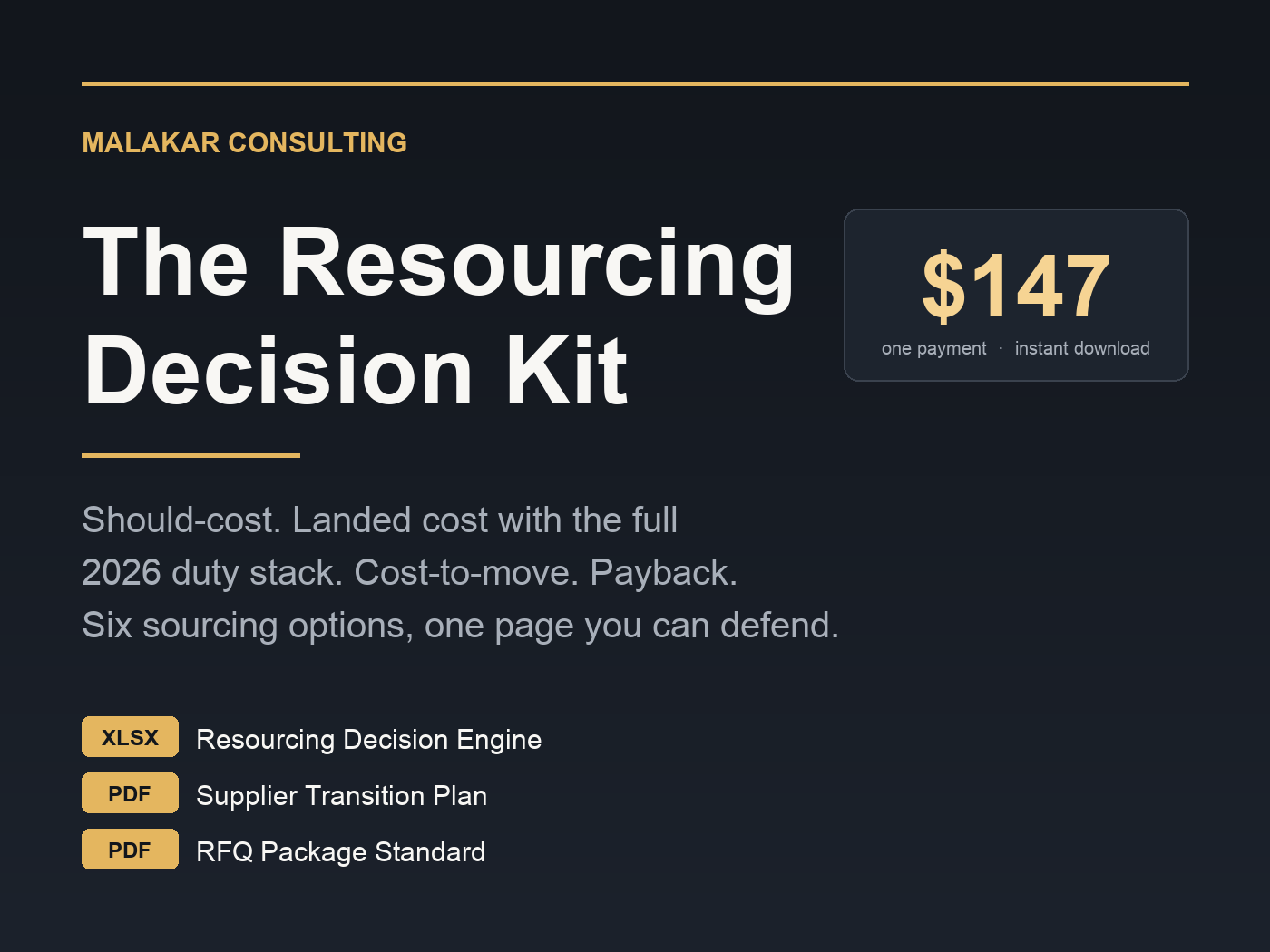
The Resourcing Decision Kit
Most resourcing business cases are wrong before anyone signs them. They count the piece-price delta and forget the tooling, the PPAP, the safety-stock build and the air freight nobody budgeted. Then a Section 232 inclusion lands on the commodity and the whole case inverts.
This is the model that catches all of it.
WHAT YOU GET — three files, instant download:
1) Resourcing Decision Engine (XLSX). A working model, not a blank template. Eight linked tabs that take one part and compare six sourcing options end to end: bottom-up should-cost, the full duty stack, statutory fees at published FY2026 rates, the one-time cost of moving, payback, NPV and a weighted risk score. Every formula is live and visible. Nothing is locked.
2) Supplier Transition Plan (PDF). The eight-week sequence for moving a part without stopping the line — nine phases, each with the exit gate you do not pass without. Plus the six failure modes that kill resourcing programmes, and what prevents each one.
3) RFQ Package Standard (PDF). Ten sections that make quotes comparable, and why each one moves a price by double digits. The most common sourcing mistake is not overpaying — it is comparing two quotes that priced different things.
WHY THE DUTY STACK IS THE PART EVERYONE GETS WRONG. There is no such thing as a country tariff rate. Your duty is a stack — base HTS rate, plus Section 232 if your commodity is in scope, plus Section 301, plus any antidumping or countervailing order — and it turns on your specific 10-digit classification, origin and entry date. Free calculators give you one number. This model makes you build the stack, because that is where the money is.
Every rate shipped in the workbook carries its source and its date on the Rate Library tab. Between July and August 2026 alone, a Section 301 forced-labour tier replaced the flat Section 122 rate, Commerce opened comment on extending 232 to more steel and aluminium derivatives, and new 232 proclamations landed on polysilicon and on drones.
WHO BUILT IT. Seventeen years in global supply chain, procurement and strategic sourcing — a Fortune 500 industrial manufacturer, Polaris, Blue Bird, Warn Automotive, BorgWarner. More than $1.58 billion in managed spend and over $128.5 million in delivered savings. Karrass-trained negotiator, Executive MBA. The transition plan is the sequence used to move a PCBA from China to Mexico in eight weeks during the chip shortage.
WHO THIS IS NOT FOR. If you need a customs ruling, a binding classification or legal advice, this is the wrong purchase — you need a licensed broker or trade counsel. This is a decision model for people who already own a sourcing number and have to defend it.
FOURTEEN-DAY GUARANTEE. Run one real part through it. If it does not change how you look at that part, reply to your receipt for a full refund. Keep the files.
Not legal, customs or tax advice. Verify your own classification before committing capital to a resourcing decision.