
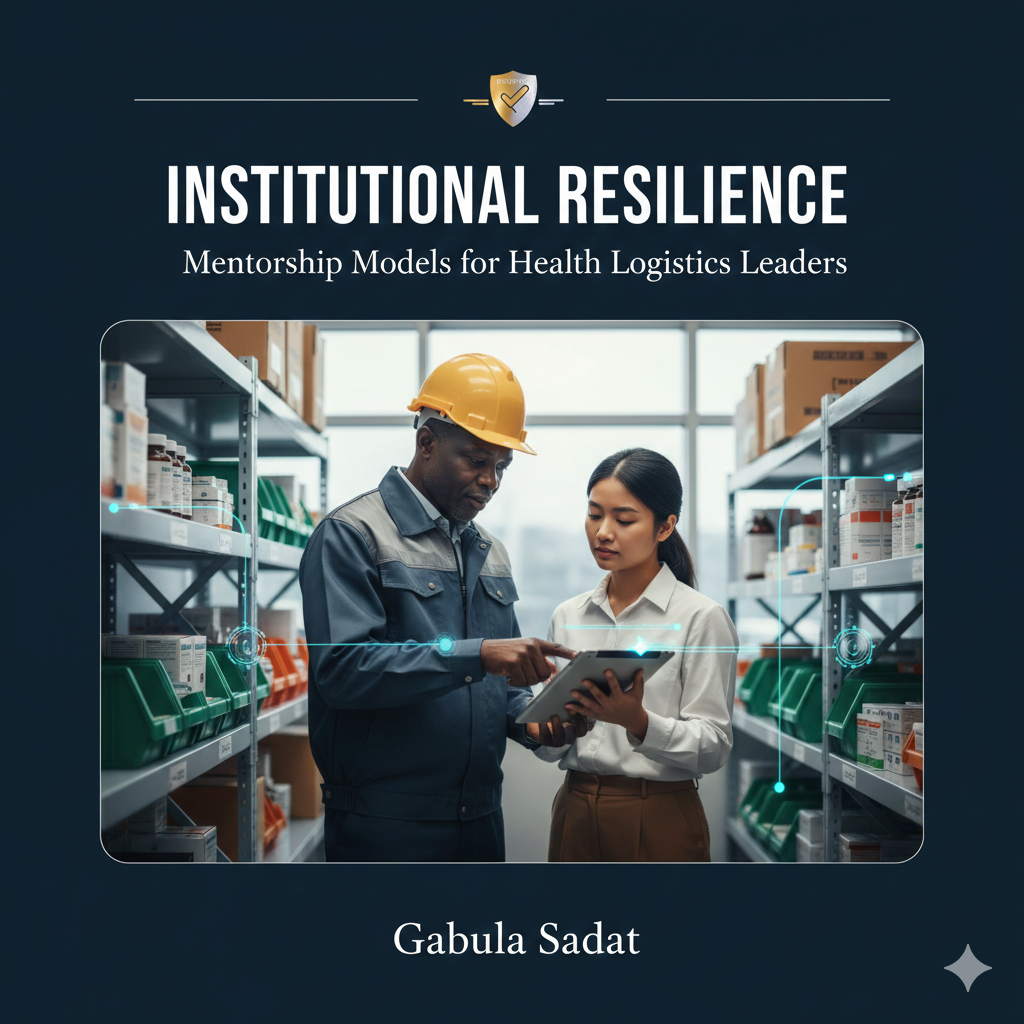
Institutional Resilience Mentorship Models for Health Logistics Leaders
Institutional Resilience: Mentorship Models for Health Logistics Leaders
Capturing Tacit Knowledge and Building Leadership Pipelines to Counter Brain Drain
By Gabula Sadat
Is This Book for You?
This book is written for policy makers, government officials, NGO administrators, health system leaders, and emerging professionals who are committed to strengthening health supply chains and ensuring that critical knowledge doesn't walk out the door when experienced staff retire or move on.
Why This Book Matters
In health logistics, the most valuable asset isn't equipment or inventory—it's people. Yet across developing nations and even established health systems, the departure of seasoned professionals creates dangerous gaps in institutional memory. When experienced leaders leave, they take with them decades of hard-won wisdom, contextual understanding, and problem-solving instincts that can't be found in any manual.
Brain drain isn't just a human resources problem—it's a threat to public health.
What This Book Offers
Gabula Sadat draws on nearly two decades of frontline experience across public, private, and humanitarian sectors to deliver a practical, field-tested framework for:
 Capturing tacit knowledge before it walks out the door
Designing structured mentorship programmes that actually work
Building leadership pipelines that ensure continuity
Measuring impact so you know what's working
Creating policy frameworks that support institutional resilience
Inside You'll Discover
· Chapter 1: Why mentorship is the antidote to brain drain in health logistics
· Chapter 2: Frameworks for effective mentorship aligned with organisational goals
· Chapter 3: Practical tools for identifying and capturing tacit knowledge
· Chapter 4: Integrating succession planning with mentorship
· Chapter 5: Step-by-step guidance for implementing mentorship programmes
· Chapter 6: Real-world case studies and evaluation tools
· Chapter 7: Policy recommendations for NGOs, governments, and administrators
· Chapter 8: Future directions in health logistics mentorship
About the Author
Gabula Sadat is Executive Director and Co-founder of Organizational Development Professionals (ODPROS) and the Proficient Pharmaceutical Inventory Management Solution (PROPIMS). With postgraduate credentials in Organizational Development and Procurement & Supply Chain Management, a Diploma in Pharmacy, and nearly two decades of frontline experience, he has pioneered simple, scalable interventions that bridge complex challenges with sustainable solutions.
Who Needs to Read This Book
 Health logistics administrators seeking to protect institutional knowledge
Policy makers designing workforce development strategies
NGO leaders committed to sustainable health systems
Government officials concerned about health sector capacity
Emerging professionals preparing for leadership roles
Mentors looking to structure their knowledge transfer
Anyone who cares about the future of health supply chains
The Bottom Line
In a world where experienced health logistics professionals are retiring faster than they can be replaced, this book offers a practical roadmap for ensuring that their wisdom endures—and that the next generation is ready to lead.
 Contact the Author: mrgabulas@gmail.com
 Phone: +256 78 0958736
 Blog: gabulasadat.blogspot.com
"The future of health logistics depends not just on what we know, but on how effectively we pass that knowledge to those who will follow."
Available in ebook, hard copy, and audio formats—with integrated digital tools for implementation.