
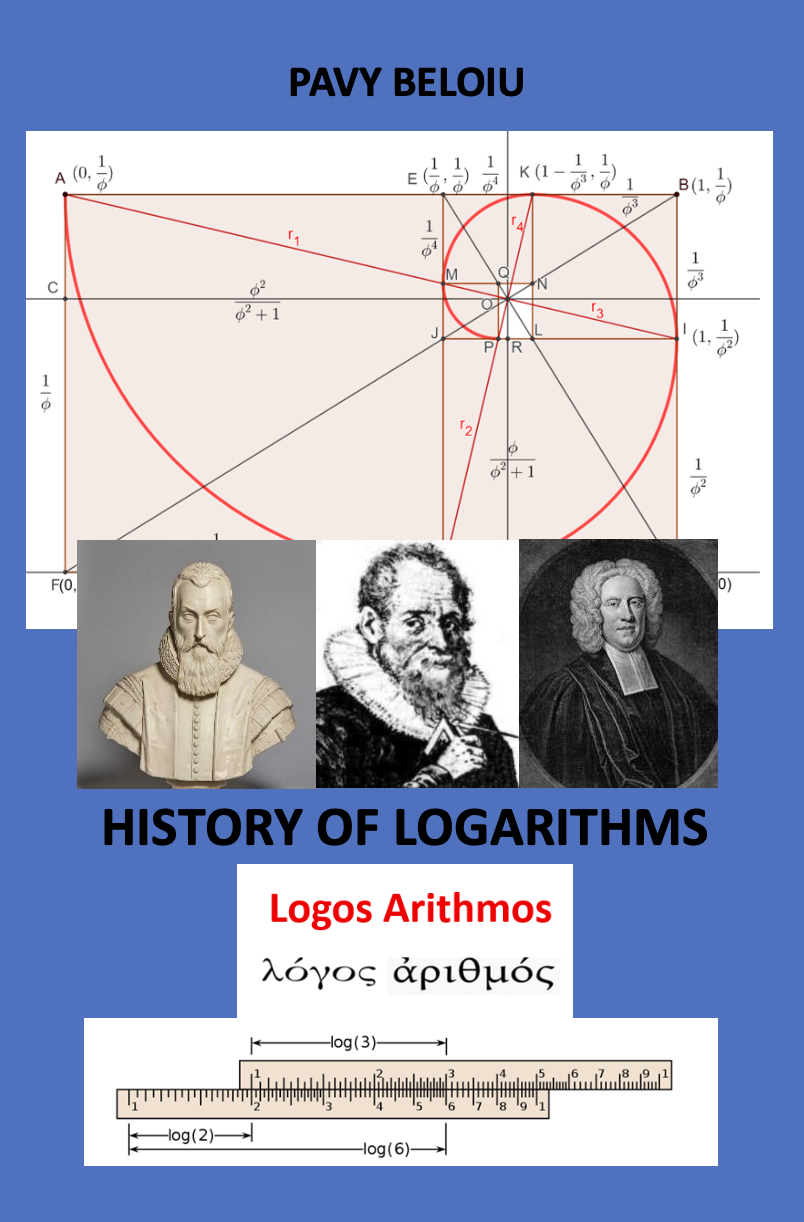
History of Logarithms
I learned logarithms in school and did my first calculations with the mantissa and characteristics, which were in the tables at the end of the algebra book. I was amazed by the power of logarithms, which helped you, in a few minutes, to do any complicated operation, raising to power and radicals of any order. My older brothers had slide rules and showed me how to multiply with 7-digit numbers, in a few translations. What a miracle! I knew nothing about this secret, kept hidden in the tables, with 10 decimal places in textbooks. Then, in integral calculus, I saw that the base of natural logarithms is the mysterious number e, then I heard something about Napier and the logarithms, which bear his name.
After 50 years, I asked myself the question, why did John Napier call them logarithms? What does logos arithmos mean, or the proportion of the number? Here are some questions, which find their answer, partially in my modest book.
Napier remained famous because his logarithms are called Napierian. Who are Bürgi and Briggs, who came after him? Here are other answers dug up from the dust of history. The world has forgotten them, who still studies logarithms? What is the slide rule, which took civilization to the heights of knowledge, until pocket calculators arrived? These pious people are still behind progress and civilization.
I have briefly reviewed the history of these mysterious small infinities, with bases around one. I have created the tables again one by one, starting with Napier, then Bürgi and Briggs. The divisions of ONE are fascinating and brought logarithms, trigonometric tables and later, small infinities, fluxions, as Newton called them. Gauss went even further and defined the circle with radius ONE in the complex plane. At 19 years old he solved the problem of constructing the regular polygon with 19 sides, which I will present in a future book. How are logarithms hidden in hyperbola and what is the connection between logarithms and the spiral of logarithms, discovered by Descartes?
Everything is linked to that universal ONE, which briefly defines the universe and especially a PERSON, which encompasses all the values of ONE: Jesus, the Son of God, the firstborn, the only one, the unique, is present on all pages of the Bible.
As a novelty, I presented the thoughts of 2 great Romanian Christian philosophers and thinkers, Noica and Moisescu, who discovered the secret of the pyramid of Cheops.
I think the adventure of reading is fascinating and brings to light a forgotten history, which deserves to be known by us, those who benefit from the inventions of those mentioned above. I conclude with the column of infinity, by Constantin Brâncuși, which goes to the sky.