






Spinning Top & Marubozu Explained — One dial (PDF Guide)
You learned these as separate patterns with separate meanings, and then found candles that seemed to be two of them at once, or neither. They are not separate. They are the two ends and the middle of a single measurement, and once you see the dial the whole vocabulary collapses into something you can derive rather than memorise.
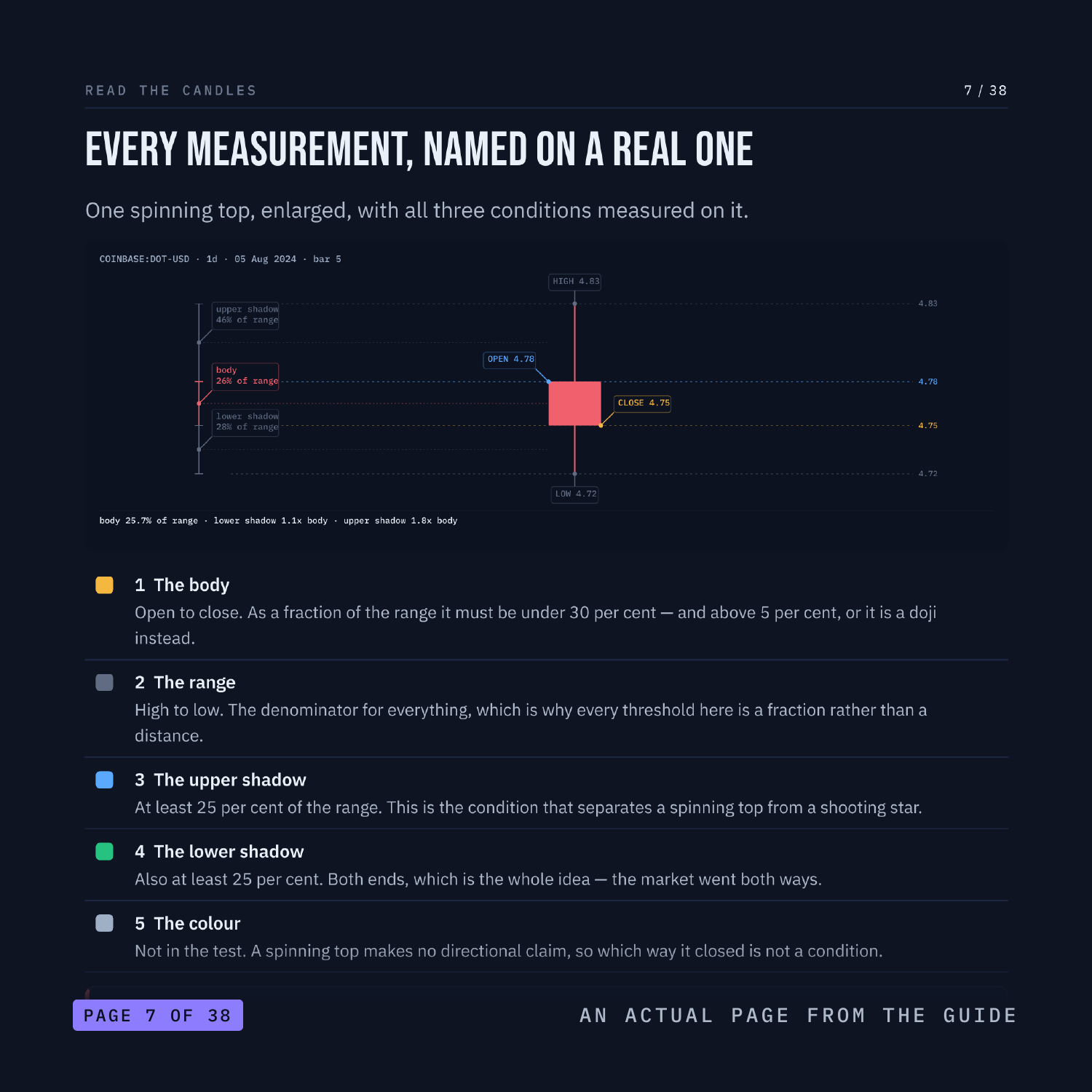
Body as a fraction of range. Under 5 per cent is a doji, under 30 per cent with shadows both sides is a spinning top, and a candle with shadows under 5 per cent at each end is a marubozu. Across 35,944 bars that gives 2,027 doji, 4,981 spinning tops and 483 marubozu. This is a 38-page PDF that teaches Spinning Top & Marubozu from the first thing you see on the screen through to a written strategy with an entry, a stop and an explicit rule for when the trade is wrong.
Nothing is taught underneath a chart. Every label sits on the candle, the line or the level it is describing, on real BTC, ETH, SOL and LINK charts, with the body and shadow fractions printed on the candles. There are three quizzes on real charts, each followed by the same chart re-shown annotated with the reasoning, plus faded practice pages where the first steps are filled in and you finish the rest.
WHAT'S INSIDE
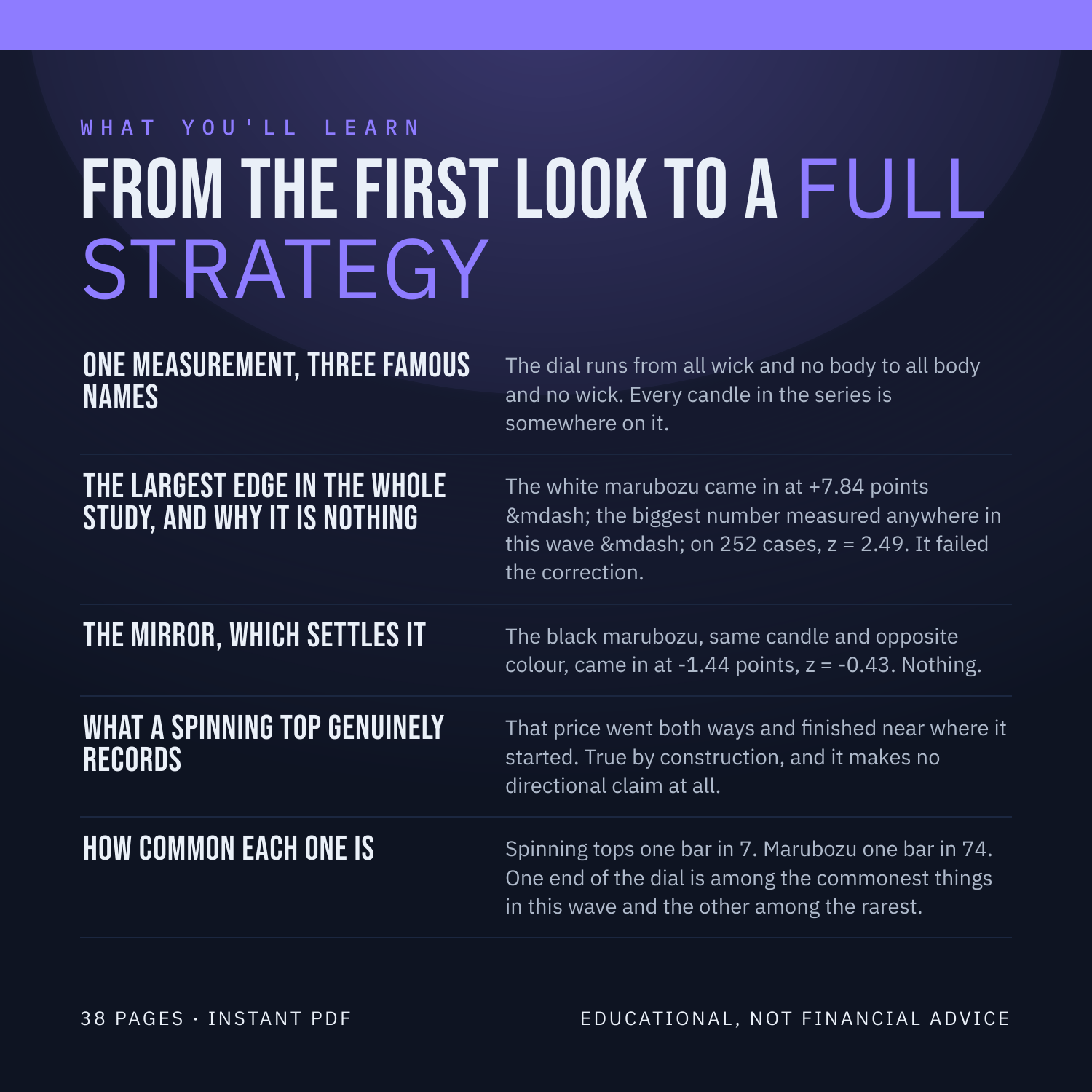
- One measurement, three famous names — The dial runs from all wick and no body to all body and no wick. Every candle in the series is somewhere on it.
- - The largest edge in the whole study, and why it is nothing — The white marubozu came in at +7.84 points — the biggest number measured anywhere in this wave — on 252 cases, z = 2.49. It failed the correction.
- - The mirror, which settles it — The black marubozu, same candle and opposite colour, came in at -1.44 points, z = -0.43. Nothing.
- - What a spinning top genuinely records — That price went both ways and finished near where it started. True by construction, and it makes no directional claim at all.
- - How common each one is — Spinning tops one bar in 7. Marubozu one bar in 74. One end of the dial is among the commonest things in this wave and the other among the rarest.
WHAT YOU'LL BE ABLE TO DO
- Derive doji, spinning top and marubozu from one measurement rather than memorising three.
- - Say where any candle sits on the body-to-range dial.
- - Read the largest number in a study correctly by checking its sample.
- - Apply the mirror test to a result you would like to believe.
- - Use a spinning top as a volatility reading without treating it as a signal.
AN HONEST NOTE
Spinning Top & Marubozu is a clue, not a crystal ball. It describes what price has already done. This guide contains no win-rates, no backtest results and no promises about what you will make, because nobody can verify those and you should not trust anyone who prints them. What it hands you instead is a set of rules you can test yourself on TradingView in an afternoon. Educational, not financial advice.
Instant download. 38 pages, PDF.