



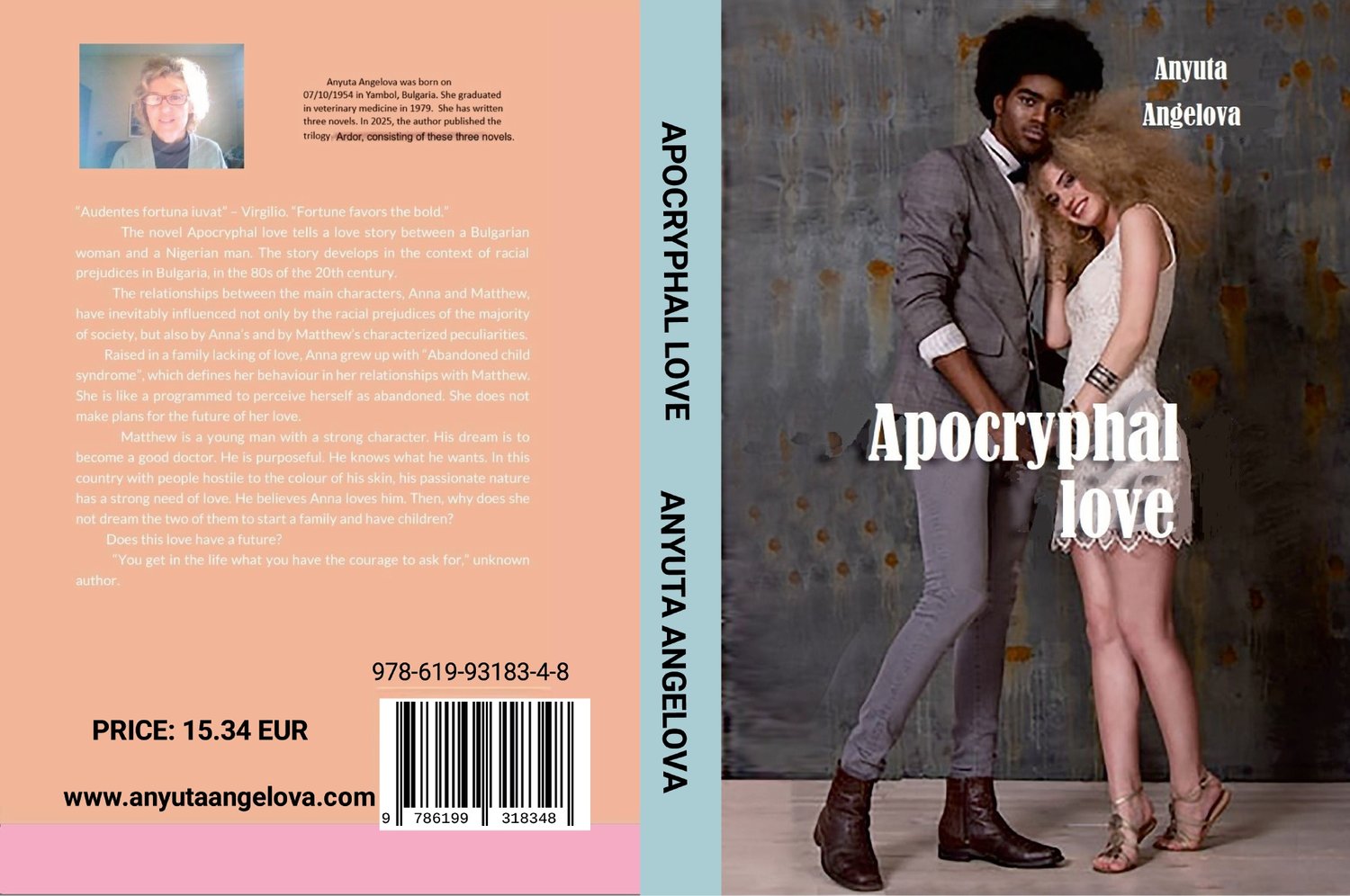




APOCRYPHAL LOVE - E-BOOK, Third edition
E-BOOK. Fiction. Novel
Author - Anyuta Angelova
Translation from Bulgarian - Diana Atanasova
Publication date - 26.01.2026
Language - English
Format - EPUB
Dimension - 0.3 MB /Print lenght - 396 pages
Source - printable file, ISBN 978-619-93183-4-8
Copyright 2026 Anyuta Angelova - author
Copyright 2026 Diana Atanasova - translator
All rights reserved
ISBN 978-619-93183-6-2
APOCRYPHAL LOVE
ANNOTATION
“Audentes fortuna iuvat” – Virgilio. “Fortune favors the bold.”
The novel Apocryphal love tells a love story between a Bulgarian woman and a Nigerian man. The story develops in the context of racial prejudices in Bulgaria, in the 80s of the 20th century.
The relationships between the main characters, Anna and Matthew, have inevitably influenced not only by the racial prejudices of the majority of society, but also by Anna’s and by Matthew’s characterized peculiarities.
Raised in a family lacking of love, Anna grew up with “Abandoned child syndrome”, which defines her behaviour in her relationships with Matthew. She is like a programmed to perceive herself as abandoned. She does not make plans for the future of her love.
Matthew is a young man with a strong character. His dream is to become a good doctor. He is purposeful. He knows what he wants. In this country with people hostile to the colour of his skin, his passionate nature has a strong need of love. He believes Anna loves him. Then, why does she not dream the two of them to start a family and have children?
Does this love have a future?
“You get in the life what you have the courage to ask for,” unknown author.
EXCERPT FROM THIS NOVEL
Foreword
The woman appeared far younger than her age, thanks to her figure—slender and sculpted like a statue, though with a slightly boyish quality, in my opinion. Her hasty movements and carefree gait seemed more childish than feminine. The receptionist had informed me that she was my age and that she would make the most suitable company for me in this modern yet undeniably somber sanatorium.
She had already claimed her half of the drawers, wardrobes, and one of the beds. As I entered the room, she greeted me warmly, or at least as warmly as she could manage, and began tidying up some of her belongings that had spilled over into my space. I set my bag down and glanced out the window. Below, my husband and daughter stood waiting at the building's entrance. A wave of meaninglessness swept over me.
My leg throbbed with increased intensity, perhaps from the journey or the weather. The constant, nagging pain made finding purpose feel impossible. Pain like this has a way of eroding the spirit. If not for this pain, I might never have realized how much it could degrade one's sense of self. After all, what kind of person are you if you're no longer needed or useful to anyone?
I made my way downstairs to meet my husband and daughter; they had come to help carry my luggage. I wanted to show them where my room was, so I looked up at the window. My roommate was standing there, gazing down at us. It felt as though her eyes were trying to pierce through the shell of my family’s happiness, searching intently for a weakness, a hidden sore spot beneath the surface.
I felt uneasy at the thought that she was probably still standing at the window, watching us.
After carrying up the luggage, I said goodbye to my husband and daughter. I returned to my room, convincing myself that I could endure this place for no more than two weeks. I had to manage at least that long for the sake of the healing procedures.
My roommate was busy arranging her belongings.
“We’ll have to be friends for a month,” she said with a warm smile. “My name is Anna. I’m forty-one, divorced, and single. I’m here for treatment for a constant, annoying headache caused by cervical spondylosis and trigeminal neuralgia.”
She rattled all of this off in one breath, then quickly explained her sudden outpouring by describing the nature of her pain in detail.
How irritating sick people can be!
“If I start frowning again in a little while, don’t pay any attention,” she warned. “My pain is constant, but sometimes it gets worse. At those times, I can’t think or speak. Talking a lot makes it worse, too. See, I’ve already talked too much. It’s time for you to say something.”
I began to wonder if she was entirely sane, but then I noticed that she’d caught on to my silence. She smiled, almost as if to excuse her unstoppable chatter. “Ah, I see. I’ve overdone it.”
“I’d like to take a shower,” she said, then added with a sheepish laugh, “I’m just catching up on conversations while I feel good enough to talk.”
"Whenever you're ready for conversations, and perhaps even for confessions, I'll be at your disposal."
I busied myself putting my things in order, maintaining a polite silence. Even if I’d wanted to respond, it would have been impossible to find a gap in the torrent of her words.
She had just started to appear more sympathetic to me when she casually took off her short jacket and headed for the bathroom, completely naked, shameless, and magnificent. She moved with the effortless freedom of an animal, unselfconscious, as though no one would ever think to condemn such natural nakedness.
When she came out of the bathroom, she said nothing. Perhaps she decided she’d amazed me enough. There was also a radio in the room. We listened to music, sharing a companionable silence. My thoughts were elsewhere, lingering at home rather than here. She dressed, picked up a book, and lounged on her bed. Glancing at the cover, I saw it was a medical textbook. As if being in a sanatorium wasn’t enough, she chose to read a textbook instead of a novel.
Like it or not, I had to go downstairs for dinner with her; there was no other company. We walked and talked about the usual painful banalities of the time: high prices, the fear of unemployment, jobs, wages, and how much we spent on medicines. We even probed each other’s home budgets. It was a surface-level conversation, the kind you didn’t need to listen to carefully to follow.
Material worries were a convenient topic for strangers—safe, universal, and capable of fostering a sense of familiarity. This was the most discussed subject during the early years of our budding democracy, already six years after November 1989.
After dinner, we sat in front of the building, waiting for the news hour on television. The conversation stayed general until I began talking about my daughter. “She’s graduating high school this year and applying to university. It will cost a lot of money,” I admitted. “And I’m finding it harder and harder to manage with my bad leg.”
She nodded in understanding, then suddenly said something startlingly personal, something you wouldn’t expect to hear from a stranger—or perhaps that’s precisely why she said it.
“And my daughter, or maybe my son, would have graduated high school by now.”
Her words left me bewildered, and the confusion in my eyes must have been evident. The same doubts I’d had about her earlier in the room resurfaced: Is she entirely sane?
“There’s never been a proper time to have children in Bulgaria,” she said sharply, her tone tinged with irritation. She rose from the bench abruptly. “And yet, they are always born,” she added, waving her hand dismissively. Then, as though tired of me, she declared she was cold and would return to the room.
It felt as if she were saying, "You’re not much of a conversationalist. Why do I even bother?”
I couldn’t stand that woman! She carried herself as if she were something special, or perhaps I just couldn’t understand her. I began to wonder how I would face her when I returned to the room. Should I ask the administrator to move me somewhere else?
I was cold, but I lingered outside for a while before joining a few others to watch television.
Looking at the people around me—men and women, all past middle age—I realized that, if it weren’t for my peculiar roommate, I would have spent the month here in lazy boredom.
This thought had barely settled when I saw her. She was walking down the broad, well-lit corridor with her light, confident gait, her head held high and tilted slightly to the side, as though she were trying to better observe the forms ahead of her. She was strikingly pretty. At that moment, her features were not marred by the neuralgic pain she had explained to me in painstaking detail, and she looked almost like a child.
All eyes turned to her, as if on cue. I noticed how, unexpectedly shy, she quickened her pace and sat in the empty chair beside me, seemingly seeking refuge from the stares.
I smiled at her kindly, touched by her sudden and surprising timidity. She must have recognized my sympathetic expression because she quickly explained, as if apologizing, that her face was asymmetrical. The swollen side, where the pain was most acute, made her uncomfortable, and she hated being stared at. Clearly, she preferred people to look at her naked body rather than her face. This wasn’t shyness—it was neurosis.
“There’s nothing wrong with your face,” I reassured her. “It only seems that way to you because it hurts.”
“No, I know how it should be,” she replied firmly.
I thought of my own discomfort when people stared at my limping, misshapen leg, but I didn’t mention it. Still, the ice between us had melted.
We watched the evening news together before deciding to retire to our room. We were both tired from the journey here. The news—a familiar mix of chaos and uncertainty in Bulgaria’s seemingly endless transition to democracy and a market economy—did little to ease us into sleep.
“I’m not watching the news or reading newspapers while I’m here,” I declared. “I’ve had enough of bad news.”
“A wise decision. I’ll join you,” my roommate said, approving the idea. “Besides, we already know the state of things. The real challenge will be to avoid thinking about our tangled home budgets while we’re here.”
“I’m drowning in unpaid bills,” I admitted.
“Me too,” she responded. “I’ve completely lost myself on this supposed journey of self-discovery people always talk about. Instead of finding myself, I lost the way. Lately, it’s all just been about money.”
Anna was, in many ways, just like me—a dissatisfied, murmuring spirit trapped in a bottle.
“Let’s find ourselves!” she suggested suddenly. “We won’t read newspapers or watch the news. Damn the stories of others—we won’t listen to them now. Instead, we’ll tell each other our own stories, ones we invent ourselves.” “We will be the protagonists in them—not losers with empty purses, aching heads, and limping legs.”
Just two hours earlier, I wouldn’t have believed we would end up talking in the dim light of our room almost until sunrise. Nor would I have imagined the immense satisfaction I’d feel from our conversation. It surprised me how fascinating she became, especially when, perhaps influenced by the unfamiliar setting and the attentive listener she’d found in me, she began to share her story so willingly.
I was a good listener—not just because she was an excellent storyteller, but because I had long since lost interest in myself. She was rekindling that spark in me.
Her storytelling was captivating because she preferred to revisit the past—a time that, though doomed, was filled with beautiful hopes and love—rather than remain hopelessly trapped in the stark clarity of the present. While it was sometimes painful for her to speak of her lost love, it also revived her spirit, bringing to light unconscious truths. As she spoke, it wasn’t hard for me to envision the girl she had once been or to feel the essence of her youthful spirit.
“Would you like to hear a fairy tale about love?” she asked, her voice imbued with a mysterious, enchanting tone that could capture a child’s imagination.
“Tomorrow, because it’s too late now,” she decided sensibly.
“Does it have a happy ending?” I asked, feeling like a child myself, swept up in her mood.
“Oh, a happy ending? If it’s very nice, it won’t be interesting,” she replied. “What does a happy ending even mean? ‘They had a grand wedding, everyone came, and for three days they ate, drank, and celebrated.’ ‘Every miracle lasts three days,’” she quoted, staring thoughtfully out at the streetlights. “No. This is a fairy tale about love—about longing, without an end.”
She turned her dreamy gaze to me and added, “It’s true this fairy tale is a bit contemporary and reflects Bulgarian reality, but you’ll see how we’ll escape it.”
The moon’s round face peered into the room. I flung the window open, letting in a fresh, cool breeze that stung our already bristling, sleepless imaginations.