

The Long Term Care Legal Survival Guide
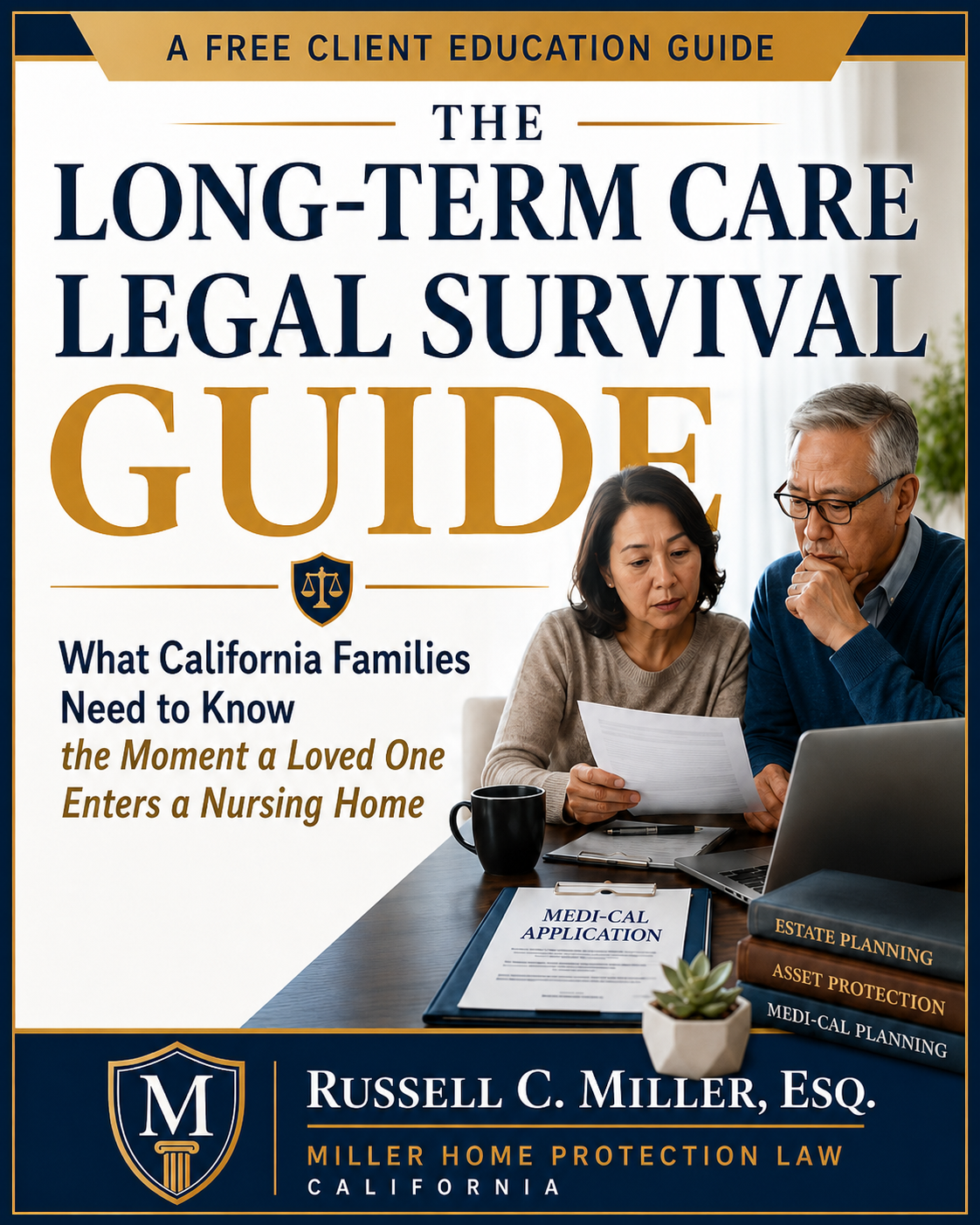
The Long-Term Care Legal Survival Guide What California Families Need to Know the Moment a Loved One Enters a Nursing Home
When a loved one enters a nursing home, families are suddenly asked to make financial and legal decisions they were never prepared for. The wrong move — even one made with the best intentions — can block Medi-Cal benefits, trigger costly penalties, or put the family home at risk of being claimed by the state after death.
This free guide was written by Russell C. Miller, Esq. of Miller Home Protection Law to help California families understand what is actually at stake — and what can still be done about it.
Inside this guide you will find:
✔ The four ways to pay for a skilled nursing facility — and what Medicare actually covers (it is not what most families think)
✔ How Medi-Cal qualification works — the asset test, the income rules, and the critical 2027 changes that could affect your family
✔ What estate recovery is and how the State of California can make a claim against the family home after death — and how a properly funded trust can stop it
✔ Why a Living Trust Estate Plan is the foundation of every Medi-Cal plan — and why not all living trusts are created equal
✔ What to do if a loved one entered a nursing home without a trust or power of attorney — and whether Medi-Cal can still be achieved
✔ A plain-English worksheet showing the five most common mistakes families make and exactly what to do instead
✔ How the Irrevocable Income Only Trust protects rental properties and excess assets — without giving anything away to the kids
This guide is 100% free. Enter your email to download instantly. No obligation. No sales pitch. Just the information California families need to protect what they have worked for.
Russell C. Miller, Esq. | Miller Home Protection Law | Visalia, California | (559) 625-4205 | www.homeprotectionlaw.com
This guide is for general educational purposes only and is not legal advice. Reading this guide does not create an attorney-client relationship.