
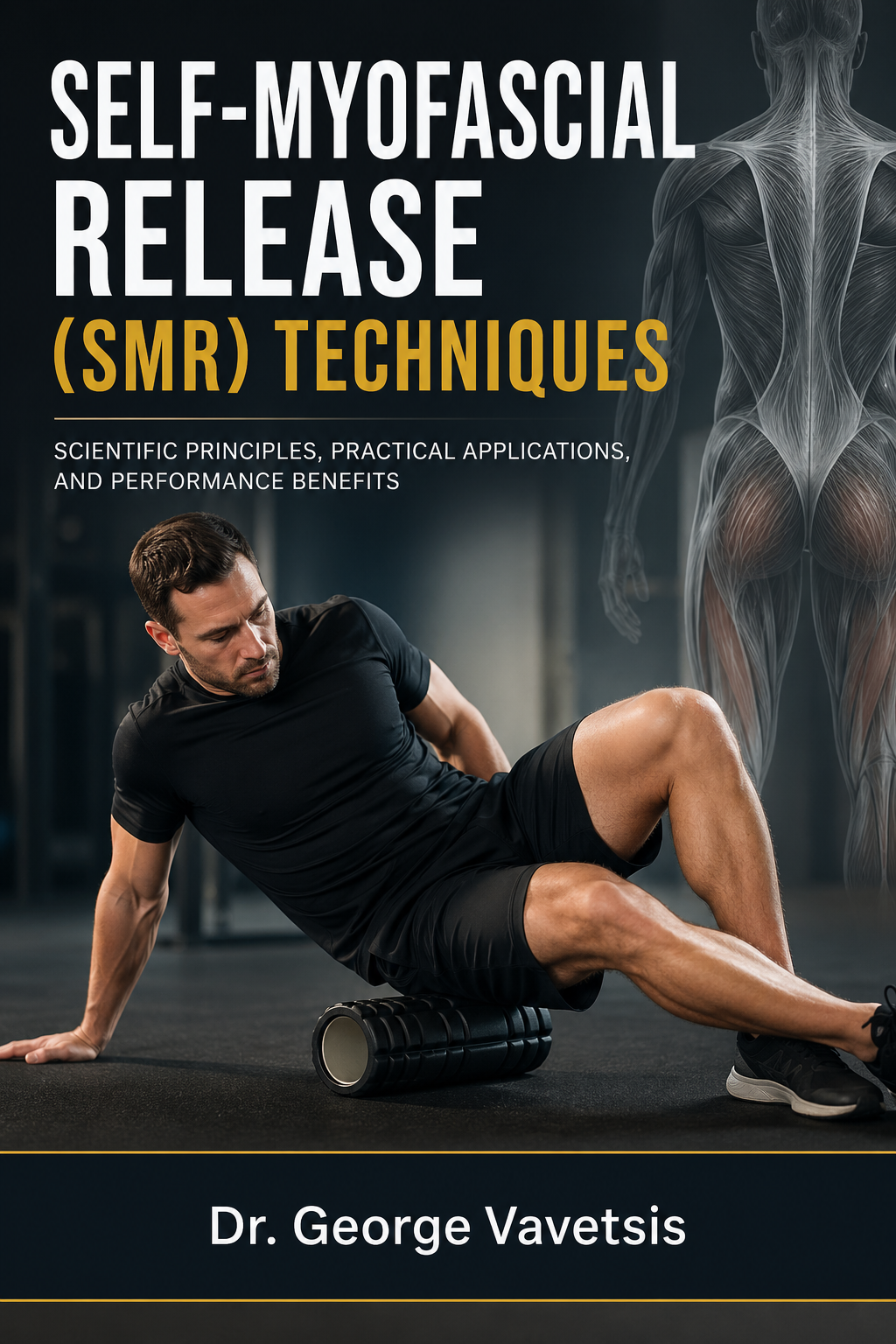
Self-Myofascial Release (SMR) Techniques
Pages: 505
In the modern landscape of strength and conditioning, recovery is no longer perceived as a passive process but as an active, measurable, and programmable component of performance optimization. Within this paradigm, Self-Myofascial Release (SMR) emerges not as a supplementary modality, but as a foundational intervention bridging biomechanics, neurophysiology, and tissue adaptation science. This book is constructed upon that premise: that SMR, when understood and applied through a scientific and performance-oriented lens, becomes a powerful tool for modulating the human system at multiple levels—from cellular signaling to global movement efficiency.
The myofascial system represents a continuous, three-dimensional network of connective tissue that integrates structure and function across the entire organism. Rather than acting as a passive wrapping, fascia operates as a dynamic interface for force transmission, proprioceptive input, and mechanical regulation. Its layered architecture—from superficial fascia to deep intermuscular compartments—creates a complex environment where forces are not isolated but distributed across interconnected pathways. As highlighted in the foundational principles of this work, the continuity of the fascial system dictates that localized interventions can produce systemic effects, reinforcing the operational concept: local input, global output .
SMR techniques exploit this interconnectedness through controlled mechanical stimuli applied via external tools or bodyweight. These stimuli—characterized by pressure, duration, and movement velocity—interact with the viscoelastic properties of connective tissue. Fascia exhibits both elastic and viscous behavior, meaning that its response is highly dependent on the rate and magnitude of loading. Slow, sustained pressure facilitates viscous deformation and fluid redistribution, while faster, oscillatory inputs stimulate elastic recoil and neuromuscular activation. This duality forms the basis for targeted SMR applications, allowing practitioners to manipulate tissue properties according to the demands of performance or recovery.
At the microscopic level, SMR induces mechanotransduction processes, where mechanical forces are translated into biochemical signals. Fibroblasts, through integrin-mediated pathways, respond to these stimuli by altering collagen synthesis, cross-link density, and extracellular matrix organization. These adaptations are not instantaneous; they require repeated exposure within optimal loading thresholds. Insufficient stimulus fails to provoke adaptation, whereas excessive pressure may lead to maladaptive responses, including inflammation or increased tissue stiffness. Thus, SMR must be programmed with the same precision as resistance training—guided by variables such as intensity, volume, and frequency.
A critical component of SMR efficacy lies in its influence on the ground substance of fascia, particularly the hyaluronan-rich interstitial fluid. This fluid governs tissue viscosity and glide between fascial layers. Alterations in hydration status can significantly impact movement quality, with dehydration leading to increased stiffness and impaired force transmission. Through slow compressive and shear forces, SMR enhances interstitial fluid flow, restoring optimal tissue hydration and facilitating mechanical efficiency. In this context, SMR becomes not only a mechanical intervention but also a regulator of the internal biochemical environment.
Equally significant is the neural dimension of SMR. Fascia is richly innervated with mechanoreceptors and nociceptors, including Ruffini endings and Pacinian corpuscles. These receptors respond to different types of stimuli—sustained pressure versus rapid oscillation—modulating both proprioception and pain perception. Through appropriate application, SMR can activate inhibitory neural pathways, reduce nociceptive signaling, and enhance body awareness. This neurophysiological modulation plays a crucial role in movement quality, as the central nervous system relies on accurate sensory input to coordinate efficient motor output.
From a performance perspective, SMR directly influences key athletic parameters such as range of motion (ROM), stiffness regulation, and stretch–shortening cycle efficiency. However, these effects must be interpreted with caution. Acute improvements in ROM or reductions in perceived stiffness do not necessarily reflect long-term structural changes. Therefore, monitoring strategies should prioritize longitudinal trends and functional outcomes rather than isolated session responses. Metrics such as movement symmetry, reactive strength index (RSI), and force production patterns provide more meaningful insights into the effectiveness of SMR interventions.
The integration of SMR into training systems requires a strategic approach aligned with periodization principles. SMR can be employed in multiple contexts: as a preparatory tool to enhance neuromuscular readiness, as a recovery modality to facilitate tissue restoration, or as a corrective intervention targeting specific dysfunctions within the kinetic chain. The sequencing of SMR—whether proximal to distal, distal to proximal, or along entire myofascial lines—must be dictated by the movement demands and identified limitations of the athlete. In all cases, the objective remains consistent: to optimize the interaction between structure and function.
This book is designed to provide a comprehensive, scientifically grounded framework for SMR application within high-performance environments. Each chapter progresses from foundational concepts to advanced implementation strategies, integrating anatomical, biomechanical, and neurophysiological perspectives. The aim is not merely to present techniques, but to establish a system of reasoning that allows practitioners to adapt SMR protocols to the specific needs of their athletes.
Ultimately, Self-Myofascial Release represents a convergence point between science and practice. It embodies the transition from generalized recovery methods to individualized, data-driven interventions. When applied with precision and intent, SMR has the capacity to enhance performance, reduce injury risk, and support long-term athletic development. This work invites the reader to move beyond surface-level application and engage with the deeper mechanisms that define human movement and adaptation.
In doing so, it positions SMR not as an accessory, but as an integral component of the modern strength and conditioning paradigm.