
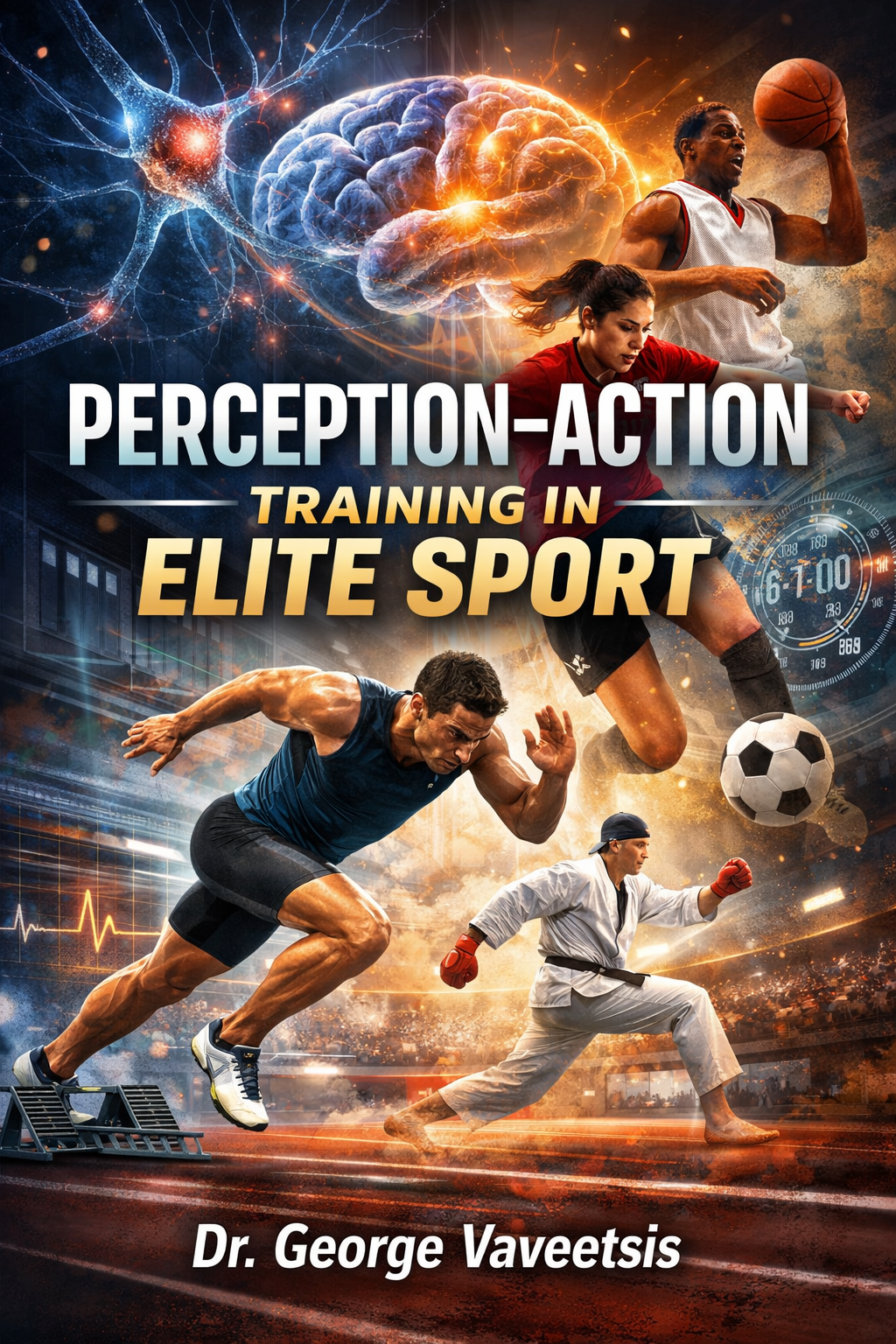
Perception–Action Training in Elite Sport
Pages: 316
High-performance sport is ultimately decided in fractions of a second. The athlete who perceives information earlier, interprets it faster, and converts it into efficient movement more effectively gains a decisive competitive advantage. While traditional models of athletic development have focused primarily on physiological capacity—strength, power, endurance, and mechanical efficiency—modern sport science increasingly recognizes that performance is governed by a deeper and more integrated system: the perception–action coupling of the human organism.
Elite athletes do not simply move faster or produce more force. They perceive the environment differently, process sensory information more efficiently, and coordinate neural and mechanical systems with extraordinary precision. This book, Perception–Action Training in Elite Sport, is dedicated to exploring this integrated system and translating scientific knowledge into practical training methodologies for coaches, sport scientists, and high-performance practitioners.
At the core of athletic performance lies the sensorimotor system, a complex network connecting perception, cognition, neural processing, and biomechanical execution. When an athlete reacts to a stimulus—whether a starting gun in sprinting, an opponent's movement in combat sport, or a ball trajectory in team sports—the process involves a sequence of rapid neural and mechanical events. Sensory information is captured by the visual, auditory, or proprioceptive systems, transmitted through neural pathways, interpreted by cortical and subcortical structures, and ultimately converted into coordinated muscular action. Reaction time therefore reflects not only muscular speed but also the efficiency of neural processing and decision-making mechanisms.
In competitive sport environments, these processes occur under extreme temporal constraints. The difference between successful and unsuccessful performance may be measured in milliseconds of reaction time, centimeters of movement displacement, or minimal variations in neuromuscular latency. Research has demonstrated that athletes with extensive sport-specific training display shorter reaction times and more efficient sensorimotor integration compared to non-athletes, illustrating the profound impact of specialized training on the neural architecture of movement.
However, traditional strength and conditioning programs have historically emphasized physical capacities while neglecting the perceptual and cognitive components that precede movement execution. This limitation has led to a growing interest in perceptual-cognitive training, reactive agility development, and decision-based movement systems. These approaches aim to train athletes not only to move better, but to perceive, anticipate, and decide more effectively within dynamic sporting environments.
The perception–action framework originates from ecological psychology and motor control theory, which propose that movement emerges from the interaction between the athlete and the environment. According to this perspective, athletes continuously detect affordances—opportunities for action—within their surroundings. Skilled performers possess superior abilities to identify relevant cues, filter irrelevant information, and anticipate future events based on subtle movement patterns of opponents, teammates, or objects.
For example, elite defenders in team sports often detect movement intentions through cues such as hip orientation, body posture, or gaze direction of opponents. These perceptual skills allow them to initiate defensive movements earlier and with greater efficiency. Similarly, expert athletes exhibit refined visual scanning strategies, superior dynamic visual acuity, and enhanced anticipatory decision-making, enabling them to process complex tactical situations under intense time pressure.
From a neuromechanical standpoint, perception–action coupling also influences the way force is produced and applied. Explosive movements such as sprint starts, jumps, or changes of direction rely on rapid neural activation, pre-programmed motor patterns, and efficient stretch–shortening cycle utilization. When a stimulus triggers movement initiation, neural activation patterns must synchronize with biomechanical force production to generate optimal acceleration and propulsion.
Consequently, training programs that integrate perceptual stimuli with biomechanical execution can significantly enhance athletic performance. Reactive sprint drills, decision-based plyometric tasks, opponent-driven agility exercises, and visual-cognitive training protocols represent practical examples of how perception–action principles can be incorporated into high-performance training environments.
Another important dimension explored in this book concerns the neuroscientific basis of movement preparation and motor planning. Research has shown that cortical structures such as the premotor cortex, supplementary motor area, and cerebellum play essential roles in preparing and coordinating athletic movements. These neural systems enable athletes to pre-activate motor programs before movement initiation, allowing for faster responses when external stimuli occur.
Understanding these neural mechanisms allows coaches and sport scientists to design training interventions that optimize neuromuscular readiness, decision-making efficiency, and motor program adaptability. Such training is particularly important in sports where rapid changes of direction, reactive decision-making, and opponent interaction dominate the performance landscape.
This book therefore bridges multiple scientific disciplines, including:
- Sport neuroscience
- Motor control and learning
- Biomechanics and neuromechanics
- Perceptual–cognitive psychology
- Strength and conditioning science
- Applied performance training
By integrating these fields, the goal of this work is to provide a comprehensive scientific framework for perception–action training in elite sport. Each chapter examines a specific component of the perception–action system—from neural processing speed and visual-motor integration to reactive plyometric mechanics and decision-based agility training.
Beyond theoretical discussion, the book emphasizes practical application. Coaches and performance specialists will find detailed insights into how perceptual-cognitive skills can be trained systematically within strength and conditioning programs. Rather than separating physical and cognitive training, this book advocates for integrated performance models where perception, decision-making, and movement execution are developed simultaneously.
In the evolving landscape of high-performance sport, success increasingly depends on the ability to integrate brain and body into a unified performance system. The athletes of the future will not only be stronger and faster; they will be more perceptive, more adaptive, and more neurologically efficient.
Perception–Action Training in Elite Sport seeks to contribute to this next generation of performance science by providing both a scientific foundation and a practical guide for those committed to pushing the limits of human athletic potential.