


Your First 365 Characters For HSK1 Workbook
365 Chinese Characters
Learning Chinese writing can often seem like an endless task of memorizing thousands of complicated characters. In reality, most Chinese characters are built according to clear and consistent principles.
Once you understand how characters are constructed, learn to write them stroke by stroke, and recognize recurring elements, memorizing them becomes much easier.
This idea lies at the heart of the Your First 365 Characters For HSK1 Workbook. It is not intended to replace a Chinese language textbook. Instead, it helps develop a fundamental skill: conscious, structured handwriting that strengthens visual memory, attention to character structure, and understanding of how the Chinese writing system works.
Why learn to write Chinese characters by hand?
Today, Chinese is typed on computers and smartphones far more often than it is written with a pen or brush. This sometimes leads to the idea that handwriting has lost its importance.
In practice, the opposite is true.
When you write each stroke yourself, your brain remembers not only the overall appearance of the character, but also its internal structure. You begin to distinguish similar characters more easily, recognize them more quickly in written text, and reproduce them from memory with greater confidence.
Handwriting therefore becomes not an end in itself, but one of the most effective ways to study the Chinese writing system itself.
Why do learners often forget Chinese characters so quickly?
Almost every beginner encounters this problem.
You open an app, review flashcards, or copy a new character several times. Everything seems familiar and well remembered. A few days later, however, you may find that you cannot write the character without looking at a model.
The problem is usually not poor memory.
More often, the learner remembers only the general outline of the character without understanding how it is constructed. When there is no clear understanding of stroke order and component structure, the character is much harder to retain.
That is why the goal of this workbook is not to increase the number of mechanical repetitions, but to teach you to see the internal structure of each character.
How the method works
Each new character is studied step by step.
Step 1. Learn the meaning of the character.
Step 2. Examine the correct stroke order.
Step 3. Build the character gradually, adding only one new stroke in each successive square.
Step 4. Once the sequence is clear, write the complete character several times.
Step 5. Reinforce its reading, pronunciation, and usage using the corresponding dictionary entry on the Baidu website.
This approach helps develop a lasting handwriting skill rather than simple mechanical copying.
Why 365 characters?
The workbook contains 365 of the most important Chinese characters for beginners. They are divided into four parts of approximately equal size and selected for the early stages of Chinese study, broadly corresponding to the requirements of HSK 1.
By learning just one or two new characters a day, you can gradually build the ability to read a wide range of simple texts while developing a solid understanding of the structure of many of the most frequently used Chinese characters.
Try a free sample
The best way to evaluate the method is to try it yourself.
Tap the Preview to see the sample page for 学 (to study). After the sample page you will see the printable blank page that can be used for practicing, but if you share our awareness on environment issues, alternatively, you can use an ordinary squared notebook as well.
Divide the page into squares approximately 1.5 × 1.5 cm (3 × 3 small squares), as shown in the illustration below. A thin pencil is convenient for drawing the guidelines, while a fine-tip ballpoint pen works well for writing.
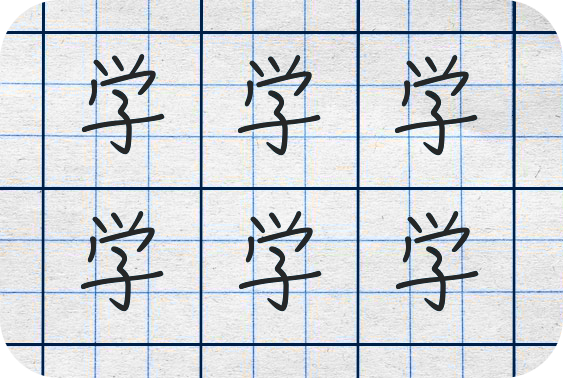
How to study with the workbook
Begin by gradually constructing the character, adding only one additional stroke in each new square. Once the sequence is clear, move on to writing the complete character across several lines.
Then open the corresponding online dictionary entry, watch the stroke-order animation, listen to the pronunciation, and repeat the reading aloud.
An effective pace is one or two new characters a day. This workload is easy to combine with work or study and allows you to gradually develop a reliable handwriting skill.
What is included?
The complete workbook consists of four independent parts.
Each part contains practice pages for 91 Chinese characters, including:
- pinyin pronunciation;
- the character's radical;
- stroke count;
- a stroke-order diagram;
- exercises for independent practice;
- links to online dictionary entries for studying not only the graphic form, but also pronunciation and usage.
The complete set covers 365 frequently used beginner-level Chinese characters, divided into four logical blocks:
- Part I — “I Am Learning to Write Chinese Characters”
- Part II — “I Am Beginning to Talk About the World Around Me”
- Part III — “I Can Describe People, Actions, and Events More Freely”
- Part IV — “I Can Independently Read and Write More Complex Texts”
Who is this workbook for?
It is especially useful if you:
- are just beginning to study Chinese;
- want to learn to write Chinese characters correctly rather than simply copy them;
- are preparing for beginner-level HSK examinations;
- are studying Chinese independently;
- want to better understand how the Chinese writing system is constructed.
The method is based on understanding, not memorization
Chinese characters may seem difficult as long as they are viewed as thousands of unrelated drawings.
Chinese characters are written, not drawn.
Once you begin to recognize recurring elements (graphemes), understand the role of radicals, follow the correct stroke order, and gradually connect written form with pronunciation and meaning, learning becomes much more systematic and much more effective.
The goal is not simply to memorize 365 individual characters.
The goal is to learn to see how Chinese characters are built.