
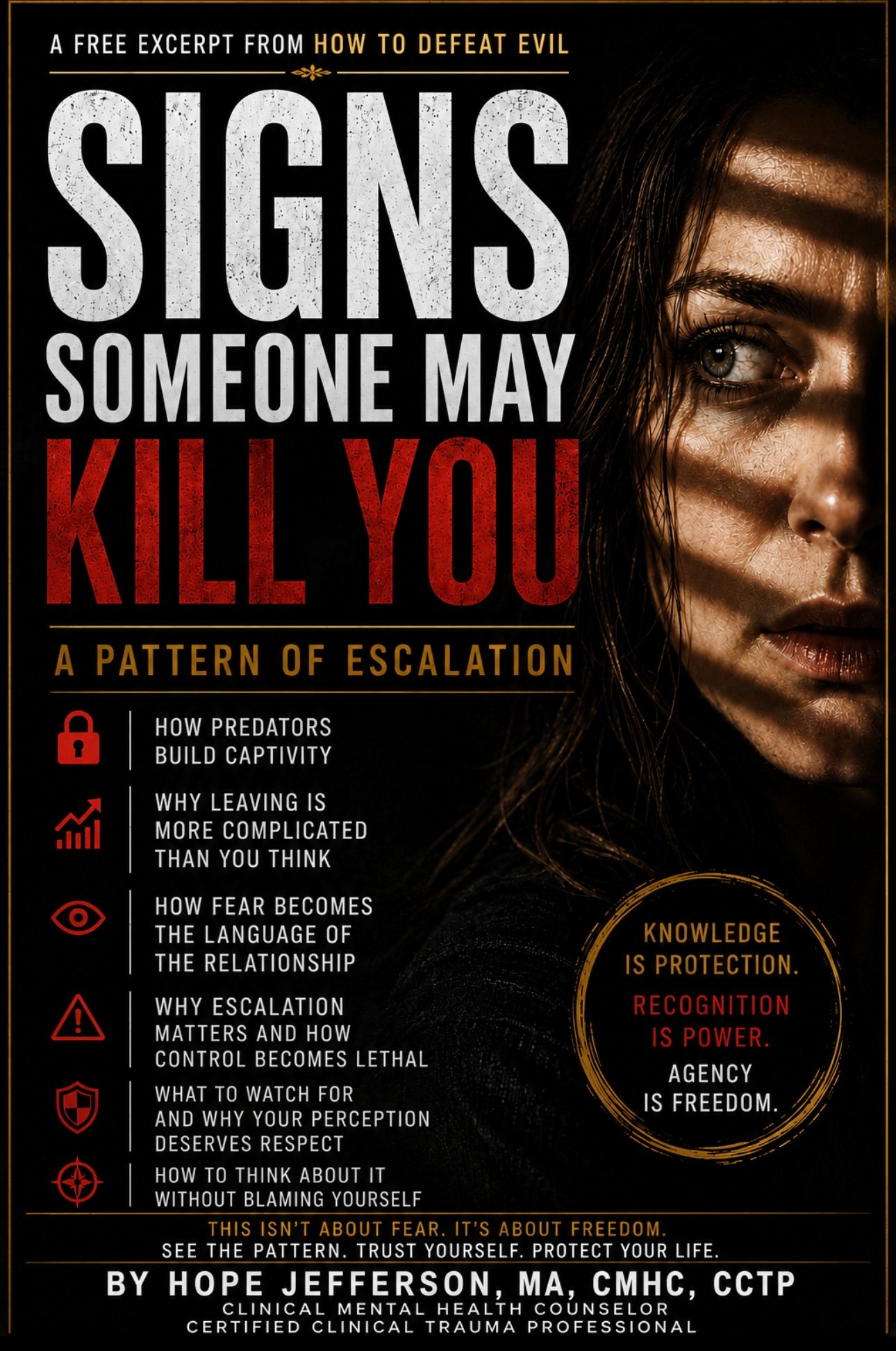
Signs Someone May Kill You
Signs Someone May Kill You
A Pattern of Escalation
A Free Excerpt from How to Defeat Evil
Predatory violence rarely begins with the worst incident.
It begins with entitlement. Surveillance. Isolation. Conditioning. Retaliation. Fear.
This is not another generic list of red flags. It is a framework for recognizing how coercive control is built, how dangerous people test limits, and how seemingly separate incidents can form a pattern of escalating risk.
It explains why intelligent, compassionate people become trapped, why leaving is often more dangerous than outsiders understand, how fear gradually replaces freedom, and how control can become lethal. Most importantly, it gives survivors language for what they are seeing—without blaming them for how they survived it.
Inside, you will learn:
- How predators manufacture confusion, dependency, and self-doubt.
- How boundary violations function as tests of consequence.
- Why property destruction, threats, stalking, strangulation, weapons, and separation can signal escalating danger.
- How public charm can coexist with calculated private abuse.
- Why apologies, remorse, and temporary tenderness do not necessarily indicate safety.
- How predators attack the practical infrastructure of escape: money, housing, transportation, medication, reputation, sleep, and support.
- Why your fear and intuition may contain information your conscious mind has not yet organized.
- Why leaving requires strategy—not shame, impulsivity, or simplistic advice.
Most resources ask:
“Why did the victim stay?”
This excerpt asks the more clinically useful question:
“What system of captivity was being built around them?”
That distinction matters.
Because abuse is not always a series of isolated incidents. It may be an organized pattern of domination designed to reduce resistance, increase dependency, and make escape feel impossible.
This guide will not tell you to wait for certainty. It will not require a diagnosis. It will not ask you to prove intent before taking danger seriously.
It will help you identify the pattern, name the escalation, trust your perception, and think more strategically about protection.
You do not have to prove that someone is evil before you are allowed to protect yourself.