
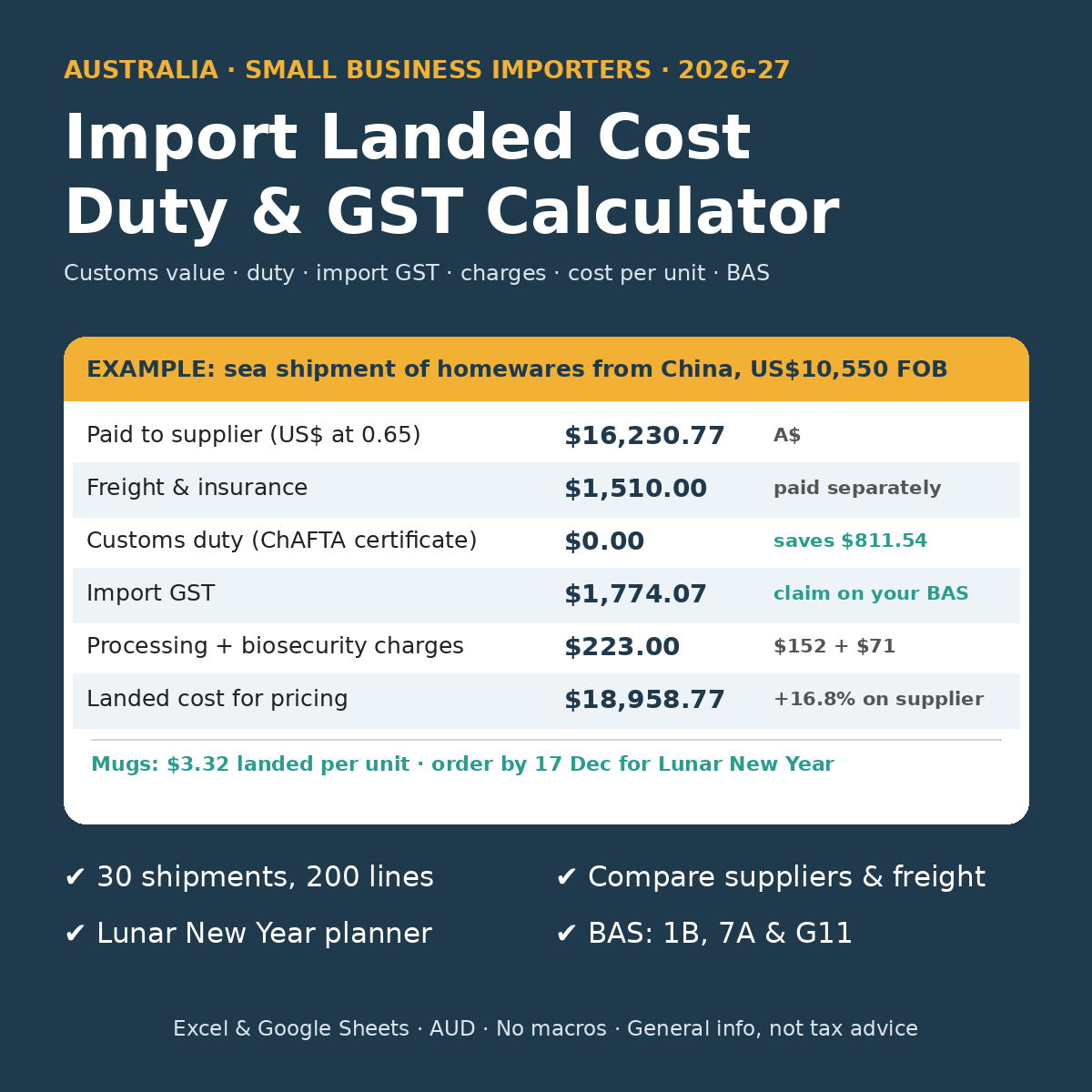
Import Landed Cost, Duty & GST Calculator – Australia 2026-27
Importing stock? Know your real cost per unit before you pay the deposit.
The supplier's price is only the start. Duty is charged on the customs value, import GST is charged on the value plus duty plus freight, consignments over A$1,000 pay processing and biosecurity charges, and then there's the broker, the port and delivery. In the worked example, a US$10,550 shipment lands at 16.8% more than the supplier price. Price off the invoice alone and every sale earns less than you think.
This spreadsheet does the maths for every shipment, down to each product's landed cost and selling price. It also works back from China's Lunar New Year closure (holiday 5–13 February 2027) to the date you need to order by.
Built for Australian small businesses that import: online shops, retailers, cafés and salons buying equipment, and tradies bringing in tools and materials.
What it does
- Customs value from your Incoterm: EXW, FOB, CFR, CIF or DDP, with pre-export costs and freight included in the price taken out, converted at your exchange rate.
- Duty done properly: general or free trade agreement rate per product line, with the FTA rate used only when you hold the origin document. Shows the duty saved, or missed.
- Import GST and charges: 10% GST on the value of the taxable importation, the import processing charge ($50 or $152, or documentary rates) and the air or sea biosecurity charge. Applies the A$1,000 low-value rule and flags overseas sellers who charged you GST.
- Landed cost per unit: spreads freight, charges and fees by value, quantity, weight or volume, leaves out the GST you can claim back, and suggests a GST-inclusive price at your target margin. Flags lines priced below cost or below target.
- Compare: three suppliers or freight options side by side (sea vs air, with or without a certificate of origin) with the landed cost per unit and arrival date.
- Lunar New Year planner: works back from the date you need stock through clearance, transit, factory closure and production to an order-by date, with countdowns.
- BAS totals: import GST and GST on local charges per monthly or quarterly period, deferred GST (7A) and G11 figures. A Checks tab flags 20 common mistakes.
What you get
- 1 Excel workbook (.xlsx) that works in Excel, LibreOffice and Google Sheets
- Tabs: Instructions, Settings, Summary, Shipments, Lines, Compare, Planner, BAS, Checks, Checklist, Rules
- A worked EXAMPLE (an online homewares shop with three shipments from China and Vietnam) to type over
- A 14-step import costing checklist
- No macros, no add-ins, no subscription. AUD.
Good to know
- It doesn't classify your goods: you type each product's duty rate (most are Free or 5%) from your customs broker or the ABF Working Tariff.
- Doesn't cover anti-dumping duty, excise, luxury car tax or wine equalisation tax. Import charges are rates published by the ABF; your broker's invoice is what you pay.
- Rules and charges checked against the Australian Border Force, the ATO and DFAT on 22 November 2026. Sources are on the Rules tab.
- General information, not tax, customs or financial advice. Not affiliated with the ABF, ATO or DFAT.