
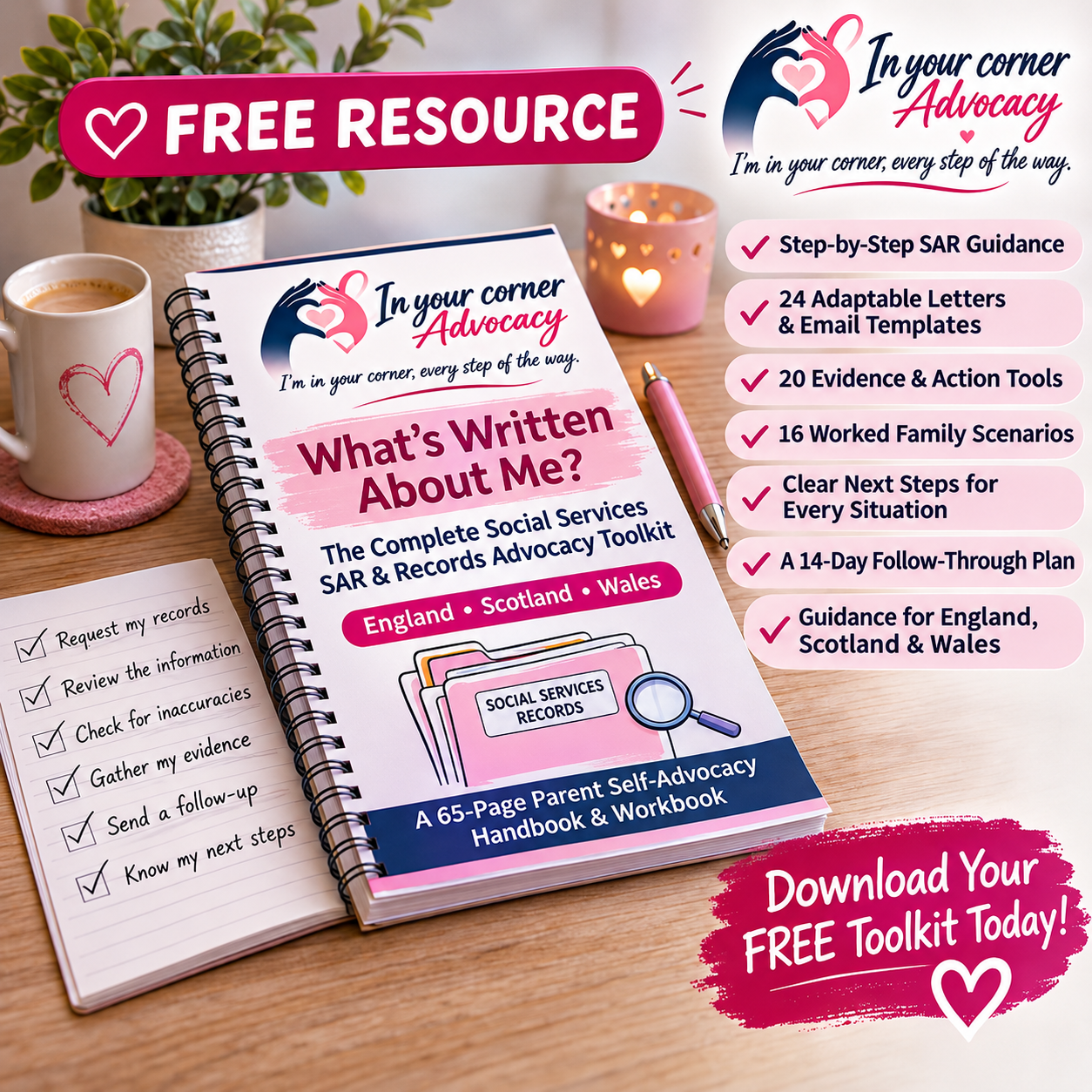
💗 FREE — What's Written About Me? | Complete Social Services SAR & Records Advocacy Toolkit — England, Scotland & Wales
💗 FREE — WHAT'S WRITTEN ABOUT ME?
The Complete Social Services SAR & Records Advocacy Toolkit
England • Scotland • Wales
A comprehensive 65-page parent self-advocacy handbook and workbook
🚨 HAVE YOU EVER WONDERED WHAT SOCIAL SERVICES HAVE ACTUALLY WRITTEN ABOUT YOU?
Can I ask you something?
Have you ever walked away from a meeting with a social worker wondering what was written down afterwards?
Have you ever read an assessment or report and thought:
💬 “That's not what I said.”
💬 “That isn't what happened.”
💬 “Where has that information come from?”
💬 “Why hasn't my explanation been included?”
💬 “How can I challenge something I believe is wrong?”
Or perhaps you've been involved with Children's Social Services and simply want to understand what personal information they hold about you.
If any of this sounds familiar, this FREE resource has been created for you. 💗
⚖️ DID YOU KNOW YOU CAN REQUEST YOUR PERSONAL INFORMATION?
Under Article 15 of the UK GDPR, you have the right to request access to your personal data, subject to applicable exemptions.
This is called a Subject Access Request (SAR).
A SAR can help you understand information held about you within:
📁 Social work assessments and reports.
📁 Case notes and records of visits.
📁 Emails and correspondence concerning you.
📁 Meeting records and telephone contact notes.
📁 Records of concerns, allegations and professional observations.
📁 Relevant electronic case management records.
But here's where many parents can feel overwhelmed…
WHAT HAPPENS WHEN THE RECORDS ARRIVE?
What if you're sent hundreds of pages?
What if information has been blacked out?
What if documents appear to be missing?
What if something recorded about you is factually incorrect?
How do you organise your evidence?
What should you write when requesting a correction?
And what happens if your concerns aren't resolved?
That's exactly what this toolkit is designed to help you understand.
💗 WHAT'S INSIDE YOUR FREE 65-PAGE TOOLKIT?
📚 1. Clear, Step-by-Step SAR Guidance
Understand what a Subject Access Request is, how to make one, what information you can request and what normally happens afterwards.
Learn about response times, identity checks, clarification requests, redactions and applicable exemptions.
✉️ 2. 24 Adaptable Letters and Email Templates
Practical wording to help you:
✅ Make your initial SAR.
✅ Follow up when information is delayed.
✅ Request explanations about withheld information.
✅ Raise concerns about an incomplete response.
✅ Request correction of inaccurate personal data.
✅ Ask for disputed information to be reviewed.
✅ Raise a data protection complaint.
✅ Escalate unresolved concerns appropriately.
No staring at a blank page wondering how to word an important email.
📝 3. 20 Evidence and Action Tools
Learn how to organise your information using:
- SAR request trackers.
- Evidence registers.
- Dated chronologies.
- Records review checklists.
- Factual inaccuracy logs.
- Correspondence trackers.
- Meeting preparation worksheets.
- Follow-up action plans.
These practical tools are designed to help you stay organised throughout the process.
🔍 4. Understanding and Reviewing Your Records
Learn how to review the information you've received and identify questions that may need further clarification.
Understand the difference between:
✔ Recorded facts.
✔ Allegations or concerns.
✔ Professional observations and opinions.
✔ Information that may be incomplete or inaccurate.
Disagreeing with a professional opinion does not automatically mean it must be deleted, but you can raise concerns and provide evidence where appropriate.
💬 5. What to Say — and What to Avoid Saying
Discover practical examples of how to communicate confidently and constructively.
Learn how to ask questions, explain concerns, request information and challenge factual inaccuracies without making unsupported allegations.
👨👩👧 6. 16 Worked Family Scenarios
Explore realistic fictional situations showing how parents might approach common difficulties.
Follow examples involving missing information, disputed records, redactions, delays and requests for corrections.
🧭 7. Clear Guidance on WHAT TO DO NEXT
This is one of the most important parts of the toolkit.
Learn what steps to consider when:
✅ Your SAR has been acknowledged.
✅ You're asked to confirm your identity.
✅ Your records arrive.
✅ Some information has been withheld.
✅ You find a possible factual error.
✅ Your correction request is refused.
✅ The organisation misses an applicable deadline.
✅ You need to consider escalating your concerns.
The aim is to help you understand what to do, what to write, what evidence to keep and where to seek further assistance.
📅 8. A 14-Day Follow-Through Plan
Use the action plan to organise your first steps, track outstanding questions and decide what further action may be appropriate.
This is an organisational guide, not a replacement for statutory deadlines.
⚖️ 9. Guidance for England, Scotland and Wales
Understand the shared UK data protection rules alongside important differences affecting children's information rights and access to social services records.
💗 WHO IS THIS RESOURCE FOR?
This toolkit is designed for:
✅ Parents involved with Children's Social Services.
✅ Families wanting access to their own personal information.
✅ Parents concerned about inaccurate social work reports.
✅ Carers who need help understanding the SAR process.
✅ Families organising paperwork and evidence.
✅ Anyone who wants to become better informed about their data protection rights.
Created for families in England, Scotland and Wales.
💗 WHY HAVE I MADE THIS FREE?
Because I believe parents and carers should be able to understand their information rights without facing a financial barrier.
I know how overwhelming it can feel when you're trying to make sense of reports, assessments, professional terminology and decisions affecting your family.
Sometimes, you know something doesn't seem right, but you don't know what to ask or where to begin.
I wanted to create something practical.
A letter you can adapt.
An example you can follow.
A worksheet you can complete.
A guide that explains what happens next.
Not just information — tools that help you advocate for yourself.
And that's why this resource is completely FREE. 💗
📥 WHAT WILL YOU RECEIVE?
💗 ONE downloadable 65-page PDF, including:
✔ Detailed guidance.
✔ 24 adaptable letters and emails.
✔ 20 evidence and action tools.
✔ 16 realistic worked family scenarios.
✔ Practical communication examples.
✔ Step-by-step next actions.
✔ A 14-day follow-through plan.
✔ Useful signposting and further information.
PRICE: £0.00 — COMPLETELY FREE!
Instant digital download. No physical product will be posted.
💗 A MESSAGE TO THE PARENT READING THIS
If you've been sitting at home wondering what has been written about you, please remember:
You can ask questions.
You can request access to your personal information.
You can raise concerns about factual inaccuracies.
And you deserve to understand the process.
You don't need to understand every piece of legislation before you begin.
Start with one request.
One document.
One organised step.
💗 In Your Corner Advocacy
I'm in your corner, every step of the way.
⚖️ IMPORTANT INFORMATION
This resource provides general educational information and self-advocacy guidance. It does not constitute individual legal advice or legal representation.
A Subject Access Request provides access to personal data, subject to legal restrictions and exemptions. It does not automatically provide unrestricted access to every document or another person's personal information, including a child's records.
SARs do not pause safeguarding processes, court proceedings or legal deadlines. Where urgent legal issues arise, seek appropriate independent specialist advice promptly.
© In Your Corner Advocacy — 2026. All rights reserved.