
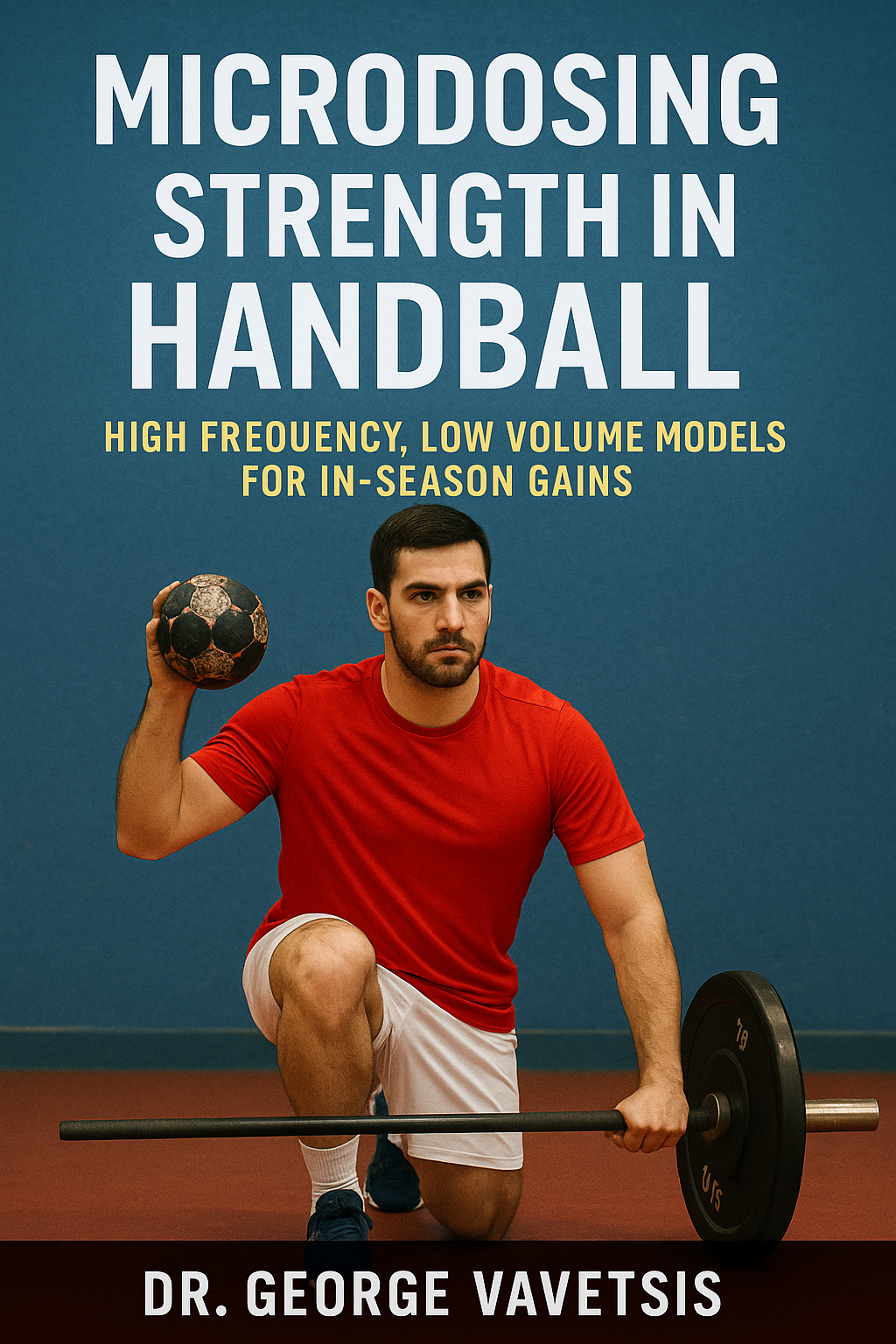
Microdosing Strength in Handball-High Frequency, Low Volume Models for In-Season Gains
Pages: 550
In the fast-paced and physically demanding world of elite handball, strength and conditioning are not luxuries—they are non-negotiable pillars of sustained performance. Yet, the modern competitive calendar poses an almost paradoxical challenge to the strength coach: how to preserve or enhance neuromuscular qualities in athletes when the very nature of the schedule seems to erode the time and recovery space needed for traditional strength development. This book, Microdosing Strength in Handball – High Frequency, Low Volume Models for In-Season Gains, is a response to that challenge—a synthesis of sport science, coaching pragmatism, and applied methodology for the realities we face inside congested in-season environments.
Microdosing, as defined in these pages, is more than simply “doing less.” It is a systematic approach to distributing highly targeted, minimal effective doses (MED) of strength training across the week in a way that sustains performance without compromising technical or tactical preparation. It is about preserving the critical adaptations—neurological, muscular, and mechanical—that underpin high-intensity handball performance, all while respecting the game’s brutal competition density. In short, it is the art and science of doing exactly enough, exactly when it matters most.
The origins of microdosing can be traced to high-frequency, low-volume training systems pioneered in the Soviet era, where the emphasis was on managing fatigue while keeping neuromuscular readiness at a constant high level. Over decades, these concepts evolved—first in weightlifting and track-and-field, then in professional team sports. Today, the microdose model stands as a refined methodology, using precise load calibration, velocity-based feedback, and exercise rotation to achieve sustainable in-season gains.
The strength coach reading this book will quickly see that microdosing is not a one-size-fits-all prescription. Rather, it is a framework for decision-making. We address the fundamental programming variables—frequency, duration, density, load, and exercise scope—with the specificity required for high-level handball. We examine neural-dominant versus muscular-dominant session priorities, session compression protocols for integrating strength work into narrow time slots, and the management of velocity loss thresholds to preserve explosive qualities throughout the season. All these are set within the broader coaching reality: that technical and tactical demands must remain primary, and strength work must integrate seamlessly without unintended interference.
One of the guiding principles here is the Minimal Effective Dose. Too often, strength programming in-season either drifts toward “maintenance” with no strategic stimulus or pushes into excessive loading that undermines sport-specific training quality. The MED concept, backed by dose–response research, gives us a reference point for the smallest possible stimulus that still produces a meaningful adaptation. In a microdosing context, that might mean two to three high-quality sets at 85–90% intensity, or ballistic work at >1.0 m/s, placed precisely within the microcycle for maximal transfer.
Equally important is the concept of priority stacking—allocating each microdose to a specific role in the week: a CNS primer to heighten neural readiness, a neural reload to reinforce motor pathways at high intensity, or a hormonal deload to promote recovery and regeneration. This strategic layering ensures that no session is “just another lift,” but rather a deliberate step in sustaining the athlete’s competitive profile.
The science behind microdosing in handball is robust and evolving. We know from research and applied practice that neural efficiency, rate of force development, and the integrity of the brain–muscle interface are highly trainable qualities—even with low total weekly volume—provided the training is frequent, specific, and executed with intent. Mechanisms such as partial range of motion lifts, compensatory acceleration training, and intra-repetition potentiation allow us to stimulate high-threshold motor unit recruitment without excessive metabolic cost. We also recognize that chronic monitoring—through bar velocity, reactive strength indices, and isometric peak force testing—is not optional; it is essential for keeping the stimulus above adaptation thresholds and for avoiding the silent creep into under-loading.
From a practical standpoint, the microdose model acknowledges that every minute in the in-season calendar counts. Handball players are juggling matches, travel, recovery, and tactical sessions. Long, exhaustive weight room sessions are simply incompatible with this reality. By condensing strength exposures into 15–20-minute windows—or even briefer targeted primers—we create a system that athletes can tolerate and coaches can sustain week after week, month after month.
For the strength coach, adopting microdosing is not just about programming differently; it is about thinking differently. It demands an acute awareness of load–adaptation dynamics, an ability to read athlete readiness in real time, and a willingness to abandon the traditional “more is better” mindset in favor of “better is better.” It requires communication and alignment with technical coaches, medical staff, and the athletes themselves. Above all, it requires the discipline to execute small, consistent doses with the same precision and intent as the heaviest sessions in the off-season.
This book will guide you through every layer of that process. We start with the foundational definitions and scientific rationale, move into the neuromechanical underpinnings of microdosed training, and then present practical models for integrating microdoses into the handball microcycle. We explore neural versus muscular prioritization, anti-interference strategies, and taper adaptations. We detail the tools—velocity-based training, modular session templates, exercise rotations—that allow you to individualize the approach for your athletes while keeping the system scalable across a full roster.
My hope is that this work serves both as a technical manual and as a philosophical shift. The technical side will give you the drills, loading schemes, and monitoring tools you need to apply microdosing effectively. The philosophical shift will help you embrace the reality that sustainable performance in elite sport is built not on occasional peaks, but on consistent, intelligent, precisely-timed stimuli that respect the complexity of the athletic calendar.
In the end, microdosing is not about doing less for the sake of doing less. It is about doing enough—exactly enough—to keep your athletes fast, powerful, and resilient when it matters most, without wasting a single rep or compromising a single tactical session. It is about recognizing that in the modern era of elite handball, efficiency is the new intensity.