
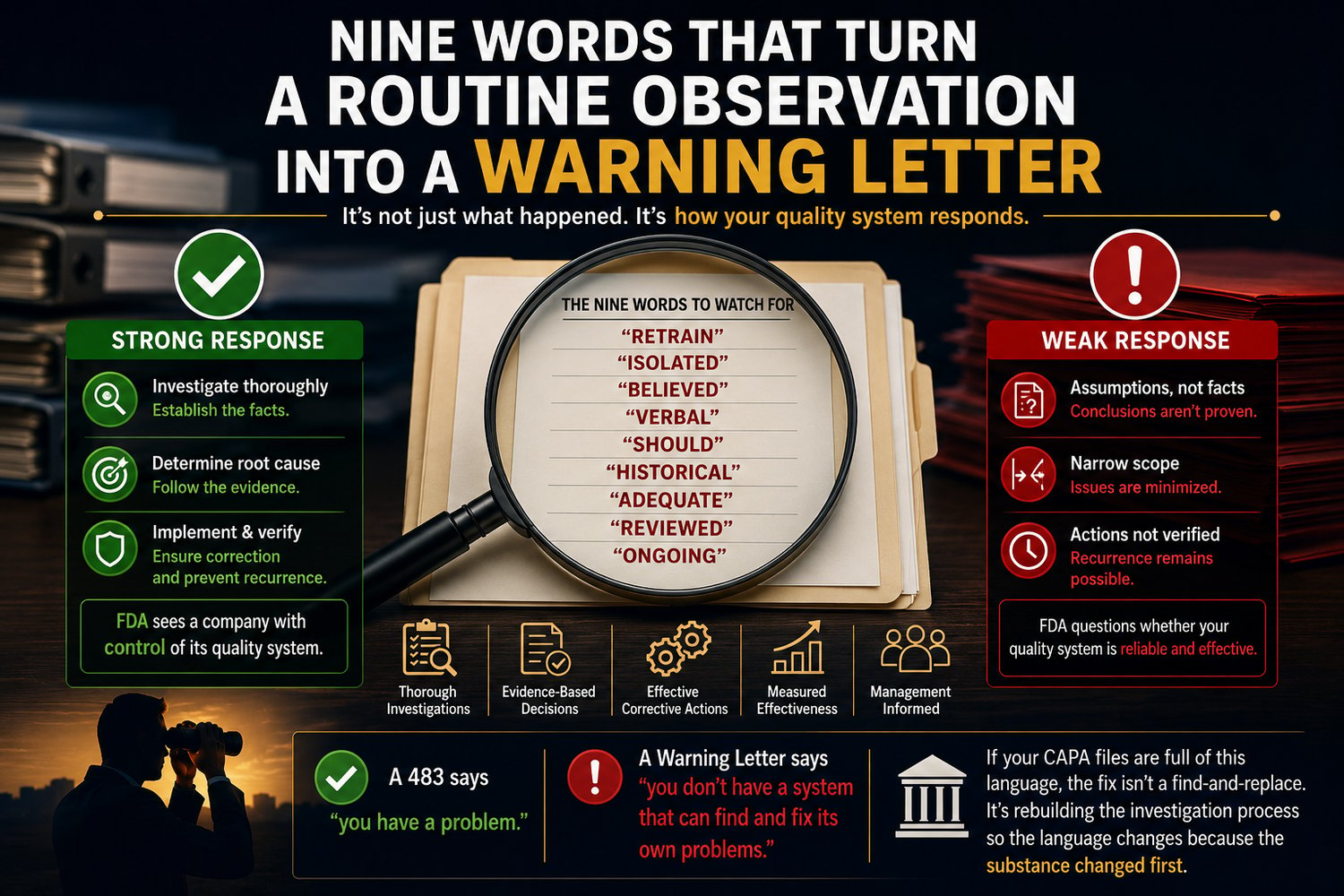
Nine Words That Turn a Routine Observation Into a Warning Letter
Nine Words That Turn a Routine Observation Into a Warning Letter
The difference between a Form FDA 483 observation and a Warning Letter is not always the severity of the original finding. In many cases, the deciding factor is what the company’s own investigation, CAPA, and written response reveal about the condition of its quality system.
[This is an employer-reimbursable professional compliance resource. Send this page to your Quality Director, Site Head, Regulatory Affairs leader or Learning and Development department for approval.]
Certain words appear repeatedly when investigations rely on assumptions instead of evidence, define the scope too narrowly, accept corrective actions that cannot be verified, or declare effectiveness without measurable results. Individually, these words may appear harmless. When they recur across deviations, complaints, laboratory investigations, CAPAs, and management-review records, however, they can signal something much more serious: a quality system that may not be capable of identifying and correcting its own failures.
In this 23-page regulatory-intelligence report examines nine seemingly ordinary words that can lead an Investigator beyond the original event and into the broader Pharmaceutical Quality System. THis article explains what these words may reveal, why FDA follows the language upstream, and what a more credible investigation should demonstrate.
This report will help readers:
- Recognize language that may expose an incomplete or poorly supported investigation.
- Understand how FDA distinguishes a discrete failure from a systemic quality problem.
- Identify conclusions that rely on assumptions, unsupported claims, or inadequate scope.
- Evaluate whether corrective actions address a verified root cause or merely close the record.
- Improve CAPA and investigation documentation by strengthening the underlying analysis—not simply replacing unfavorable words.
- Understand what FDA expects to see when a company claims that an investigation, review, training action, or effectiveness check is complete.
This is not a list of prohibited words or a cosmetic writing guide. The objective is not to make weak investigations sound better. It is to help pharmaceutical quality professionals understand how the language in their records reflects the strength—or weakness—of the systems behind them.
A Form FDA 483 generally tells a company that FDA observed a problem. A Warning Letter may indicate that FDA is no longer confident that the company has a system capable of finding and fixing its own problems.
This report explains how an Investigator can tell the difference.
Recommended For
Quality Assurance leaders, compliance professionals, CAPA owners, investigation writers, manufacturing leadership, regulatory affairs personnel, auditors, consultants, and senior executives responsible for FDA inspection readiness.
Format: Digital PDF
Length: 23 pages